Culture Ark · D-0793 · Food · Browse the gallery · The full 2,000-pick list
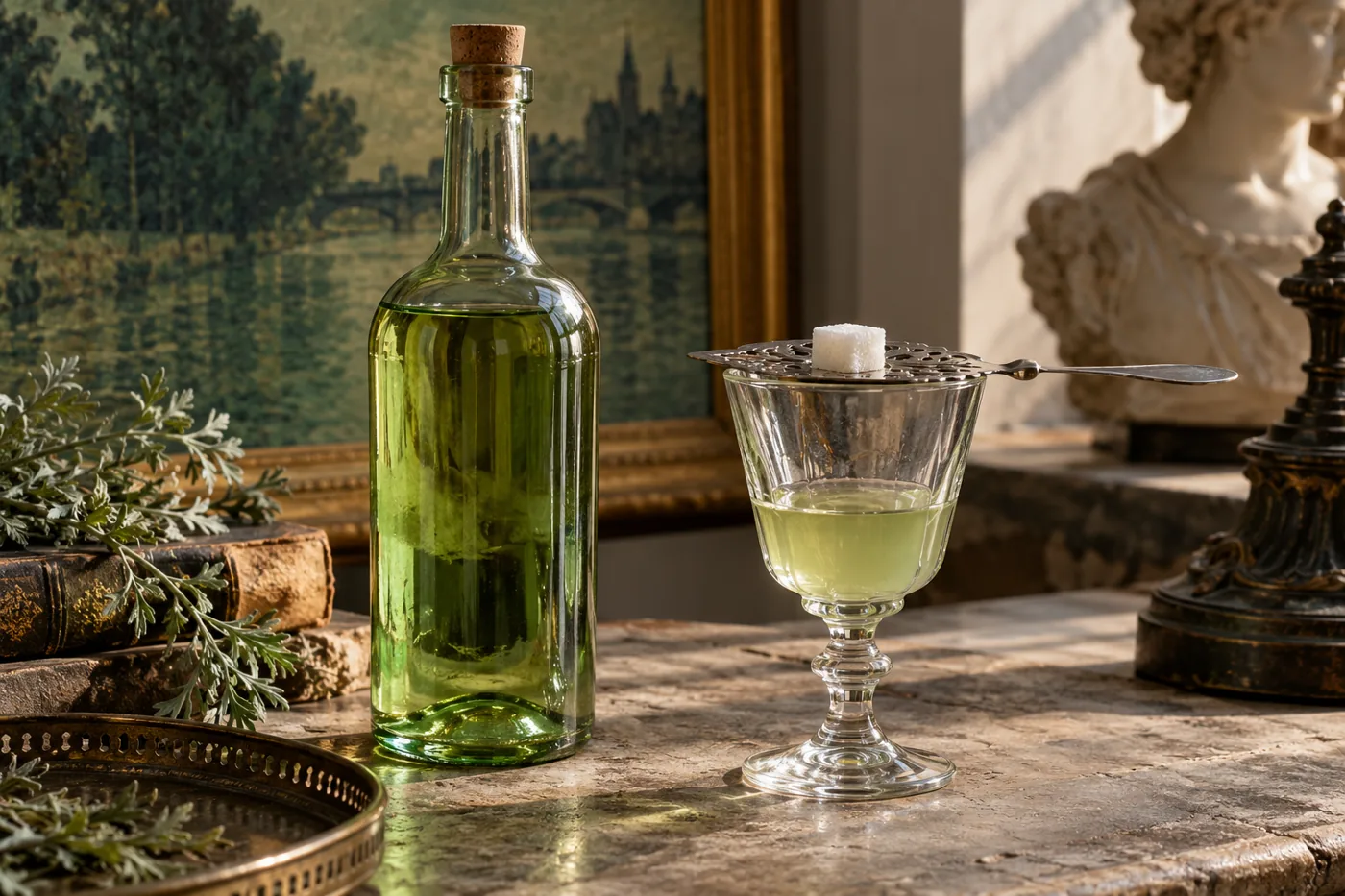
Generated interpretation, not documentary evidence. Imagined absinthe bottle, pierced spoon, sugar cube and glass in a decorative setting; not a museum artifact or historical scene.
Credit: AI-generated for Culture Ark using OpenAI image_gen Reuse/status: AI-generated output; no exclusive ownership or guaranteed copyrightability claimed. Underlying works, marks and cultural permissions remain separate. Imagined absinthe bottle, pierced spoon, sugar cube and glass in a decorative setting; not a museum artifact or historical scene. The checked museum history does not establish 1792 as a uniquely certain invention year. Its celebratory heritage perspective should not become a claim that alcohol is harmless or that absinthe causes extraordinary creativity. The green still life is only one imagined presentation; clear absinthe also exists. No flames or preparation instructions are shown.
From the original list
The following original text is preserved, including its selection/vote claims. Preservation is not independent verification of every assertion.
Why: The green fairy, once banned.
What to preserve: Ritual, spoon
Year and origin: 1792 · Switzerland
Vote: 3/9 (historian 1 · future kid 1 · curator 1)
Learn more: Absinthe on Wikipedia
Supplemental context
Absinthe preserves a revealing encounter between a drink's material culture and its public reputation. Maison de l'Absinthe places its emergence in the Swiss Jura at the end of the eighteenth century and describes the later movement between popularity, prohibition and clandestine production. Its regional history records the Swiss ban in 1910 and its lifting in 2005, while also distinguishing the French ban of 1915. For future readers, the spoon and glass are entry points into questions about artistic identity, moral campaigns and local memory. The museum itself occupies a building connected with prosecution, showing how a place associated with punishment can later become a heritage institution.
Creator/community: Val-de-Travers absinthe makers and wider Swiss and French drinking cultures Place/era: Swiss Jura and France; late eighteenth-century origins, later prohibition and revival
Context and limits
The checked museum history does not establish 1792 as a uniquely certain invention year. Its celebratory heritage perspective should not become a claim that alcohol is harmless or that absinthe causes extraordinary creativity. The green still life is only one imagined presentation; clear absinthe also exists. No flames or preparation instructions are shown.
Where to learn more
- https://apiarybee.com/community/reading/biggie-nu-series-008-noahs-ark-set-d-culture-2000
- https://maison-absinthe.ch/en-ch/pages/history
Apiary library | Original Culture Ark article
Public ID and individual routes: pending publisher allocation. Internal source ID: D-0793
Part of the Culture Ark: 2,000 things people should still be able to see in 2,000 years, picked by AI research teams. This page keeps the original list entry for D-0793 word for word and adds context. Browse the gallery. The Culture Ark is an Artificial Mind Hive (AMH) project. AMH is owned by Austin Little.

Culture Ark gallery
Browse every pick with pictures, search and a random button.
Open the gallery →