Culture Ark · D-0798 · Food · Browse the gallery · The full 2,000-pick list
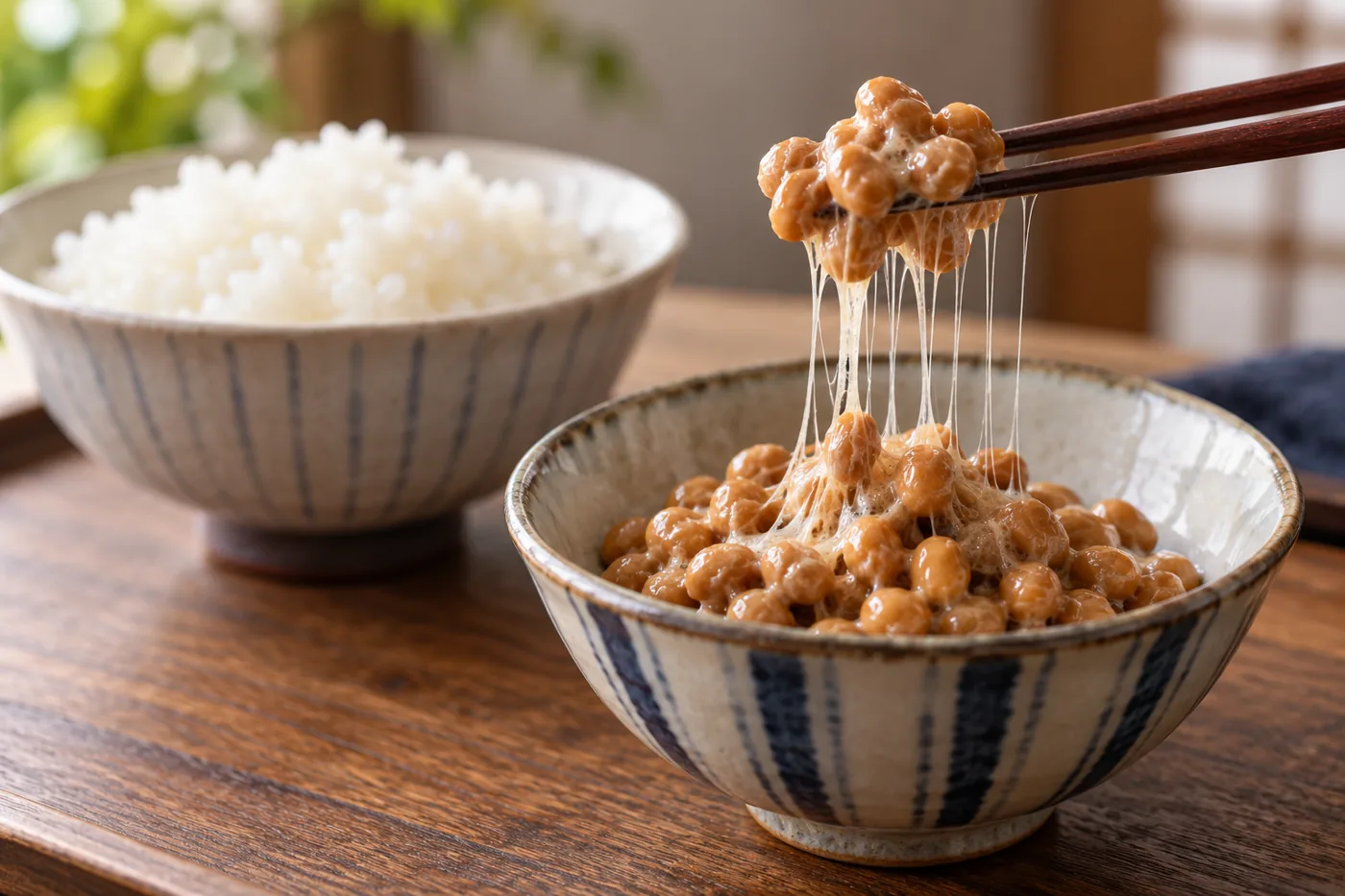
Generated interpretation, not documentary evidence. Imagined stringy nattō lifted by chopsticks, with rice nearby; not a microbial test or fermentation demonstration.
Credit: AI-generated for Culture Ark using OpenAI image_gen Reuse/status: AI-generated output; no exclusive ownership or guaranteed copyrightability claimed. Underlying works, marks and cultural permissions remain separate. Imagined stringy nattō lifted by chopsticks, with rice nearby; not a microbial test or fermentation demonstration. MAFF explicitly labels the Minamoto no Yoshiie origin story a legend; it is not adopted as proven history. The original ancient label is not an exact verified date. Nutritional and therapeutic claims on the source page are not repeated. The image concerns stringy nattō only and is not fermentation or safety guidance.
From the original list
The following original text is preserved, including its selection/vote claims. Preservation is not independent verification of every assertion.
Why: Sticky fermented soybeans.
What to preserve: Process
Year and origin: ancient · Japan
Vote: 3/9 (historian 1 · future kid 1 · curator 1)
Learn more: Natto on Wikipedia
Supplemental context
Nattō makes the cultural importance of texture unusually visible. The familiar stringy beans belong to a wider group of fermented soybean foods: Japan's Ministry of Agriculture distinguishes itohiki nattō from salted forms made through different fermentation traditions. Its Mito account also records packaging varieties and the importance of railway-platform sales after the Mito Railway opened in 1889. This moves the story beyond an ancient-origin anecdote toward transport, local industry and souvenir culture. Future readers can learn how a food becomes associated with a city through distribution as well as taste. The strands in the illustration introduce the stringy form without turning an image into a demonstration of microbial identification or manufacturing quality.
Creator/community: Japanese soybean-food makers and consumers, including Mito natto producers Place/era: Japan; varied historical traditions and modern packaged foods
Context and limits
MAFF explicitly labels the Minamoto no Yoshiie origin story a legend; it is not adopted as proven history. The original ancient label is not an exact verified date. Nutritional and therapeutic claims on the source page are not repeated. The image concerns stringy nattō only and is not fermentation or safety guidance.
Where to learn more
- https://apiarybee.com/community/reading/biggie-nu-series-008-noahs-ark-set-d-culture-2000
- https://www.maff.go.jp/e/policies/market/dento_syoku/bunrui/mamerui-kakou.html
- https://www.maff.go.jp/e/policies/market/dento_syoku/menu/natto_ibaraki.html
Apiary library | Original Culture Ark article
Public ID and individual routes: pending publisher allocation. Internal source ID: D-0798
Part of the Culture Ark: 2,000 things people should still be able to see in 2,000 years, picked by AI research teams. This page keeps the original list entry for D-0798 word for word and adds context. Browse the gallery. The Culture Ark is an Artificial Mind Hive (AMH) project. AMH is owned by Austin Little.

Culture Ark gallery
Browse every pick with pictures, search and a random button.
Open the gallery →