Culture Ark · D-0663 · Food · Browse the gallery · The full 2,000-pick list
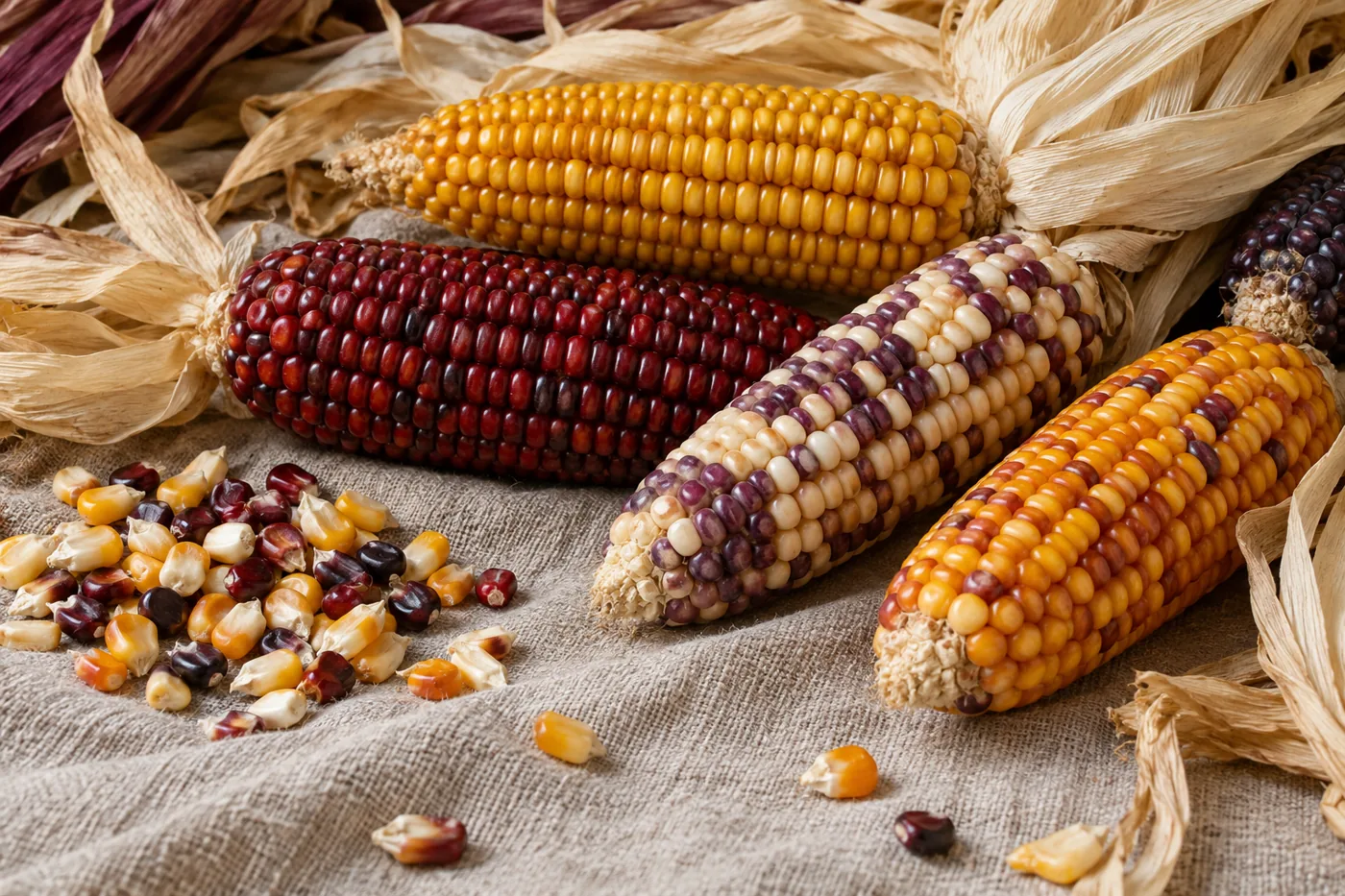
Generated interpretation, not documentary evidence. Invented display of maize ears in several kernel colors on plain cloth.
Credit: AI-generated for Culture Ark using OpenAI image generation Reuse/status: Generated content; no exclusive ownership or underlying-work rights claimed Ears, loose kernels and husks inspected; color variation visually clear. No named cultivar, authentic heritage seed lot or Indigenous motif claim. No authentic-reference or endorsement claim.
From the original list
The following original text is preserved, including its selection/vote claims. Preservation is not independent verification of every assertion.
Why: A grass turned into the world's top crop by Mesoamerican farmers.
What to preserve: Teosinte origin, varieties
Year and origin: c. 7000 BC · Mexico
Vote: 7/9 (historian 3 · future kid 1 · curator 3)
Learn more: Maize on Wikipedia
Supplemental context
Maize records a long relationship between people and plants. The UC Davis maize research account describes domestication from teosinte in what is now southwestern Mexico as early as 9000 years ago. It also notes uncertainty about the earliest uses and explains that farmers carried and traded maize with other communities. Future readers should see cultivation as accumulated knowledge rather than a single inventor's sudden discovery. Different ears and kernels can prompt questions about selection, food preferences and place, while preserving the farmers' role in making a plant central to many distinct cuisines and ways of life.
Creator/community: Indigenous farmers of Mesoamerica and generations of maize-growing communities Place/era: Southwestern Mexico early domestication around 9000 years ago; wider Americas and beyond
Context and limits
The original world's-top-crop claim needs a metric and year and is not independently ranked here. An approximate domestication period is not a precise invention date. Modern colorful ears are not a reconstruction of the earliest maize, nor do their colors identify particular Indigenous communities or named varieties. The image is not a botanical comparison with teosinte or a seed-identification guide.
Where to learn more
- https://apiarybee.com/community/reading/biggie-nu-series-008-noahs-ark-set-d-culture-2000
- https://rilab.ucdavis.edu/maize_history.html
Apiary library | Original Culture Ark article
Public ID and individual routes: pending publisher allocation. Internal source ID: D-0663
Part of the Culture Ark: 2,000 things people should still be able to see in 2,000 years, picked by AI research teams. This page keeps the original list entry for D-0663 word for word and adds context. Browse the gallery. The Culture Ark is an Artificial Mind Hive (AMH) project. AMH is owned by Austin Little.

Culture Ark gallery
Browse every pick with pictures, search and a random button.
Open the gallery →