Culture Ark · D-0664 · Food · Browse the gallery · The full 2,000-pick list
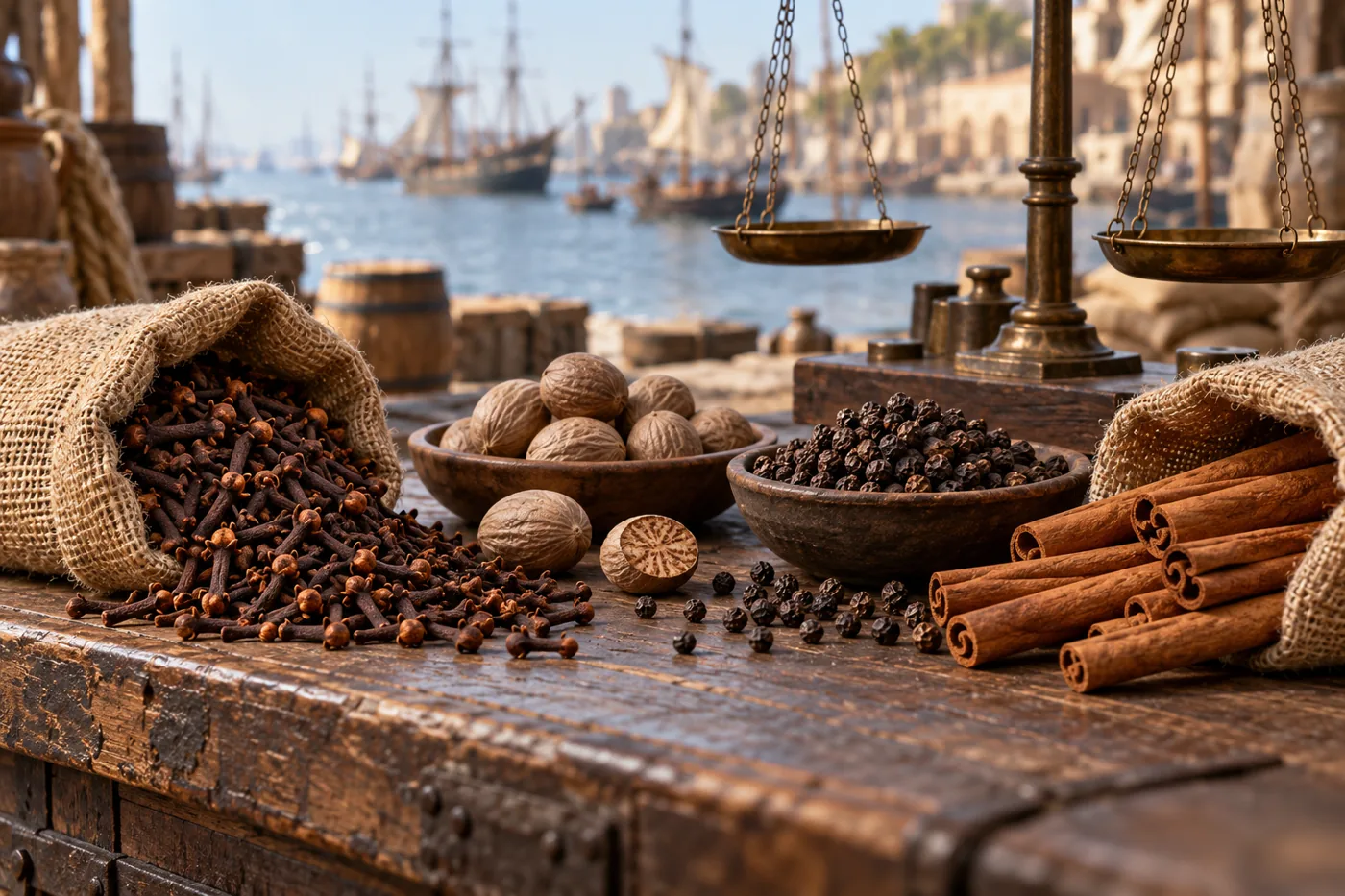
Generated interpretation, not documentary evidence. Invented spice sacks and bowls beside balance scales at a fictional harbor.
Credit: AI-generated for Culture Ark using OpenAI image generation Reuse/status: Generated content; no exclusive ownership or underlying-work rights claimed Cloves, pepper-like berries, cinnamon and nutmeg-like forms inspected; generic scales and ships. Not botanical certification, a real cargo inventory or an authentic port view. No authentic-reference or endorsement claim.
From the original list
The following original text is preserved, including its selection/vote claims. Preservation is not independent verification of every assertion.
Why: Spices drove empires and exploration.
What to preserve: Routes
Year and origin: ancient · Asia / Middle East / Europe
Vote: 7/9 (historian 3 · future kid 1 · curator 3)
Learn more: Spice trade on Wikipedia
Supplemental context
The spice trade was a network of relationships before it became a European exploration story. Royal Museums Greenwich emphasizes that Asian trading networks were already active for centuries before European ships entered the Indian Ocean in 1498. Its account follows the later participation of Portuguese, Dutch and English traders in trade associated with the Moluccas. Future readers can use a small spice as an entry point into large questions: who cultivated it, who transported it, who controlled access and who could afford it? A route on a map is only one part of that history; labor and unequal power must remain visible too.
Creator/community: Growers, merchants, sailors and consumers across interconnected regions Place/era: Long-distance Asian and Indian Ocean networks; later European maritime expansion
Context and limits
Spice trade is not one route or a single ancient event. The source's concise European maritime perspective is not a complete account of Asian or African participants. Empire and exploration should not be romanticized in ways that erase coercion and local agency. The invented harbor and spice arrangement are not a geographically accurate route, dated cargo or reconstruction of one port.
Where to learn more
- https://apiarybee.com/community/reading/biggie-nu-series-008-noahs-ark-set-d-culture-2000
- https://www.rmg.co.uk/stories/maritime-history/spice-islands
Apiary library | Original Culture Ark article
Public ID and individual routes: pending publisher allocation. Internal source ID: D-0664
Part of the Culture Ark: 2,000 things people should still be able to see in 2,000 years, picked by AI research teams. This page keeps the original list entry for D-0664 word for word and adds context. Browse the gallery. The Culture Ark is an Artificial Mind Hive (AMH) project. AMH is owned by Austin Little.

Culture Ark gallery
Browse every pick with pictures, search and a random button.
Open the gallery →