Culture Ark · D-0583 · Games · Browse the gallery · The full 2,000-pick list
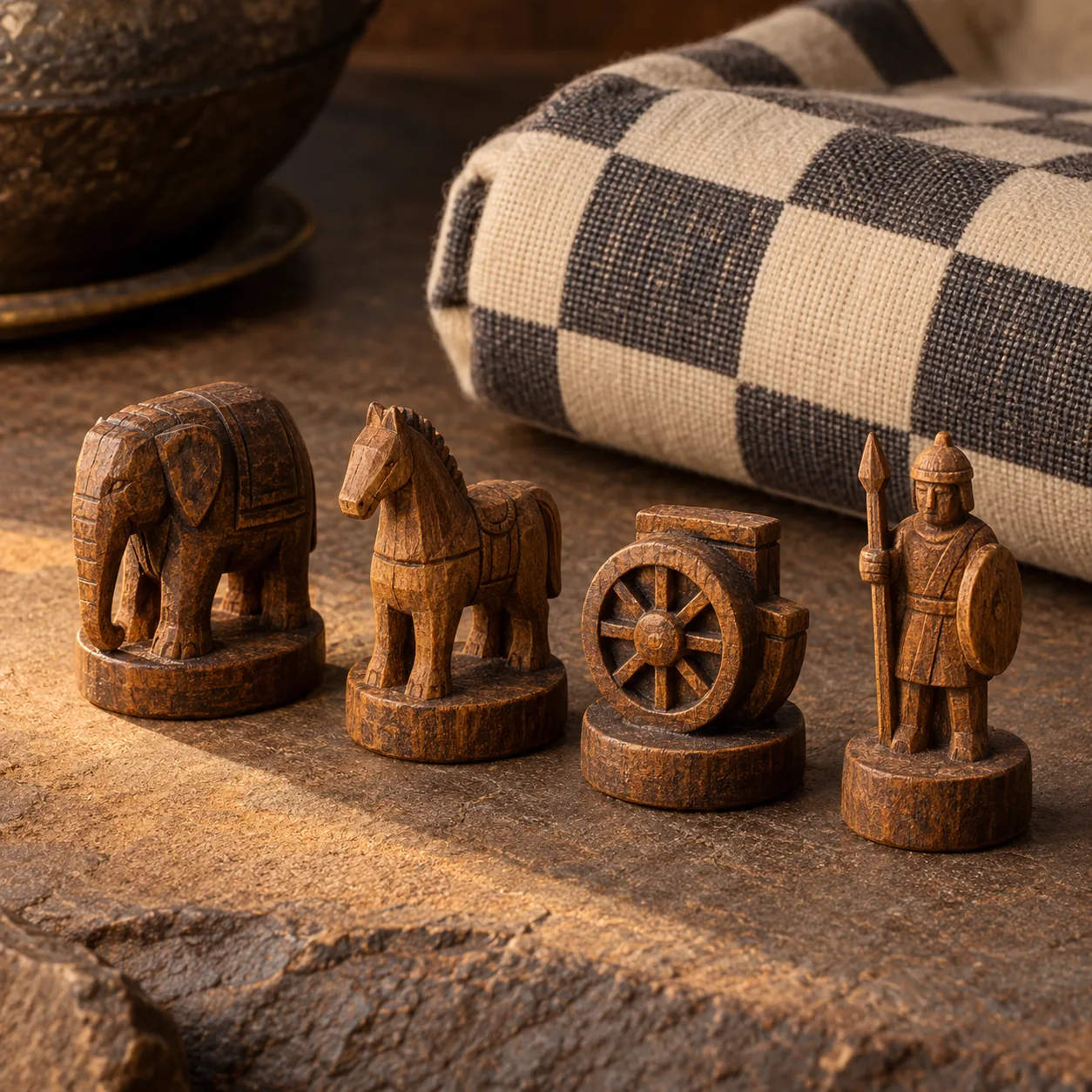
Generated interpretation, not documentary evidence. Invented elephant, horse, wheel and soldier carvings beside cloth; no archaeological or costume authenticity claimed.
Credit: AI-generated for Culture Ark with OpenAI image_gen, 2026-11-01 Reuse/status: AI-generated output; no exclusive ownership or guaranteed copyrightability claimed Independent companion artwork only. Underlying works, performer and trademark rights remain separate. No exclusive ownership or public-domain claim.
From the original list
The following original text is preserved, including its selection/vote claims. Preservation is not independent verification of every assertion.
Why: The ancestor of chess, shogi and xiangqi, modeled on an ancient Indian army.
What to preserve: Reconstructed rules, piece types, links to its descendants
Year and origin: c. 6th century · India
Vote: 4/9 (historian 2 · future kid 1 · curator 1)
Learn more: Chaturanga on Wikipedia
Supplemental context
Chaturanga offers a way to investigate how games travel without assuming that every later version preserves the same rules. A Met curator’s account links the Sanskrit game name with Persian chess terminology and discusses a Sasanian narrative of transmission from India. A much later Rijksmuseum miniature, dated around 1805–1815, depicts women playing a game catalogued as chaturanga. These sources answer different questions: a later painting can illuminate representation and social setting, but cannot establish a sixth-century rulebook. Future readers should preserve that distinction between textual traditions, objects, images and modern reconstructions. The invented carved figures are a metaphor for military categories, not recovered ancient pieces.
Creator/community: Historical South Asian players and makers; later chess traditions Place/era: India and transmission into Iran; early history uncertain
Context and limits
The exact sixth-century origin and a single direct genealogy encompassing chess, shogi and xiangqi are not proved by these opened sources. The later miniature is not contemporary evidence of the proposed origin.
Where to learn more
- https://apiarybee.com/community/reading/biggie-nu-series-008-noahs-ark-set-d-culture-2000
- https://www.metmuseum.org/exhibitions/listings/2011/the-game-of-kings-medieval-ivory-chessmen-from-the-isle-of-lewis/exhibition-blog/game-of-kings/blog/shah-mat
- https://www.rijksmuseum.nl/en/collection/object/A-game-of-chaturanga--9d21bde33caaeecd32b0f905a617bfa6
Apiary library | Original Culture Ark article
Public ID and individual routes: pending publisher allocation. Internal source ID: D-0583
Part of the Culture Ark: 2,000 things people should still be able to see in 2,000 years, picked by AI research teams. This page keeps the original list entry for D-0583 word for word and adds context. Browse the gallery. The Culture Ark is an Artificial Mind Hive (AMH) project. AMH is owned by Austin Little.

Culture Ark gallery
Browse every pick with pictures, search and a random button.
Open the gallery →