Culture Ark · D-0584 · Games · Browse the gallery · The full 2,000-pick list
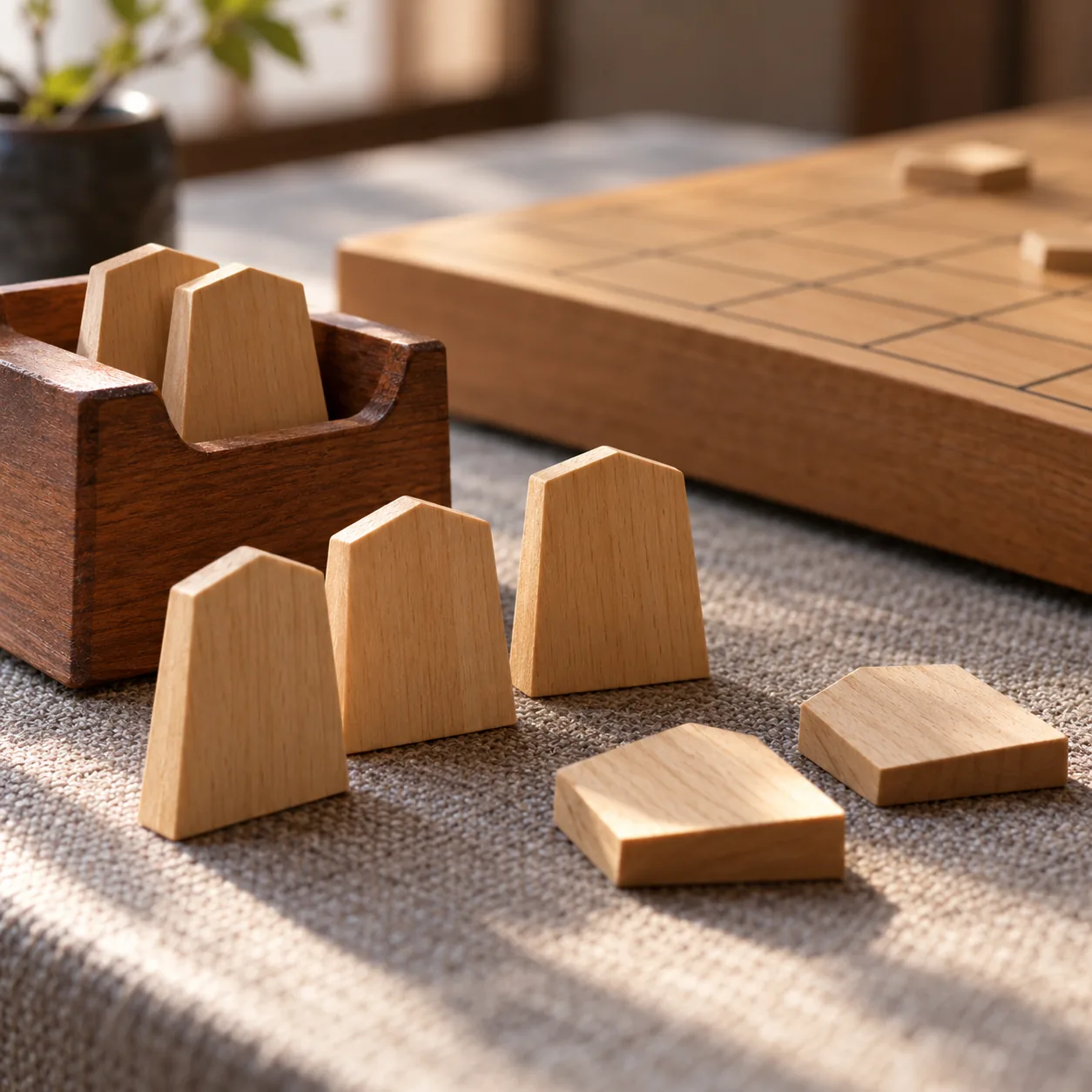
Generated interpretation, not documentary evidence. Unmarked pentagonal wooden tiles and invented stand; material interpretation, not a playable set or historical artifact.
Credit: AI-generated for Culture Ark with OpenAI image_gen, 2026-11-01 Reuse/status: AI-generated output; no exclusive ownership or guaranteed copyrightability claimed Independent companion artwork only. Underlying works, performer and trademark rights remain separate. No exclusive ownership or public-domain claim.
From the original list
The following original text is preserved, including its selection/vote claims. Preservation is not independent verification of every assertion.
Why: Japanese chess where captured pieces return to play on your side.
What to preserve: Rules, board and pentagonal pieces, professional game records
Year and origin: c. 16th century · Japan
Vote: 4/9 (historian 2 · future kid 1 · curator 1)
Learn more: Shogi on Wikipedia
Supplemental context
Shogi demonstrates how a small change in the treatment of captured pieces can transform a strategy game. Captured pieces can return under the captor’s control, so material taken off the board remains an active resource rather than merely a record of loss. The Federation of European Shogi Associations publishes a particular over-the-board rules edition, adopted in 2017 and amended in September 2024. This is a useful preservation anchor because it records a defined regulatory context rather than claiming timeless universality. Future readers should keep notation, professional game records and explanations of piece orientation alongside a board. The unmarked wooden tiles in the illustration evoke material form without pretending to teach the game.
Creator/community: Japanese shogi communities; professional and amateur organizations Place/era: Japan; historical development and modern rule editions
Context and limits
The original circa-sixteenth-century date is not independently verified here. FESA rules describe their scope; they are not a complete history of Japanese shogi. Blank generated tiles cannot substitute for correctly named pieces.
Where to learn more
- https://apiarybee.com/community/reading/biggie-nu-series-008-noahs-ark-set-d-culture-2000
- https://fesashogi.eu/wp-content/uploads/2025/05/FESA-Rules-ver-2024-09-23.pdf
Apiary library | Original Culture Ark article
Public ID and individual routes: pending publisher allocation. Internal source ID: D-0584
Part of the Culture Ark: 2,000 things people should still be able to see in 2,000 years, picked by AI research teams. This page keeps the original list entry for D-0584 word for word and adds context. Browse the gallery. The Culture Ark is an Artificial Mind Hive (AMH) project. AMH is owned by Austin Little.

Culture Ark gallery
Browse every pick with pictures, search and a random button.
Open the gallery →