Culture Ark · D-0588 · Games · Browse the gallery · The full 2,000-pick list
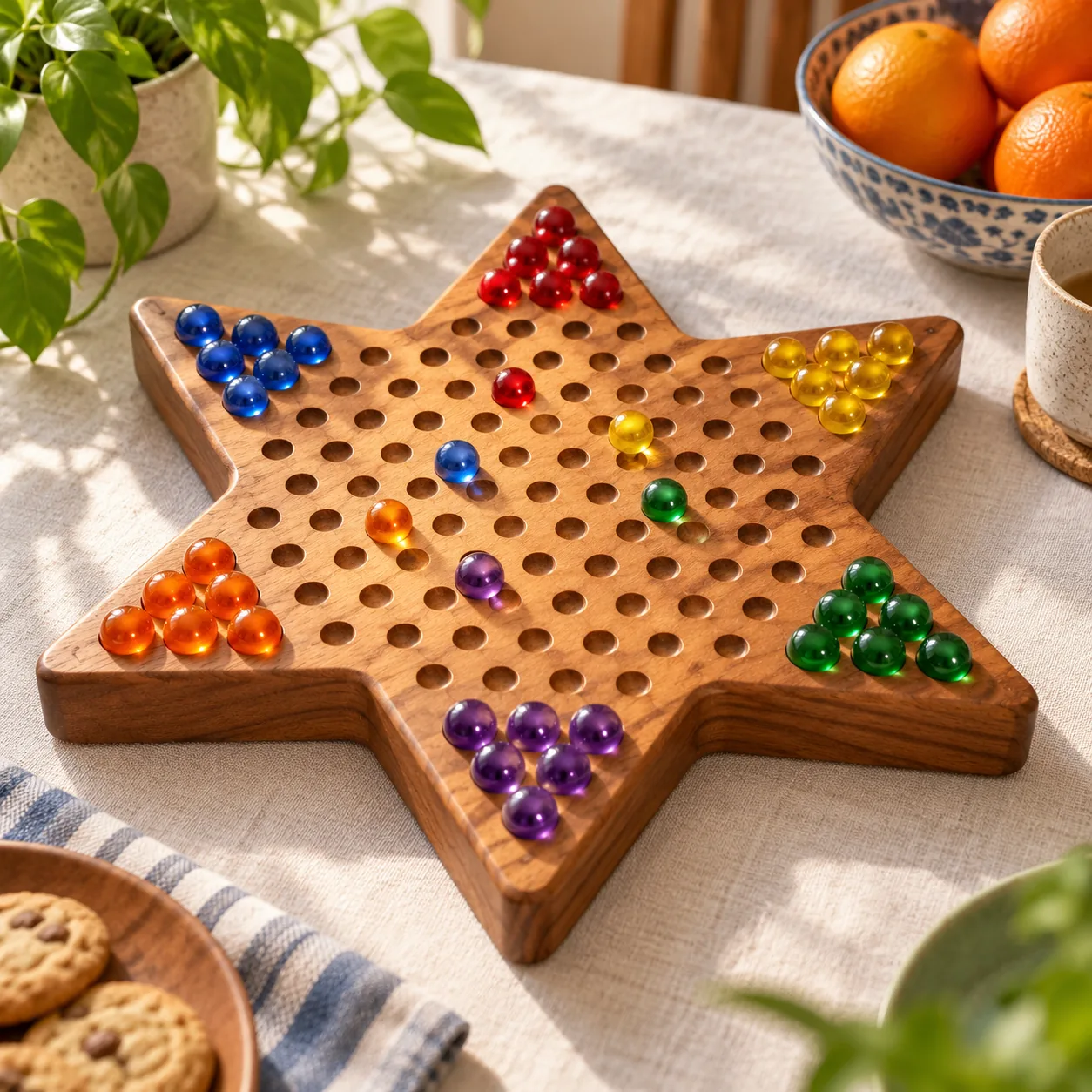
Generated interpretation, not documentary evidence. Invented six-pointed wooden star board and colored marbles; not the museum’s 1939 set or a measured playable design.
Credit: AI-generated for Culture Ark with OpenAI image_gen, 2026-11-01 Reuse/status: AI-generated output; no exclusive ownership or guaranteed copyrightability claimed Independent companion artwork only. Underlying works, performer and trademark rights remain separate. No exclusive ownership or public-domain claim.
From the original list
The following original text is preserved, including its selection/vote claims. Preservation is not independent verification of every assertion.
Why: A star-shaped game that is neither Chinese nor checkers.
What to preserve: Board, marbles, rules, the naming story
Year and origin: 1892 · Germany
Vote: 4/9 (historian 1 · future kid 2 · curator 1)
Learn more: Chinese checkers on Wikipedia
Supplemental context
Chinese checkers is a useful warning against treating a product name as an origin label. Thunder Bay Museum identifies its own example as a 1939 Whitman product while explaining the earlier German Stern-Halma history and the later American naming. This separates three dates that could otherwise be collapsed: the development of the game, its renaming and the manufacture of a particular museum object. The play centers on moving pieces across a star-shaped board, making routes and temporary obstacles socially visible around the table. Future readers would learn from packaging as well as rules, since commercial language can shape assumptions about foreign cultures long after a game has traveled.
Creator/community: Stern-Halma makers and international players; American commercial renaming Place/era: Germany, 1892; later international commercial circulation
Context and limits
The name does not establish Chinese origin. The museum’s 1939 example is not the original 1892 product. The generated board has an illustrative hole pattern and cannot serve as a precise construction or rules diagram.
Where to learn more
- https://apiarybee.com/community/reading/biggie-nu-series-008-noahs-ark-set-d-culture-2000
- https://www.thunderbaymuseum.com/exhibits/virtual/toys-of-our-past/chinese-checkers/
Apiary library | Original Culture Ark article
Public ID and individual routes: pending publisher allocation. Internal source ID: D-0588
Part of the Culture Ark: 2,000 things people should still be able to see in 2,000 years, picked by AI research teams. This page keeps the original list entry for D-0588 word for word and adds context. Browse the gallery. The Culture Ark is an Artificial Mind Hive (AMH) project. AMH is owned by Austin Little.

Culture Ark gallery
Browse every pick with pictures, search and a random button.
Open the gallery →