Culture Ark · D-0585 · Games · Browse the gallery · The full 2,000-pick list
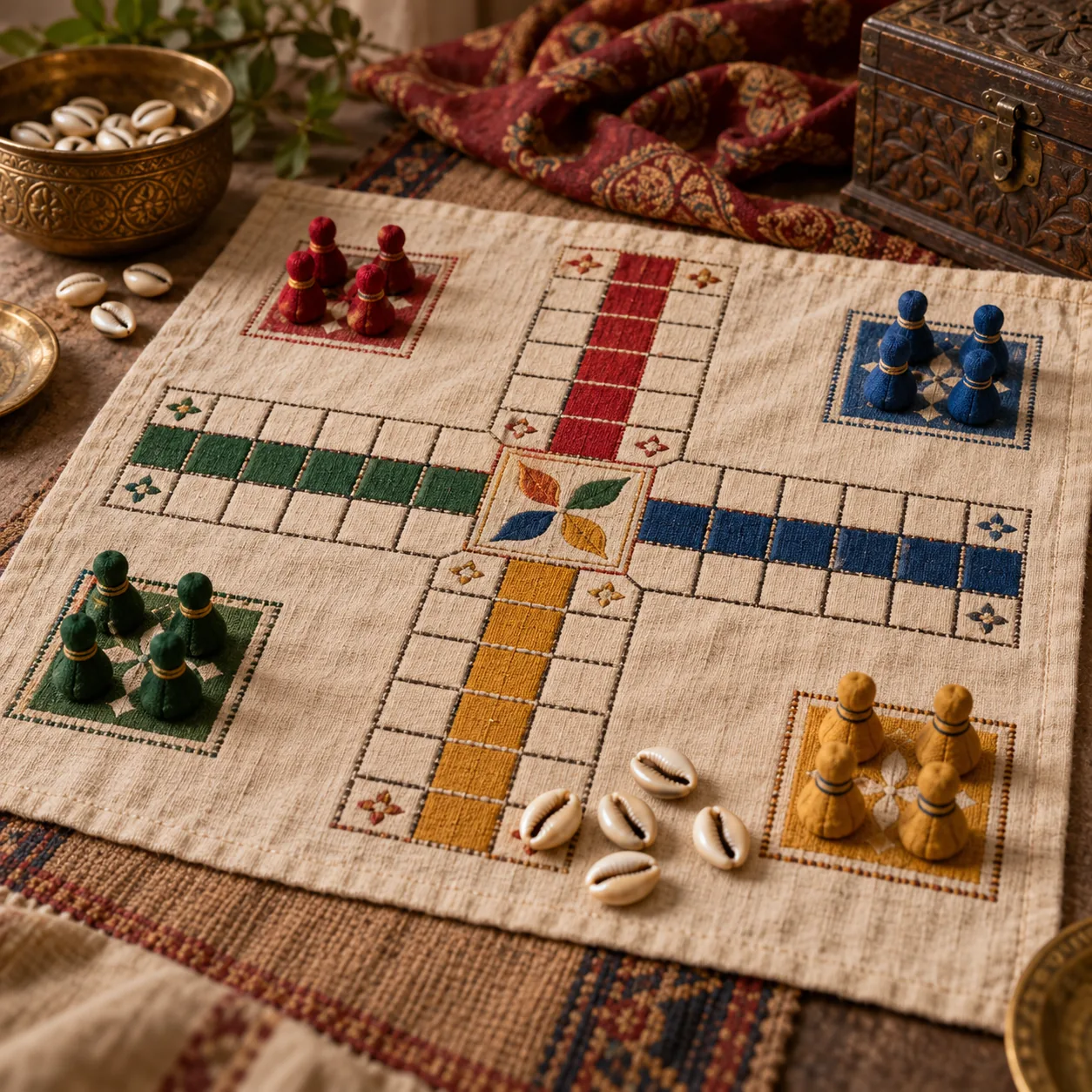
Generated interpretation, not documentary evidence. Invented embroidered cross-track cloth, colored pawns and cowries; not a royal board or accurate rules diagram.
Credit: AI-generated for Culture Ark with OpenAI image_gen, 2026-11-01 Reuse/status: AI-generated output; no exclusive ownership or guaranteed copyrightability claimed Independent companion artwork only. Underlying works, performer and trademark rights remain separate. No exclusive ownership or public-domain claim.
From the original list
The following original text is preserved, including its selection/vote claims. Preservation is not independent verification of every assertion.
Why: The royal cross-and-circle game Mughal emperors played on life-size courtyards.
What to preserve: Rules, cloth boards, cowrie shells, the Fatehpur Sikri court
Year and origin: c. 16th century · India
Vote: 4/9 (historian 2 · future kid 1 · curator 1)
Learn more: Pachisi on Wikipedia
Supplemental context
Pachisi belongs to a wider history of cross-shaped race games whose names, materials and rules need careful identification. The Ashmolean’s record of a chaupar piece describes courtly play during the Mughal period and a complete set of sixteen painted pieces. The museum dates that particular set to the later eighteenth century and tentatively associates it with a royal court in Rajasthan. This is valuable evidence about a specific object, not a license to treat every modern board as an imperial artifact. Future readers could compare cloth, shell and dice-based practices, but should retain each source’s terminology. The companion artwork suggests portable play materials without reconstructing an emperor’s courtyard.
Creator/community: South Asian pachisi and chaupar communities; regional makers Place/era: India; Mughal-period popularity and diverse surviving sets
Context and limits
The cited object is chaupar, discussed by the museum alongside pachisi; related games and local rules are not automatically identical. The sixteenth-century origin and life-size court claim are not independently confirmed by this object record.
Where to learn more
- https://apiarybee.com/community/reading/biggie-nu-series-008-noahs-ark-set-d-culture-2000
- https://jameelcentre.ashmolean.org/collection/4/891/895/13233
Apiary library | Original Culture Ark article
Public ID and individual routes: pending publisher allocation. Internal source ID: D-0585
Part of the Culture Ark: 2,000 things people should still be able to see in 2,000 years, picked by AI research teams. This page keeps the original list entry for D-0585 word for word and adds context. Browse the gallery. The Culture Ark is an Artificial Mind Hive (AMH) project. AMH is owned by Austin Little.

Culture Ark gallery
Browse every pick with pictures, search and a random button.
Open the gallery →