Culture Ark · D-0586 · Games · Browse the gallery · The full 2,000-pick list
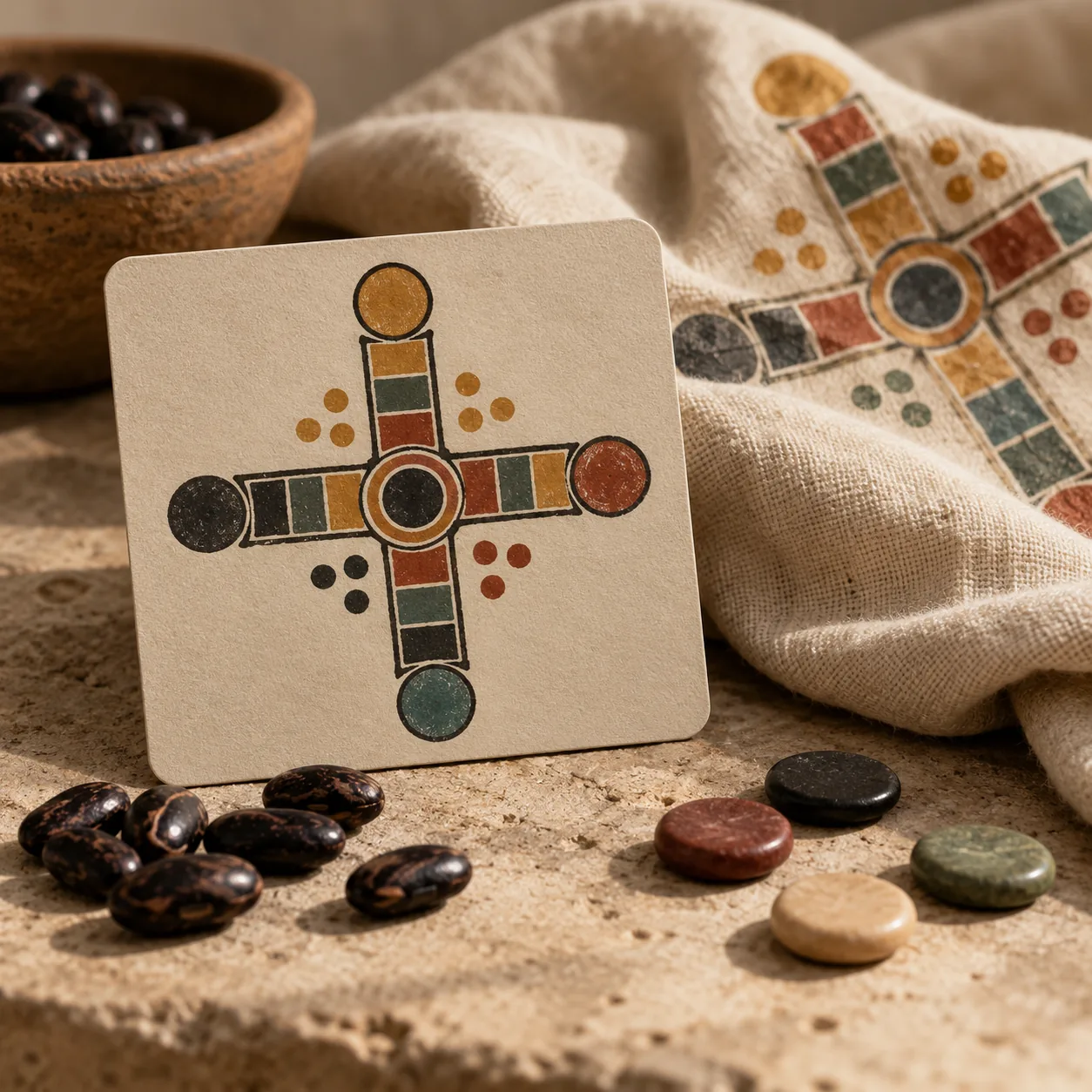
Generated interpretation, not documentary evidence. Beans, counters and invented cross-track designs on card and cloth; not a codex reproduction or validated reconstruction.
Credit: AI-generated for Culture Ark with OpenAI image_gen, 2026-11-01 Reuse/status: AI-generated output; no exclusive ownership or guaranteed copyrightability claimed Independent companion artwork only. Underlying works, performer and trademark rights remain separate. No exclusive ownership or public-domain claim.
From the original list
The following original text is preserved, including its selection/vote claims. Preservation is not independent verification of every assertion.
Why: An Aztec gambling board game played with beans as dice.
What to preserve: Codex illustrations, reconstructed rules
Year and origin: pre-Columbian · Mesoamerica (Aztec)
Vote: 4/9 (historian 1 · future kid 1 · curator 2)
Learn more: Patolli on Wikipedia
Supplemental context
Patolli shows why historical games must be documented with the evidence behind each reconstruction. The Digital Ludeme Project’s evidence page gathers accounts that describe beans used as dice, marked playing surfaces and the movement of counters. It identifies the writers and dates of those accounts, making it possible to distinguish a historical report from a modern playable interpretation. Future readers should not assume that every cross-shaped design was used with the same rules, or that colonial descriptions were culturally neutral. The selection can teach how material, chance, social stakes and interpretation intersect. Its companion artwork uses an invented geometric track and loose beans rather than copying a codex or staging a ritual.
Creator/community: Historical Nahua and other Mesoamerican players; later researchers Place/era: Mesoamerica; pre-colonial practices described in colonial sources
Context and limits
Sources include colonial outsiders and need critical interpretation. No complete universal ancient rulebook is asserted. Mexicolore returned 403 and was not retried; the research-project evidence page was independently opened.
Where to learn more
- https://apiarybee.com/community/reading/biggie-nu-series-008-noahs-ark-set-d-culture-2000
- https://ludii.games/data.php?gameId=117
Apiary library | Original Culture Ark article
Public ID and individual routes: pending publisher allocation. Internal source ID: D-0586
Part of the Culture Ark: 2,000 things people should still be able to see in 2,000 years, picked by AI research teams. This page keeps the original list entry for D-0586 word for word and adds context. Browse the gallery. The Culture Ark is an Artificial Mind Hive (AMH) project. AMH is owned by Austin Little.

Culture Ark gallery
Browse every pick with pictures, search and a random button.
Open the gallery →