Culture Ark · D-0483 · Games · Browse the gallery · The full 2,000-pick list
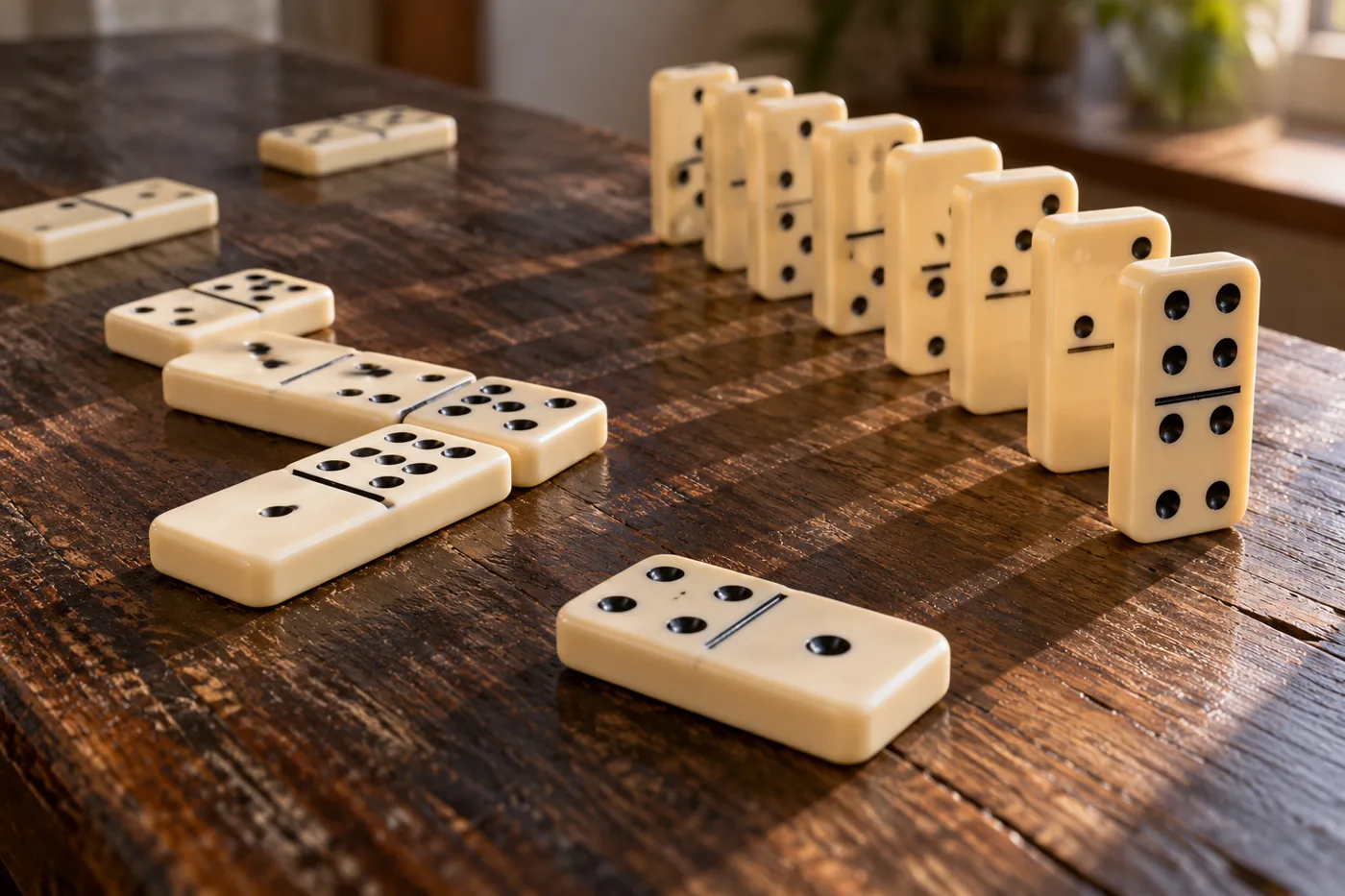
Generated interpretation, not documentary evidence. Invented domino still life combining flat tiles with a short standing row.
Credit: AI-generated for Culture Ark using OpenAI image generation Reuse/status: Generated content; no exclusive ownership or underlying-work rights claimed Distinct cream tiles and readable pip divisions; arrangement is decorative, not a validated set or matching chain. No authentic-reference or endorsement claim.
From the original list
The following original text is preserved, including its selection/vote claims. Preservation is not independent verification of every assertion.
Why: Simple tiles that spawned dozens of games and the domino-toppling art form.
What to preserve: A set, game rules, domino-toppling records
Year and origin: c. 12th century · China
Vote: 6/9 (historian 2 · future kid 2 · curator 2)
Learn more: Dominoes on Wikipedia
Supplemental context
Dominoes are a family of games as well as physical tiles that can be balanced and toppled. The Strong distinguishes Chinese forms from European sets containing extra blank combinations and explains that the spots, or pips, represent dice outcomes. Its account separates blocking and scoring games from toppling exhibitions. This is a valuable example of one object supporting different kinds of pleasure: numerical comparison, competition, patient construction and spectacular collapse. Preservation should identify which set and rules a particular community actually used.
Creator/community: Chinese and later regional domino-playing communities Place/era: China and international traditions; varied historical dating
Context and limits
The live entry says approximately the twelfth century, whereas The Strong’s page says the 1300s. That discrepancy is retained explicitly rather than resolved by guesswork. Toppling records need event dates and verification, and do not define the entire domino tradition. The illustration is neither a complete set nor a legal game sequence.
Where to learn more
- https://apiarybee.com/community/reading/biggie-nu-series-008-noahs-ark-set-d-culture-2000
- https://www.museumofplay.org/toys/dominoes/
Apiary library | Original Culture Ark article
Public ID and individual routes: pending publisher allocation. Internal source ID: D-0483
Part of the Culture Ark: 2,000 things people should still be able to see in 2,000 years, picked by AI research teams. This page keeps the original list entry for D-0483 word for word and adds context. Browse the gallery. The Culture Ark is an Artificial Mind Hive (AMH) project. AMH is owned by Austin Little.

Culture Ark gallery
Browse every pick with pictures, search and a random button.
Open the gallery →