Culture Ark · D-0487 · Games · Browse the gallery · The full 2,000-pick list
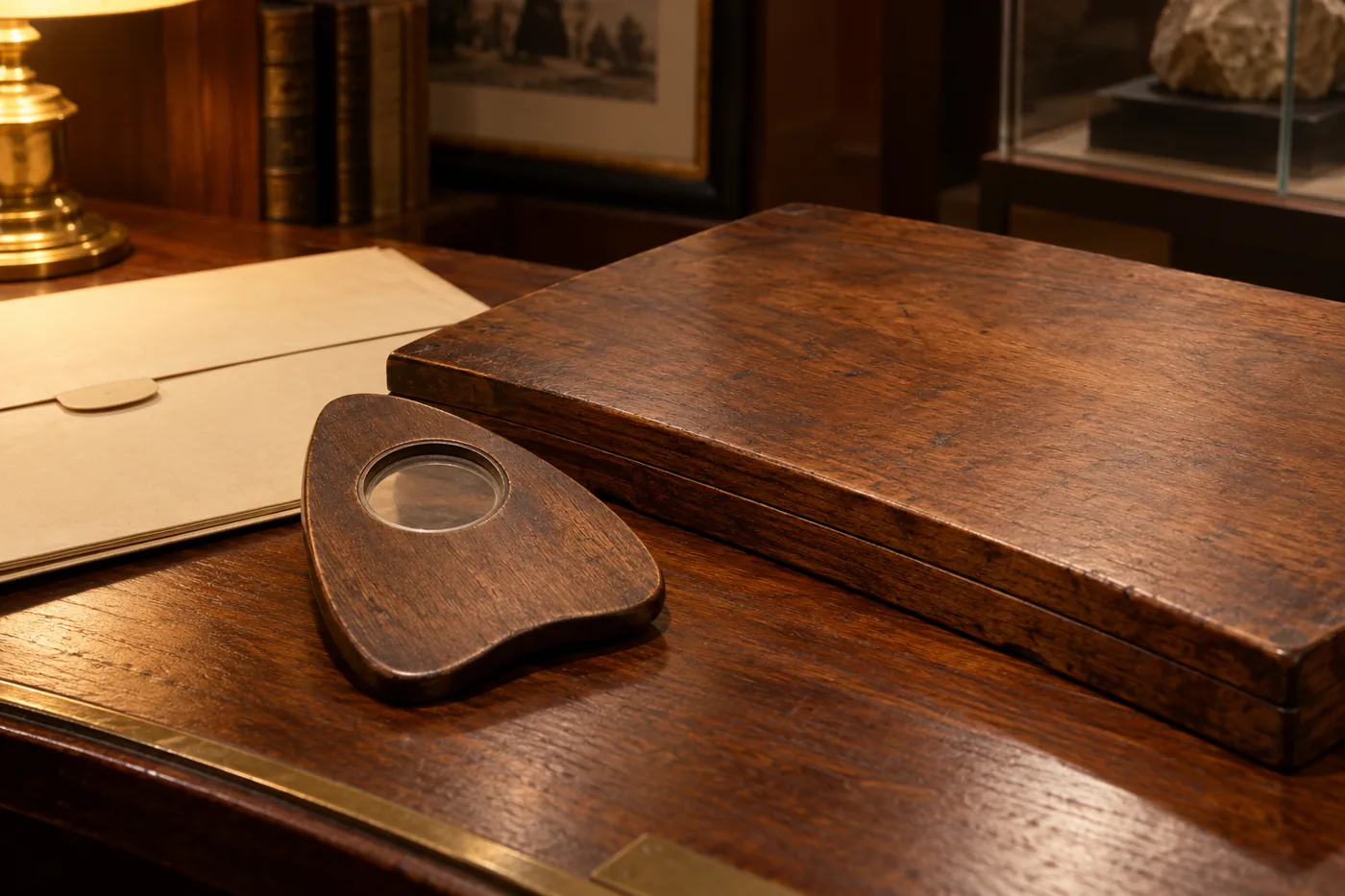
Generated interpretation, not documentary evidence. Invented talking-board pointer beside a plain closed board and archival folder.
Credit: AI-generated for Culture Ark using OpenAI image generation Reuse/status: Generated content; no exclusive ownership or underlying-work rights claimed Coherent wooden pointer and circular window, no ghosts, false manifestations, reproduced lettering or authenticated-artifact claim. No authentic-reference or endorsement claim.
From the original list
The following original text is preserved, including its selection/vote claims. Preservation is not independent verification of every assertion.
Why: A parlor game that became a cultural icon of the supernatural.
What to preserve: The board, planchette, patents, horror film use
Year and origin: 1890 · United States
Vote: 6/9 (historian 2 · future kid 2 · curator 2)
Learn more: Ouija on Wikipedia
Supplemental context
The Ouija board can be studied as a manufactured game and as an object interpreted through belief and popular storytelling. Bond’s patent describes a lettered board and a hand-operated pointer intended to answer questions through selected letters. The document is useful evidence of what an inventor claimed and how the apparatus was described commercially. It is not evidence that the device communicates with spirits. Future readers can compare the physical design, marketing language and users’ interpretations without confusing these different kinds of evidence.
Creator/community: Elijah J. Bond and commercial talking-board makers; parlor-game audiences Place/era: United States; application in 1890, patent granted 10 February 1891
Context and limits
The patent separates an 1890 application from its February 1891 grant, refining the original year without altering it. A patent records a claimed invention, not supernatural verification. The card shows generic contemporary objects, not Bond’s exact patented pointer, an authentic historic board or a paranormal event. Brand and later artwork rights are separate.
Where to learn more
- https://apiarybee.com/community/reading/biggie-nu-series-008-noahs-ark-set-d-culture-2000
- https://patents.google.com/patent/US446054A/en
Apiary library | Original Culture Ark article
Public ID and individual routes: pending publisher allocation. Internal source ID: D-0487
Part of the Culture Ark: 2,000 things people should still be able to see in 2,000 years, picked by AI research teams. This page keeps the original list entry for D-0487 word for word and adds context. Browse the gallery. The Culture Ark is an Artificial Mind Hive (AMH) project. AMH is owned by Austin Little.

Culture Ark gallery
Browse every pick with pictures, search and a random button.
Open the gallery →