Culture Ark · D-0485 · Games · Browse the gallery · The full 2,000-pick list
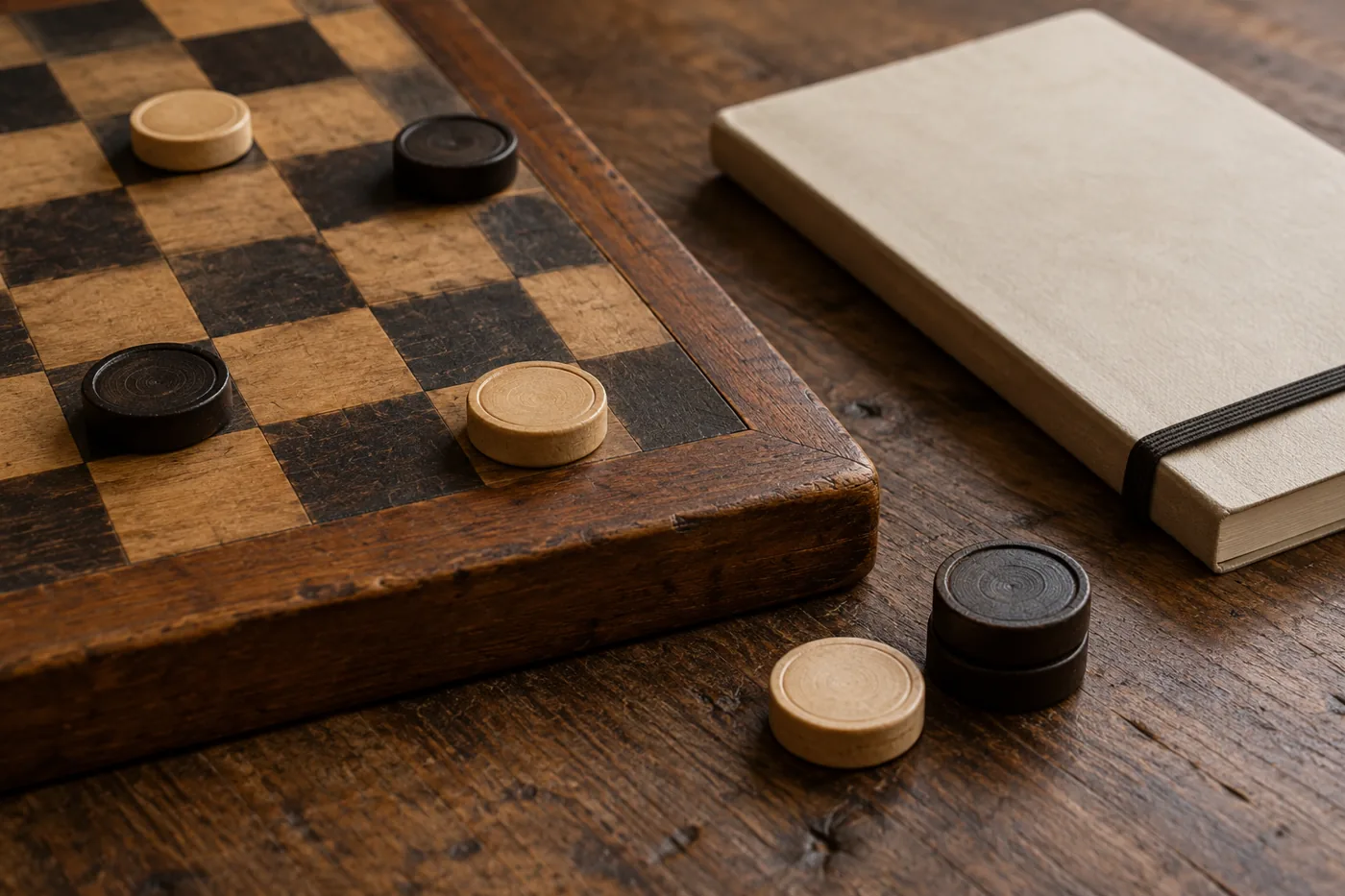
Generated interpretation, not documentary evidence. Interpreted checkerboard detail with loose round counters and a blank notebook.
Credit: AI-generated for Culture Ark using OpenAI image generation Reuse/status: Generated content; no exclusive ownership or underlying-work rights claimed Coherent round counters and grid texture; some pieces are arranged decoratively rather than according to legal dark-square play. No authentic-reference or endorsement claim.
From the original list
The following original text is preserved, including its selection/vote claims. Preservation is not independent verification of every assertion.
Why: Checkers, played on a chessboard by millions worldwide.
What to preserve: Rules, international and English variants, Chinook solving it in 2007
Year and origin: c. 12th century · Europe
Vote: 6/9 (historian 2 · future kid 2 · curator 2)
Learn more: Checkers on Wikipedia
Supplemental context
Draughts turns movement and capture on a grid into a contest with surprisingly deep possibilities. The 2007 research paper Checkers Is Solved reports a weak solution: from the standard starting position, perfect play leads to a draw. It explains how search and endgame databases support that result. This does not make ordinary games meaningless; people still must choose moves without the complete computational proof. Preserving both human play and the research shows different meanings of mastery, from learned judgment to formal game-theoretic certainty.
Creator/community: Draughts playing communities; Jonathan Schaeffer and the Chinook research team Place/era: Multiple regional traditions; 2007 computer proof for English/American checkers
Context and limits
The proof concerns the English/American checkers game, not every draughts variant, including international draughts. ‘Weakly solved’ does not mean every possible position was separately solved or every human game ends in a draw. The original medieval-origin wording is not verified by this computer-science source. The picture is not a legal position or proof diagram.
Where to learn more
- https://apiarybee.com/community/reading/biggie-nu-series-008-noahs-ark-set-d-culture-2000
- https://webdocs.cs.ualberta.ca/~mmueller/courses/657-Fall2025/readings/2007-checkers.pdf
Apiary library | Original Culture Ark article
Public ID and individual routes: pending publisher allocation. Internal source ID: D-0485
Part of the Culture Ark: 2,000 things people should still be able to see in 2,000 years, picked by AI research teams. This page keeps the original list entry for D-0485 word for word and adds context. Browse the gallery. The Culture Ark is an Artificial Mind Hive (AMH) project. AMH is owned by Austin Little.

Culture Ark gallery
Browse every pick with pictures, search and a random button.
Open the gallery →