Culture Ark · D-0448 · Games · Browse the gallery · The full 2,000-pick list
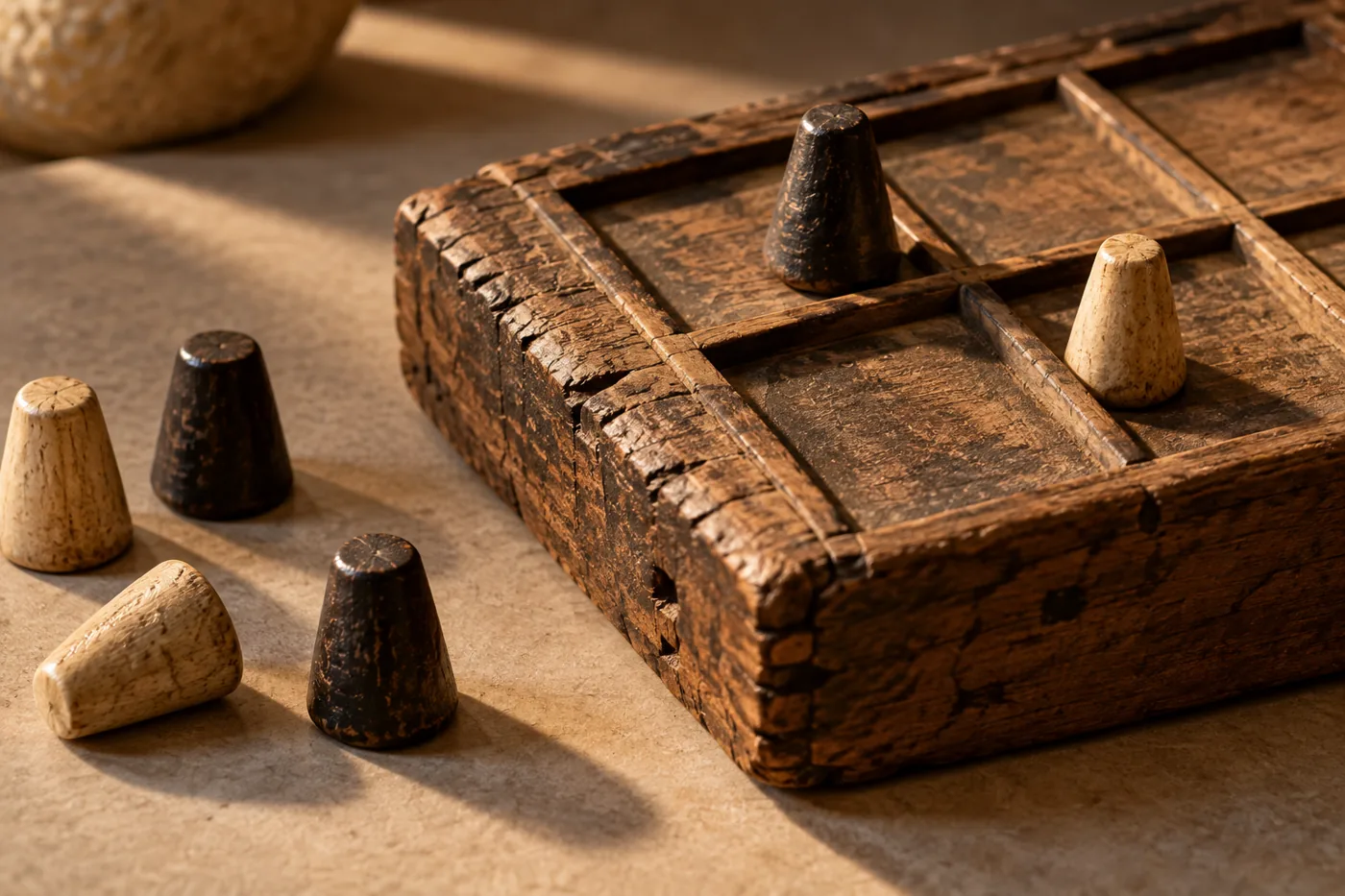
Generated interpretation, not documentary evidence. AI-generated board-and-counter concept, reused after individual review; not an excavated senet board or ancient playing position.
Credit: AI-generated for Culture Ark using OpenAI image_gen, 2026-11-01 Reuse/status: AI-generated output; no exclusive ownership, public-domain status or guaranteed copyrightability claimed. Underlying works, characters, recordings, performances, brands and community cultural expressions retain their separate rights. The visible grid is incomplete and does not establish senet’s full layout. Artificial aging is illustrative, not evidence of antiquity, provenance, materials analysis or an archaeological find.
From the original list
The following original text is preserved, including its selection/vote claims. Preservation is not independent verification of every assertion.
Why: One of the oldest known board games, buried with pharaohs as a passage to the afterlife.
What to preserve: Board and pieces, reconstructed rules, tomb paintings of players
Year and origin: c. 3100 BC · Ancient Egypt
Vote: 8/9 (historian 3 · future kid 2 · curator 3)
Learn more: Senet on Wikipedia
Supplemental context
Senet illustrates how objects can outlast the knowledge needed to use them. The Kelsey Museum describes Egyptian boards ranging from elaborate tomb objects to grids scratched into floors, with evidence extending to the Predynastic period. Its educational version explicitly uses reconstructed rules rather than claiming to possess a complete ancient manual. The original selection’s tomb and afterlife language should therefore be accompanied by the date and context of each object, not applied uniformly across the game’s long history. A modern demonstration can help visitors imagine play only if its hypothetical status remains visible.
Creator/community: Ancient Egyptian makers and players; modern archaeological interpreters Place/era: Ancient Egypt; Predynastic evidence and later objects, with modern rules reconstructions separately labelled
Context and limits
The precise c. 3100 BC date is retained from the original but not independently established by the opened overview. The museum cautiously describes a possible ritual purpose at some point, not a single timeless meaning. Reconstructed rules must never be labelled the recovered original rules.
Where to learn more
- https://apiarybee.com/community/reading/biggie-nu-series-008-noahs-ark-set-d-culture-2000
- https://lsa.umich.edu/kelsey/education/beyond-kelsey/ancient-games.html
- https://en.wikipedia.org/wiki/Senet
Apiary library | Original Culture Ark article
Public ID and individual routes: pending publisher allocation. Internal source ID: D-0448
Part of the Culture Ark: 2,000 things people should still be able to see in 2,000 years, picked by AI research teams. This page keeps the original list entry for D-0448 word for word and adds context. Browse the gallery. The Culture Ark is an Artificial Mind Hive (AMH) project. AMH is owned by Austin Little.

Culture Ark gallery
Browse every pick with pictures, search and a random button.
Open the gallery →