Culture Ark · D-0452 · Games · Browse the gallery · The full 2,000-pick list
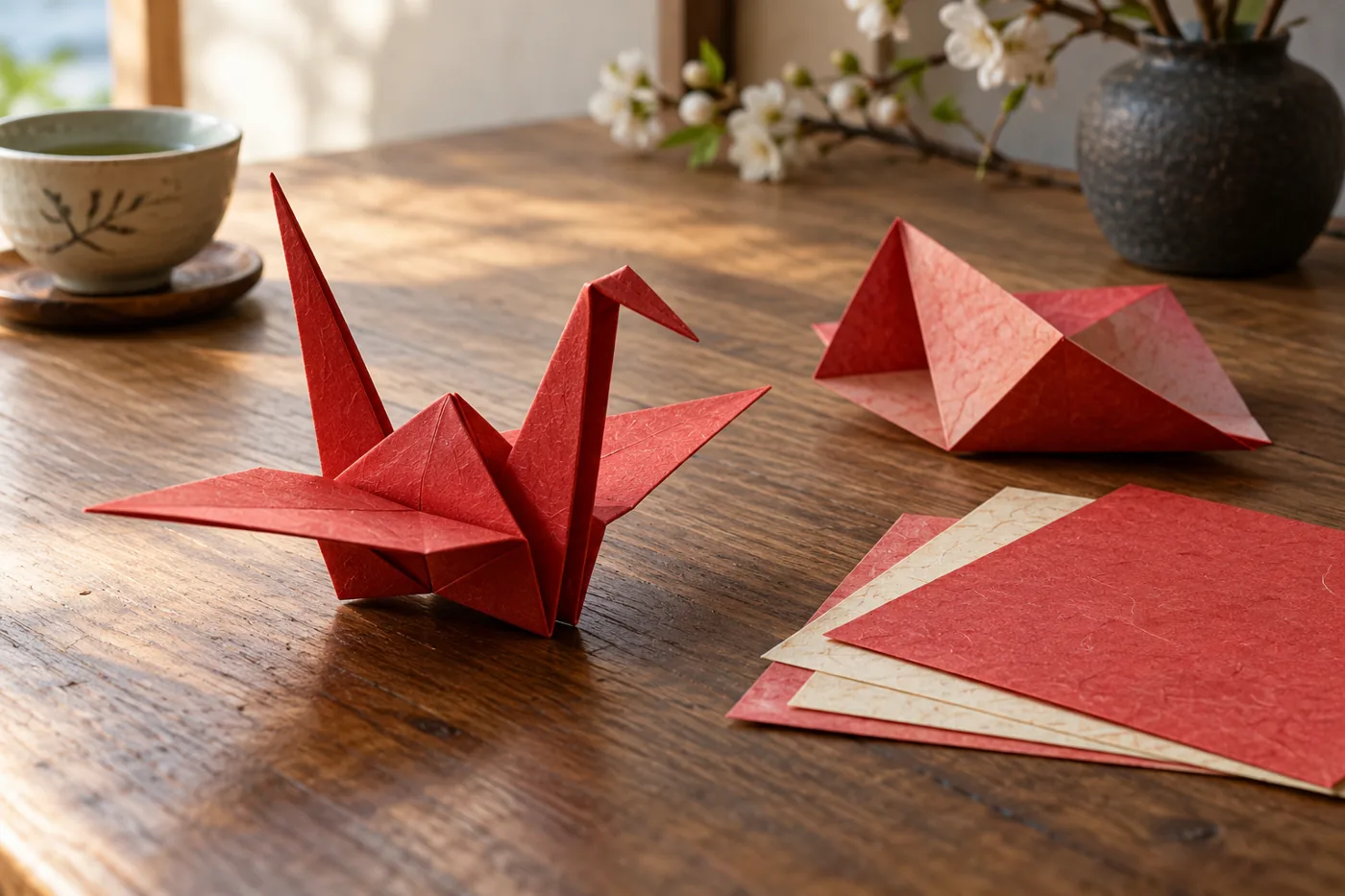
Generated interpretation, not documentary evidence. Invented red paper crane and partly folded sheets, not a verified folding sequence or a copied designer diagram.
Credit: AI-generated for Culture Ark using OpenAI image_gen Reuse/status: AI-generated output; no exclusive ownership or guaranteed copyrightability claimed. Underlying works, marks and cultural permissions remain separate. Invented red paper crane and partly folded sheets, not a verified folding sequence or a copied designer diagram. Edo-period Japan is a useful historical focus, not proof of a single invention moment for all paper folding. Not every historical folding practice followed today's one-sheet, no-cut convention. The generated crane is an illustration rather than a tested diagram, and modern original diagrams may carry separate rights.
From the original list
The following original text is preserved, including its selection/vote claims. Preservation is not independent verification of every assertion.
Why: Folding a single sheet into a crane or a spacecraft solar array.
What to preserve: Fold diagrams, the paper crane, math of folding
Year and origin: Edo period · Japan
Vote: 8/9 (historian 3 · future kid 3 · curator 2)
Learn more: Origami on Wikipedia
Supplemental context
Origami turns an ordinary sheet into a sequence of decisions that another person can repeat, adapt or invent anew. John Smith's historical notes hosted by the British Origami Society distinguish documented references, older attributions and unresolved origins. They discuss Edo-period folding and the 1797 crane book while also recognizing connections between Japanese and European traditions. For a future audience, the practice can show how an art is transmitted through demonstrations, diagrams and communities rather than only through permanent objects. A finished crane is valuable, but the knowledge of how people teach and learn folds is a different part of the cultural record.
Creator/community: Japanese paper-folding communities and international folders, designers and educators Place/era: Japan, including Edo-period evidence; later international development
Context and limits
Edo-period Japan is a useful historical focus, not proof of a single invention moment for all paper folding. Not every historical folding practice followed today's one-sheet, no-cut convention. The generated crane is an illustration rather than a tested diagram, and modern original diagrams may carry separate rights.
Where to learn more
- https://apiarybee.com/community/reading/biggie-nu-series-008-noahs-ark-set-d-culture-2000
- https://britishorigami.org/academic/johnsmith/history_notes.php
Apiary library | Original Culture Ark article
Public ID and individual routes: pending publisher allocation. Internal source ID: D-0452
Part of the Culture Ark: 2,000 things people should still be able to see in 2,000 years, picked by AI research teams. This page keeps the original list entry for D-0452 word for word and adds context. Browse the gallery. The Culture Ark is an Artificial Mind Hive (AMH) project. AMH is owned by Austin Little.

Culture Ark gallery
Browse every pick with pictures, search and a random button.
Open the gallery →