Culture Ark · D-0431 · Games · Browse the gallery · The full 2,000-pick list
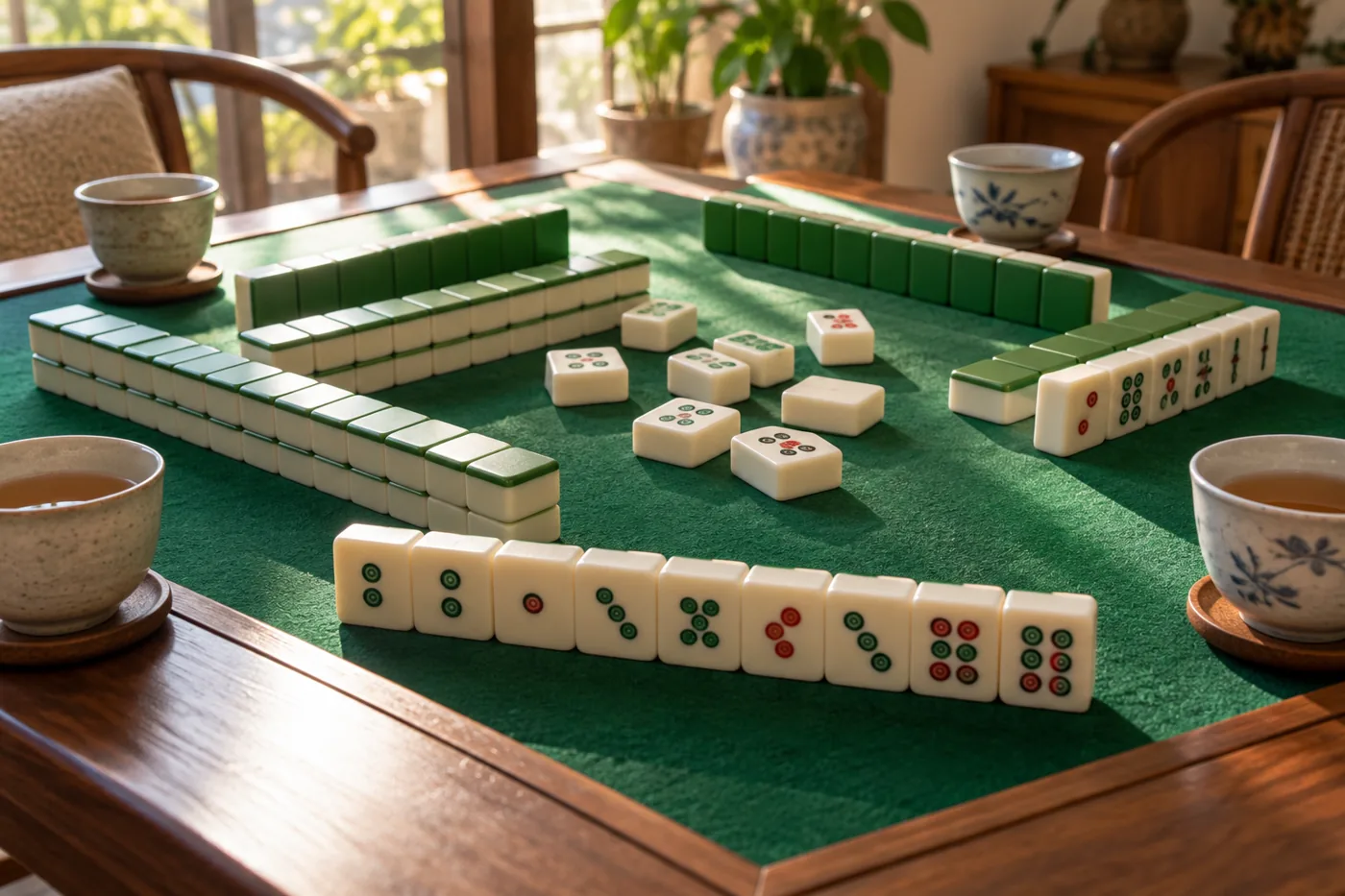
Generated interpretation, not documentary evidence. Invented contemporary mahjong-table interpretation with tiles and four cups.
Credit: AI-generated for Culture Ark using OpenAI image generation Reuse/status: Generated content; no exclusive ownership or underlying-work rights claimed Coherent cream-and-green tiles and social table setting; decorative tile marks and arrangement are not validated rules evidence. No authentic-reference or endorsement claim.
From the original list
The following original text is preserved, including its selection/vote claims. Preservation is not independent verification of every assertion.
Why: A tile game of skill and chance that is a social ritual across East Asia.
What to preserve: A full tile set, regional rules, scoring tables
Year and origin: c. 1850s · China
Vote: 9/9 (historian 3 · future kid 3 · curator 3)
Learn more: Mahjong on Wikipedia
Supplemental context
Mahjong combines tile combinations, chance, memory and negotiation around a shared table. The Strong’s oral-history finding aid documents its early-1920s popularity in Europe and the United States, Joseph Babcock’s 1923 simplified rules, and the National Mah Jongg League’s later role in maintaining American play. It distinguishes American score cards and joker tiles from other forms. A future archive therefore needs recorded conversation and named rule systems as well as attractive tiles: the social meaning of a game can travel while its scoring changes.
Creator/community: Chinese players and regional and diaspora playing communities Place/era: China; modern international traditions
Context and limits
The original approximate 1850s date is retained as archival wording, not independently established by this finding aid. Tile counts and scoring vary; a four-player tradition is not the same thing as computerized mahjong solitaire. The illustration is not a legal hand or complete tile inventory.
Where to learn more
- https://apiarybee.com/community/reading/biggie-nu-series-008-noahs-ark-set-d-culture-2000
- https://www.museumofplay.org/app/uploads/2022/05/Finding-Aid-to-the-Mahjong-oral-history-collection_060622.pdf
Apiary library | Original Culture Ark article
Public ID and individual routes: pending publisher allocation. Internal source ID: D-0431
Part of the Culture Ark: 2,000 things people should still be able to see in 2,000 years, picked by AI research teams. This page keeps the original list entry for D-0431 word for word and adds context. Browse the gallery. The Culture Ark is an Artificial Mind Hive (AMH) project. AMH is owned by Austin Little.

Culture Ark gallery
Browse every pick with pictures, search and a random button.
Open the gallery →