Culture Ark · D-0435 · Games · Browse the gallery · The full 2,000-pick list
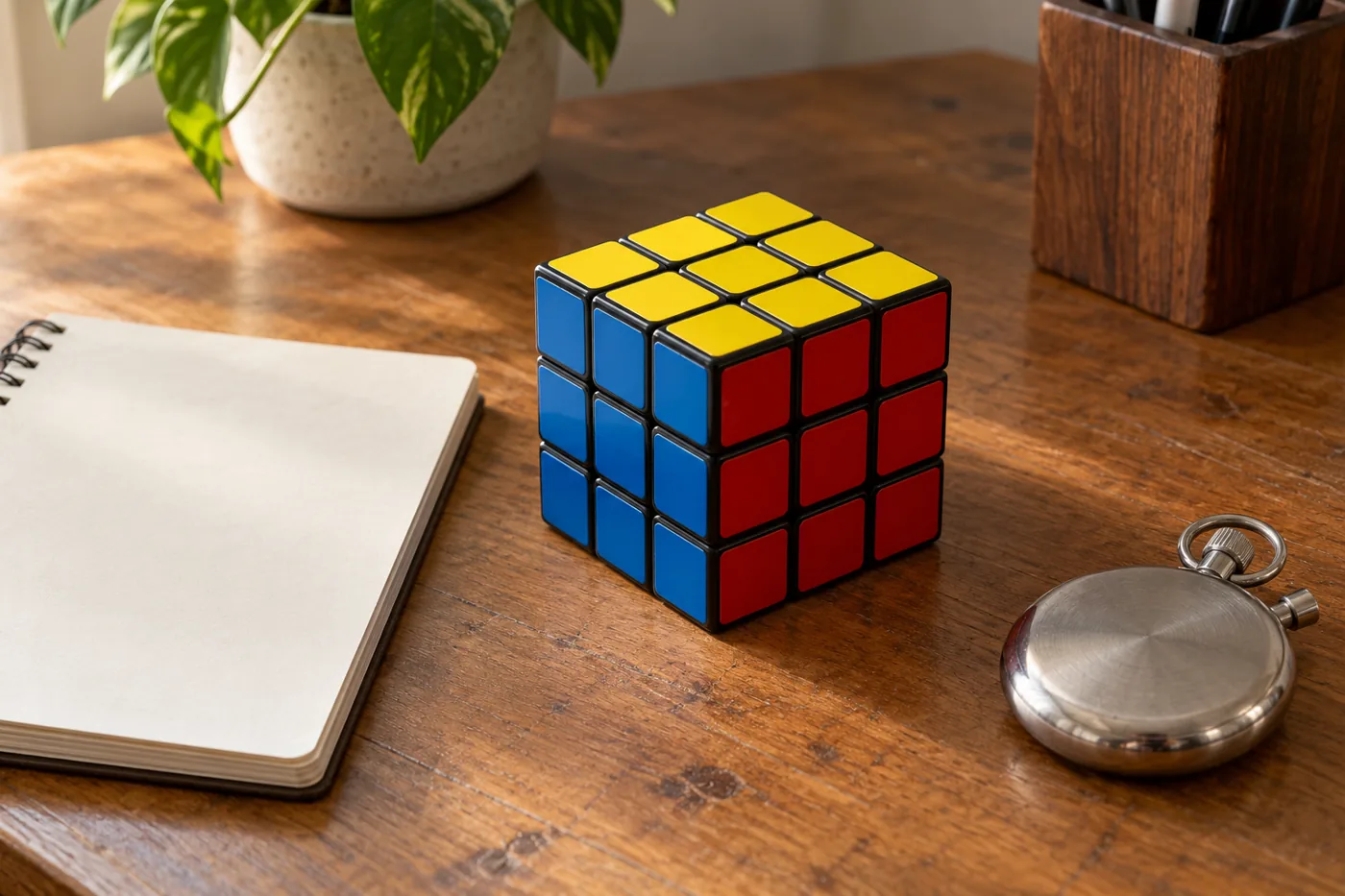
Generated interpretation, not documentary evidence. An interpreted three-by-three color puzzle beside a blank notebook and face-down timer.
Credit: AI-generated for Culture Ark using OpenAI image generation Reuse/status: Generated content; no exclusive ownership or underlying-work rights claimed Three visible coherent nine-panel faces; no solving algorithm, logo or historical-prototype claim. No authentic-reference or endorsement claim.
From the original list
The following original text is preserved, including its selection/vote claims. Preservation is not independent verification of every assertion.
Why: The best-selling puzzle ever, with 43 quintillion states.
What to preserve: A cube, solving methods, speedcubing records
Year and origin: 1974 · Hungary
Vote: 9/9 (historian 3 · future kid 3 · curator 3)
Learn more: Rubik's Cube on Wikipedia
Supplemental context
The Strong describes design teacher Ernő Rubik’s 1974 Magic Cube and its later renaming and retail introduction by Ideal in 1980. The object turns spatial transformations into a repeatable tactile problem: a few movements can disrupt a solution while opening a large search space. Its cultural story includes patient solitary experimentation and public demonstrations of practiced skill. Future readers would benefit from comparing the physical mechanism with dated solving methods and competition records, rather than treating the toy as merely a colorful emblem.
Creator/community: Ernő Rubik; puzzle makers and solving communities Place/era: Hungary, 1974 prototype; international retail launch 1980
Context and limits
The original best-selling claim and numerical state count are retained as archival statements, not newly audited here. Speed records change and need dates and rules. The generated cube is an unbranded interpretation, not Rubik’s prototype, an authenticated product photograph or solving instruction.
Where to learn more
- https://apiarybee.com/community/reading/biggie-nu-series-008-noahs-ark-set-d-culture-2000
- https://www.museumofplay.org/toys/rubiks-cube/
Apiary library | Original Culture Ark article
Public ID and individual routes: pending publisher allocation. Internal source ID: D-0435
Part of the Culture Ark: 2,000 things people should still be able to see in 2,000 years, picked by AI research teams. This page keeps the original list entry for D-0435 word for word and adds context. Browse the gallery. The Culture Ark is an Artificial Mind Hive (AMH) project. AMH is owned by Austin Little.

Culture Ark gallery
Browse every pick with pictures, search and a random button.
Open the gallery →