Culture Ark · D-0437 · Games · Browse the gallery · The full 2,000-pick list
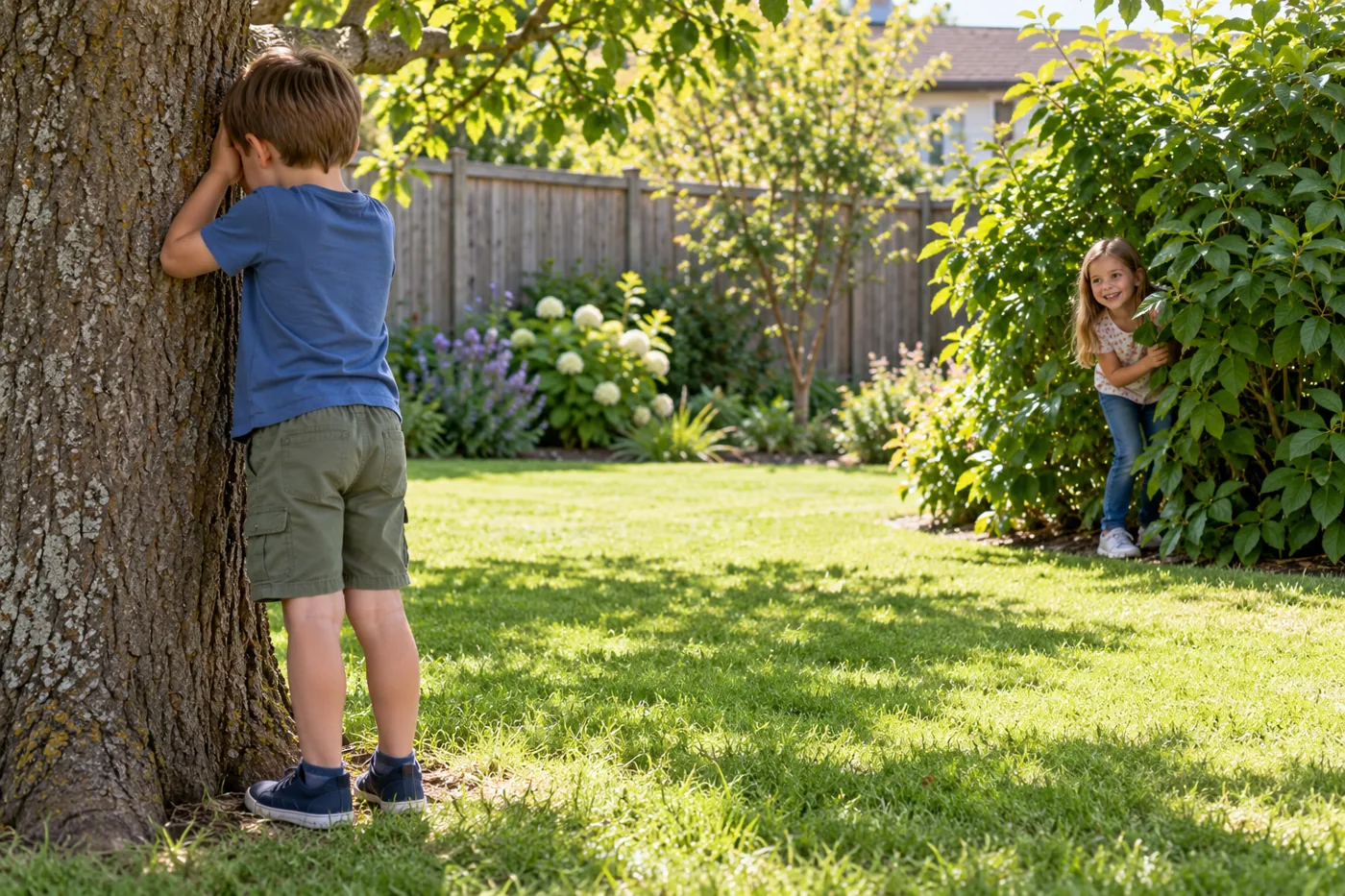
Generated interpretation, not documentary evidence. Invented garden hide-and-seek scene with a counting seeker and a child peeking from a shrub.
Credit: AI-generated for Culture Ark using OpenAI image generation Reuse/status: Generated content; no exclusive ownership or underlying-work rights claimed Two naturally posed fully clothed fictional children in a bounded garden; no documentary identity or specific community claim. No authentic-reference or endorsement claim.
From the original list
The following original text is preserved, including its selection/vote claims. Preservation is not independent verification of every assertion.
Why: Perhaps the most universal children's game.
What to preserve: Rules, regional names, counting rhymes
Year and origin: ancient · Worldwide
Vote: 9/9 (historian 3 · future kid 3 · curator 3)
Learn more: Hide-and-seek on Wikipedia
Supplemental context
Hide-and-seek depends on a shared agreement about visibility, waiting and discovery. Museums Victoria preserves Christine Brown’s 1954 account of names used by children in Brisbane, collected by folklorist Dorothy Howard. This local record is more informative than assuming one universal script. A modern Playworks version has a seeker count while others hide, then return found players to a starting point; its guide also documents a remote-play adaptation. Together these sources show how a seemingly simple game changes with place, language and circumstance.
Creator/community: Children and other local playing communities Place/era: Multiple regions and eras; Brisbane example recorded 1954
Context and limits
No single ancient origin or global popularity ranking is established by these sources. Counting, boundaries and who seeks next vary. Safe accessible hiding areas and an agreed ending signal matter. The museum’s archival image is all rights reserved and was not copied; the pictured children and garden are fictional.
Where to learn more
- https://apiarybee.com/community/reading/biggie-nu-series-008-noahs-ark-set-d-culture-2000
- https://collections.museumsvictoria.com.au/items/2104833
- https://www.playworks.org/wp-content/uploads/2020/06/National_Play-at-Home-Weekly-Challenge_6.15.-20.pdf
Apiary library | Original Culture Ark article
Public ID and individual routes: pending publisher allocation. Internal source ID: D-0437
Part of the Culture Ark: 2,000 things people should still be able to see in 2,000 years, picked by AI research teams. This page keeps the original list entry for D-0437 word for word and adds context. Browse the gallery. The Culture Ark is an Artificial Mind Hive (AMH) project. AMH is owned by Austin Little.

Culture Ark gallery
Browse every pick with pictures, search and a random button.
Open the gallery →