Culture Ark · D-0430 · Games · Browse the gallery · The full 2,000-pick list
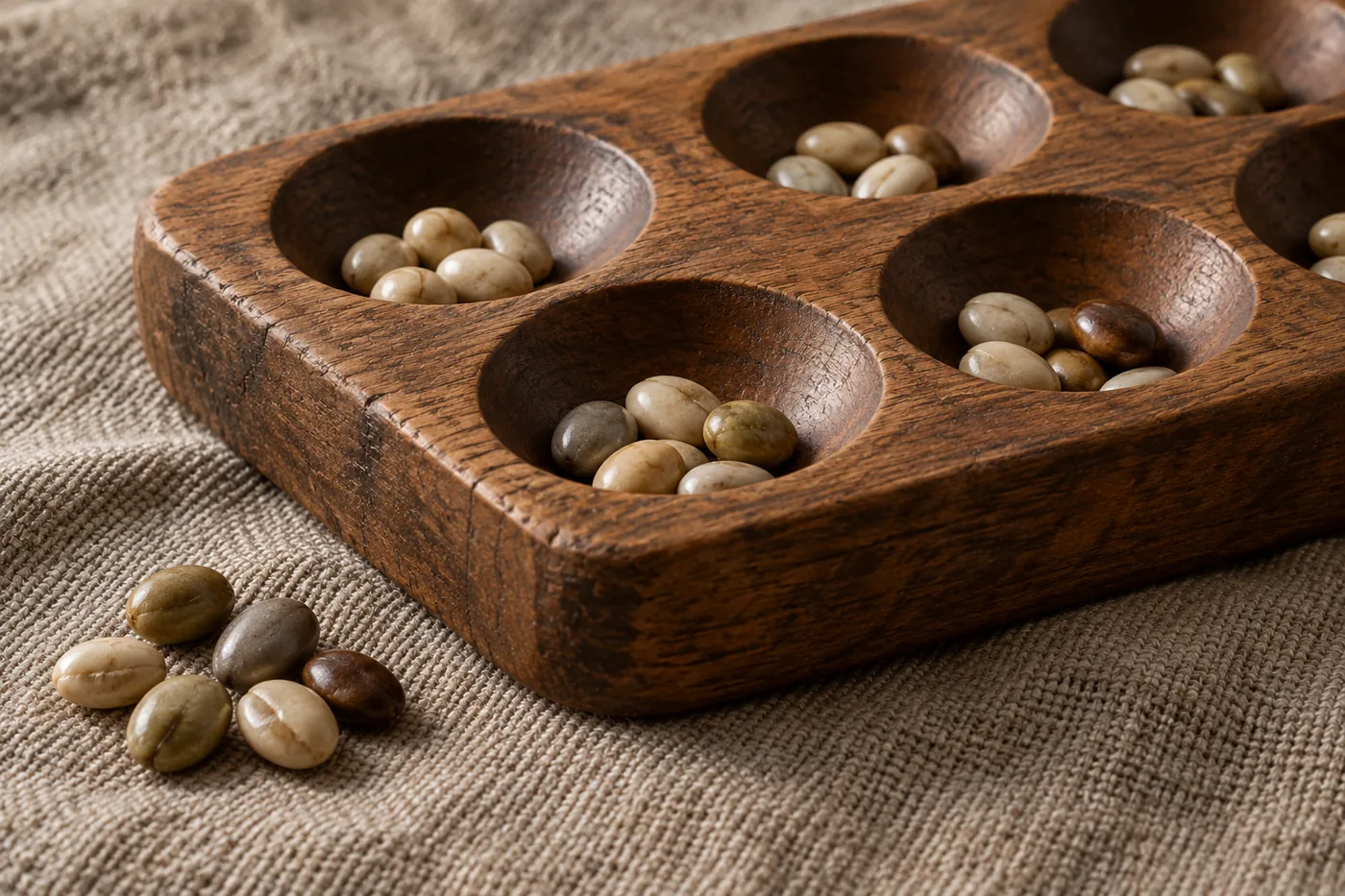
Generated interpretation, not documentary evidence. Generated cropped wooden pits and smooth counters; generic sowing-game context, not a named variant’s full board.
Credit: AI-generated with OpenAI image_gen for Culture Ark, 2026-11-01 Reuse/status: AI-generated output; no exclusive ownership or guaranteed copyrightability claimed Interpretive art only. Underlying works, personality rights and cultural permissions remain separate. No score, choreography or technical reconstruction is supplied.
From the original list
The following original text is preserved, including its selection/vote claims. Preservation is not independent verification of every assertion.
Why: A family of sowing games played with seeds and pits across Africa and Asia.
What to preserve: Boards, regional rule variants, carved and dug examples
Year and origin: c. 7th century · Africa
Vote: 9/9 (historian 3 · future kid 3 · curator 3)
Learn more: Mancala on Wikipedia
Supplemental context
Mancala names a family of games in which counters move through pits or holes. Specific variants differ, so a board alone cannot establish the rules. Future readers can learn from regional names, materials and teaching practices as well as from the mathematical possibilities of repeated sowing and capture.
Creator/community: Diverse communities of players and makers across Africa, Asia and elsewhere Place/era: Multiple regions and eras; a family of sowing games, not a single invention
Context and limits
The cropped board and counters are generic invented context, not a named community’s artifact or a complete rules diagram. The original single date and African origin label are preserved without endorsing one certain origin for the whole diverse family.
Where to learn more
- https://apiarybee.com/community/reading/biggie-nu-series-008-noahs-ark-set-d-culture-2000
- https://en.wikipedia.org/wiki/Mancala
Apiary library | Original Culture Ark article
Public ID and individual routes: pending publisher allocation. Internal source ID: D-0430
Part of the Culture Ark: 2,000 things people should still be able to see in 2,000 years, picked by AI research teams. This page keeps the original list entry for D-0430 word for word and adds context. Browse the gallery. The Culture Ark is an Artificial Mind Hive (AMH) project. AMH is owned by Austin Little.

Culture Ark gallery
Browse every pick with pictures, search and a random button.
Open the gallery →