Culture Ark · D-0428 · Games · Browse the gallery · The full 2,000-pick list
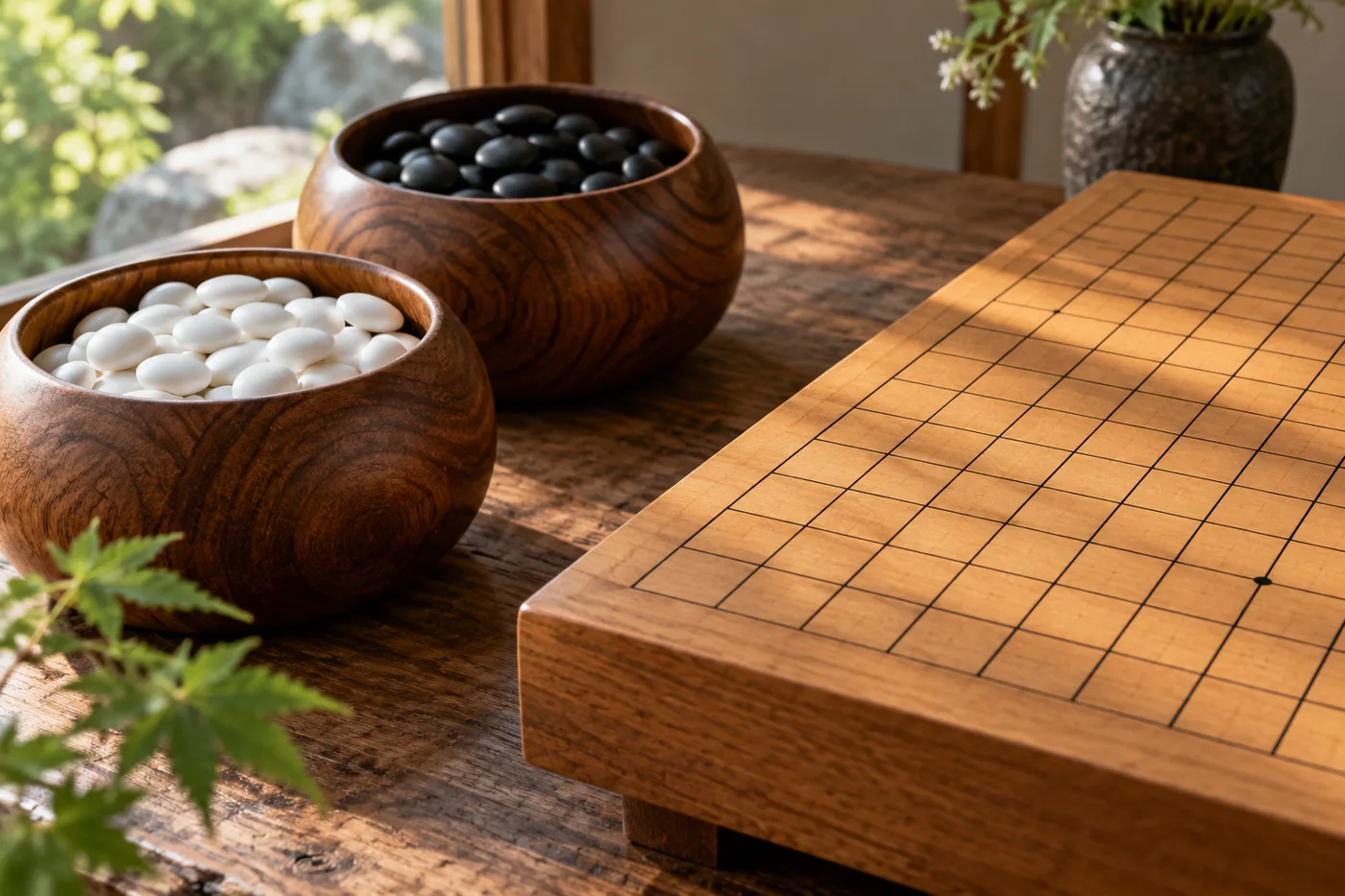
Generated interpretation, not documentary evidence. Two bowls of Go stones beside an empty cropped grid; original study context, not a game record.
Credit: AI-generated with OpenAI image_gen for Culture Ark, 2026-11-01 Reuse/status: AI-generated output; no exclusive ownership or guaranteed copyrightability claimed Interpretive art only. Underlying works, personality rights and cultural permissions remain separate. No score, choreography or technical reconstruction is supplied.
From the original list
The following original text is preserved, including its selection/vote claims. Preservation is not independent verification of every assertion.
Why: A game of simple rules and near-infinite depth, played for over two millennia.
What to preserve: Rules, a board and stones, famous historic games, ranking system
Year and origin: c. 4th century BC · China
Vote: 9/9 (historian 3 · future kid 3 · curator 3)
Learn more: Go (game) on Wikipedia
Supplemental context
Go, called weiqi in Chinese, combines stones and a grid with decisions about territory and influence. Early written references are evidence of its history, not a precise invention date. Future readers can preserve actual rules and recorded games alongside accounts of learning, competition and social play.
Creator/community: Generations of players, teachers and Go communities Place/era: Originating in China; longstanding East Asian and international play
Context and limits
The empty cropped grid and stone bowls are contemporary invented context, not an ancient board or a famous match. Different rulesets and scoring conventions should be named when teaching play. The image does not supply a complete board or instructional position.
Where to learn more
- https://apiarybee.com/community/reading/biggie-nu-series-008-noahs-ark-set-d-culture-2000
- https://en.wikipedia.org/wiki/Go_(game)
Apiary library | Original Culture Ark article
Public ID and individual routes: pending publisher allocation. Internal source ID: D-0428
Part of the Culture Ark: 2,000 things people should still be able to see in 2,000 years, picked by AI research teams. This page keeps the original list entry for D-0428 word for word and adds context. Browse the gallery. The Culture Ark is an Artificial Mind Hive (AMH) project. AMH is owned by Austin Little.

Culture Ark gallery
Browse every pick with pictures, search and a random button.
Open the gallery →