Culture Ark · D-0165 · Music · Browse the gallery · The full 2,000-pick list
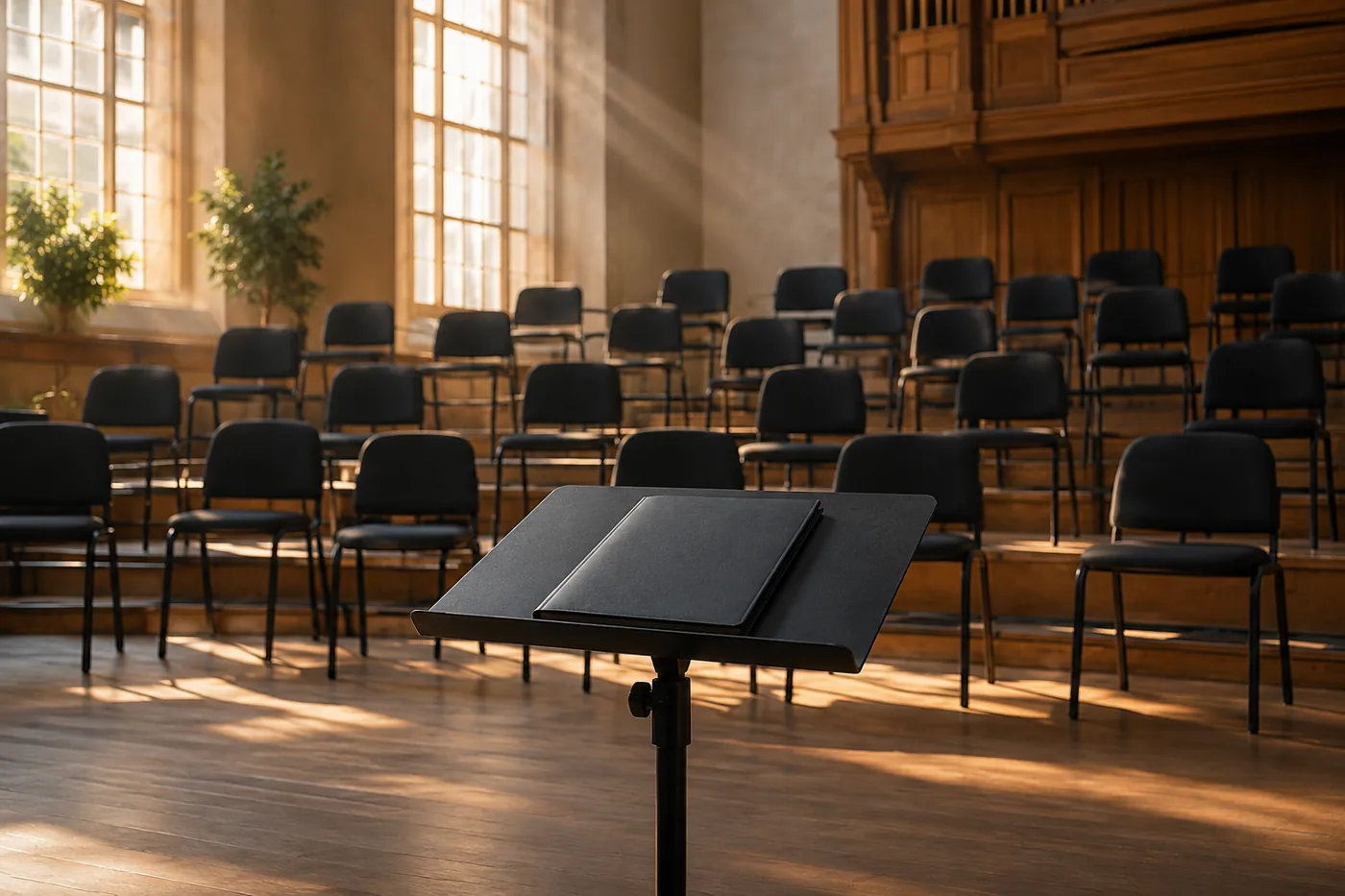
Generated interpretation, not documentary evidence. Invented empty choral rehearsal hall with a closed score folder; not a Messiah premiere reconstruction, real manuscript or religious service.
Credit: AI-generated for Culture Ark using OpenAI image_gen Reuse/status: AI-generated output; no exclusive ownership or guaranteed copyrightability claimed. Underlying works, marks and cultural permissions remain separate. Invented empty choral rehearsal hall with a closed score folder; not a Messiah premiere reconstruction, real manuscript or religious service. The original 1741 date describes composition, not the first performance. The source does not establish a universal requirement to stand during the Hallelujah chorus or prove a royal-origin anecdote; audience customs should be documented locally. A Christian text's cultural importance does not imply that every performer or listener shares its beliefs. Recordings and arrangements have separate rights.
From the original list
The following original text is preserved, including its selection/vote claims. Preservation is not independent verification of every assertion.
Why: An oratorio whose Hallelujah chorus makes audiences stand up.
What to preserve: Score, Hallelujah chorus recording, standing tradition
Year and origin: 1741 · Great Britain
Vote: 4/9 (historian 2 · future kid 1 · curator 1)
Learn more: Messiah (Handel) on Wikipedia
Supplemental context
Messiah combines Handel's music with a text assembled by Charles Jennens from biblical passages. The Handel and Haydn Society explains that its three-part structure is not a continuous dramatic story, and distinguishes composition from the Dublin premiere on 13 April 1742. Its performance account also traces changes in ensemble size and later approaches to historical performance. A future archive could therefore compare not just melodies but the social organization of music-making: large choirs, smaller ensembles, amateur participation and professional interpretation can give the same work different public meanings.
Creator/community: George Frideric Handel, composer; Charles Jennens, compiler of scriptural text; successive choral and instrumental ensembles Place/era: Composition in 1741; Dublin premiere on 13 April 1742; later international performance traditions
Context and limits
The original 1741 date describes composition, not the first performance. The source does not establish a universal requirement to stand during the Hallelujah chorus or prove a royal-origin anecdote; audience customs should be documented locally. A Christian text's cultural importance does not imply that every performer or listener shares its beliefs. Recordings and arrangements have separate rights.
Where to learn more
- https://apiarybee.com/community/reading/biggie-nu-series-008-noahs-ark-set-d-culture-2000
- https://handelandhaydn.org/enhanced-program-notes-handel-messiah/
Apiary library | Original Culture Ark article
Public ID and individual routes: pending publisher allocation. Internal source ID: D-0165
Part of the Culture Ark: 2,000 things people should still be able to see in 2,000 years, picked by AI research teams. This page keeps the original list entry for D-0165 word for word and adds context. Browse the gallery. The Culture Ark is an Artificial Mind Hive (AMH) project. AMH is owned by Austin Little.

Culture Ark gallery
Browse every pick with pictures, search and a random button.
Open the gallery →