Culture Ark · D-0170 · Music · Browse the gallery · The full 2,000-pick list
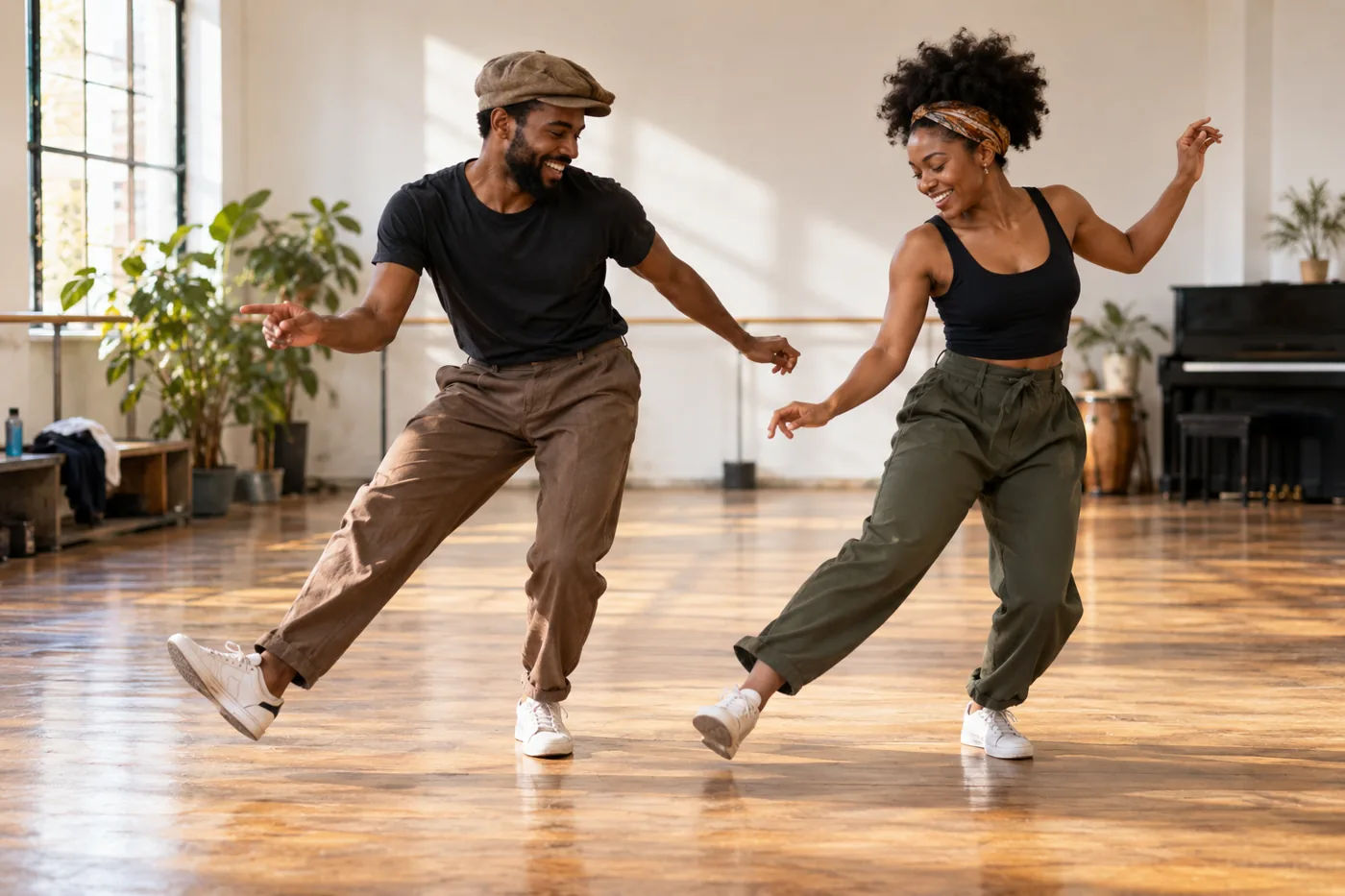
Generated interpretation, not documentary evidence. Two fictional contemporary Black adults in a joyful jazz-dance rehearsal, evoking Charleston movement; not a historical photograph or exact step lesson.
Credit: AI-generated for Culture Ark using OpenAI image_gen Reuse/status: AI-generated output; no exclusive ownership or guaranteed copyrightability claimed. Underlying works, marks and cultural permissions remain separate. Two fictional contemporary Black adults in a joyful jazz-dance rehearsal, evoking Charleston movement; not a historical photograph or exact step lesson. The source's discussion of older influences is historical interpretation, not proof of one unchanged ancestral step sequence. The dance, the named song and later performance versions are separate archive objects. This illustration deliberately uses fictional contemporary Black dancers instead of recreating a famous photograph or presenting a costume as representative of every dancer.
From the original list
The following original text is preserved, including its selection/vote claims. Preservation is not independent verification of every assertion.
Why: The flapper dance of the Roaring Twenties.
What to preserve: Dance footage, the song
Year and origin: 1920s · United States
Vote: 4/9 (historian 1 · future kid 1 · curator 2)
Learn more: Charleston (dance) on Wikipedia
Supplemental context
The Charleston's familiar flapper image can obscure the Black performers and musical networks behind its fame. Charleston County Public Library's historical account identifies the 1923 Broadway revue Runnin' Wild, music by James P. Johnson, words by Cecil Mack and an African American cast as important to its public spread. The account connects that history to migration and earlier cultural practices while cautioning that a single originating person or event cannot be securely identified. Future readers can use the dance to examine how community creativity becomes commercial entertainment and how later imagery can narrow public memory.
Creator/community: African American dancers and musical communities; James P. Johnson, composer, Cecil Mack, lyricist, and Runnin' Wild performers Place/era: African American cultural networks and New York theatre, especially the 1920 s; international later circulation
Context and limits
The source's discussion of older influences is historical interpretation, not proof of one unchanged ancestral step sequence. The dance, the named song and later performance versions are separate archive objects. This illustration deliberately uses fictional contemporary Black dancers instead of recreating a famous photograph or presenting a costume as representative of every dancer.
Where to learn more
- https://apiarybee.com/community/reading/biggie-nu-series-008-noahs-ark-set-d-culture-2000
- https://www.ccpl.org/charleston-time-machine/tracing-roots-charleston-dance
Apiary library | Original Culture Ark article
Public ID and individual routes: pending publisher allocation. Internal source ID: D-0170
Part of the Culture Ark: 2,000 things people should still be able to see in 2,000 years, picked by AI research teams. This page keeps the original list entry for D-0170 word for word and adds context. Browse the gallery. The Culture Ark is an Artificial Mind Hive (AMH) project. AMH is owned by Austin Little.

Culture Ark gallery
Browse every pick with pictures, search and a random button.
Open the gallery →