Culture Ark · D-0169 · Music · Browse the gallery · The full 2,000-pick list
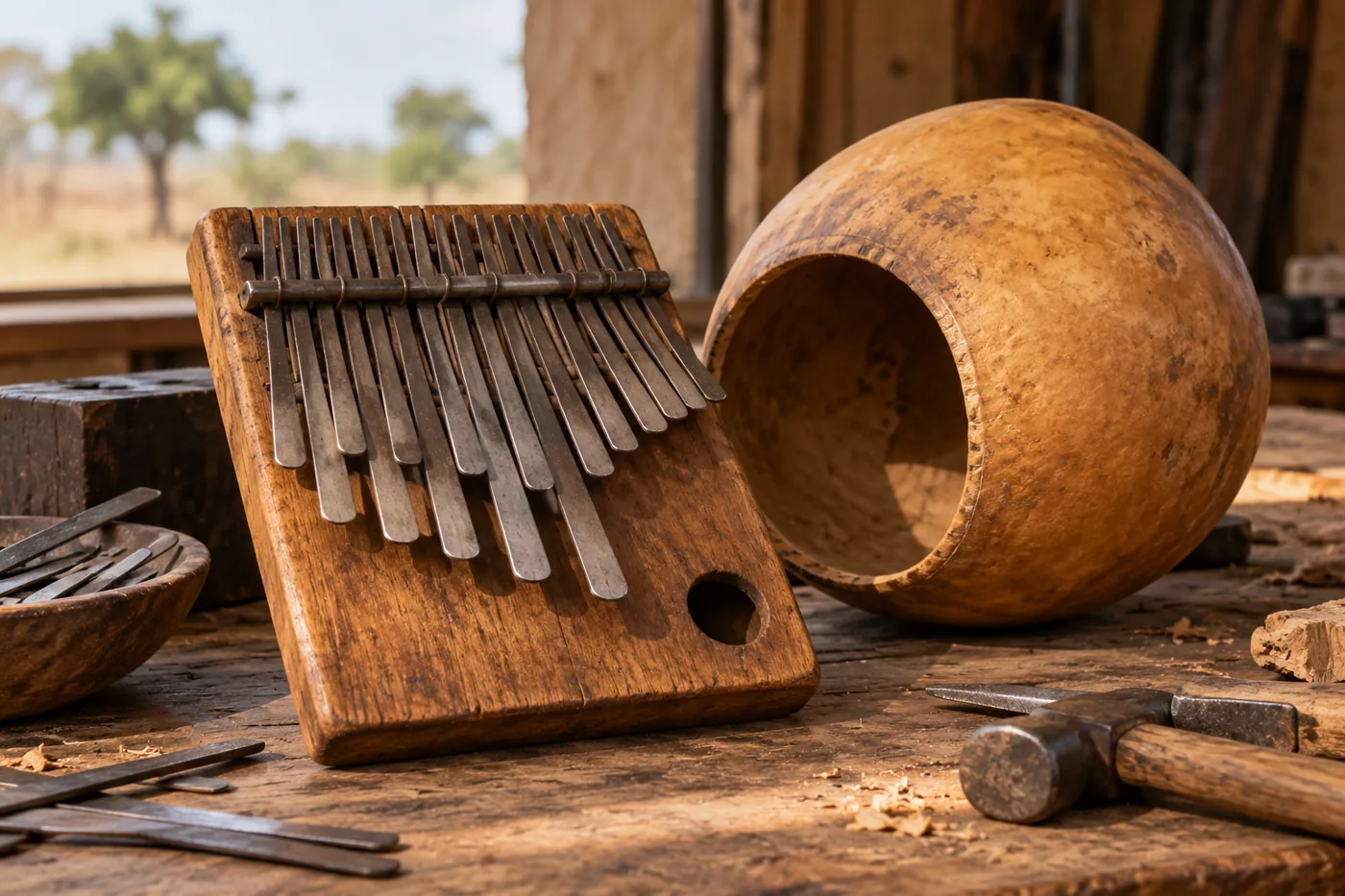
Generated interpretation, not documentary evidence. Imagined plucked-metal-key instrument and separate gourd resonator on a workbench; approximate contextual illustration, not a named Shona instrument or technical model.
Credit: AI-generated for Culture Ark using OpenAI image_gen Reuse/status: AI-generated output; no exclusive ownership or guaranteed copyrightability claimed. Underlying works, marks and cultural permissions remain separate. Imagined plucked-metal-key instrument and separate gourd resonator on a workbench; approximate contextual illustration, not a named Shona instrument or technical model. The museum article is a broad overview and its illustrated Zambian object is not a universal Shona mbira model. 'Thumb piano' is a convenient analogy, not identity with a keyboard piano. Spiritual claims describe practitioners' beliefs rather than an independently verified supernatural mechanism. No private ceremony is recreated, and the generated tine layout is not a tuning or construction guide.
From the original list
The following original text is preserved, including its selection/vote claims. Preservation is not independent verification of every assertion.
Why: A thumb piano used to contact ancestors in Shona ceremonies.
What to preserve: An instrument, recordings
Year and origin: Ancient · Zimbabwe
Vote: 4/9 (historian 1 · future kid 1 · curator 2)
Learn more: Mbira on Wikipedia
Supplemental context
Mbira joins material craft, patterned playing and social meaning. The Australian Museum describes metal keys attached to a wooden resonating structure and discusses ceremonial as well as later musical uses. Its collection also illustrates related instruments from several communities, which is a reason to preserve local names rather than calling every plucked-key instrument identical. A future archive should keep instrument form, named repertoire, player testimony and the circumstances of performance together. An object alone cannot explain the relationships that make music meaningful, particularly where ancestral remembrance and spiritual practice are involved.
Creator/community: Shona mbira practitioners and makers, alongside distinct related lamellophone communities across Africa Place/era: Zimbabwe and regional living traditions; diverse related instruments and contemporary adaptations
Context and limits
The museum article is a broad overview and its illustrated Zambian object is not a universal Shona mbira model. 'Thumb piano' is a convenient analogy, not identity with a keyboard piano. Spiritual claims describe practitioners' beliefs rather than an independently verified supernatural mechanism. No private ceremony is recreated, and the generated tine layout is not a tuning or construction guide.
Where to learn more
- https://apiarybee.com/community/reading/biggie-nu-series-008-noahs-ark-set-d-culture-2000
- https://australian.museum/learn/cultures/international-collection/african/mbira-thumb-piano-of-africa/
Apiary library | Original Culture Ark article
Public ID and individual routes: pending publisher allocation. Internal source ID: D-0169
Part of the Culture Ark: 2,000 things people should still be able to see in 2,000 years, picked by AI research teams. This page keeps the original list entry for D-0169 word for word and adds context. Browse the gallery. The Culture Ark is an Artificial Mind Hive (AMH) project. AMH is owned by Austin Little.

Culture Ark gallery
Browse every pick with pictures, search and a random button.
Open the gallery →