Culture Ark · D-0164 · Music · Browse the gallery · The full 2,000-pick list
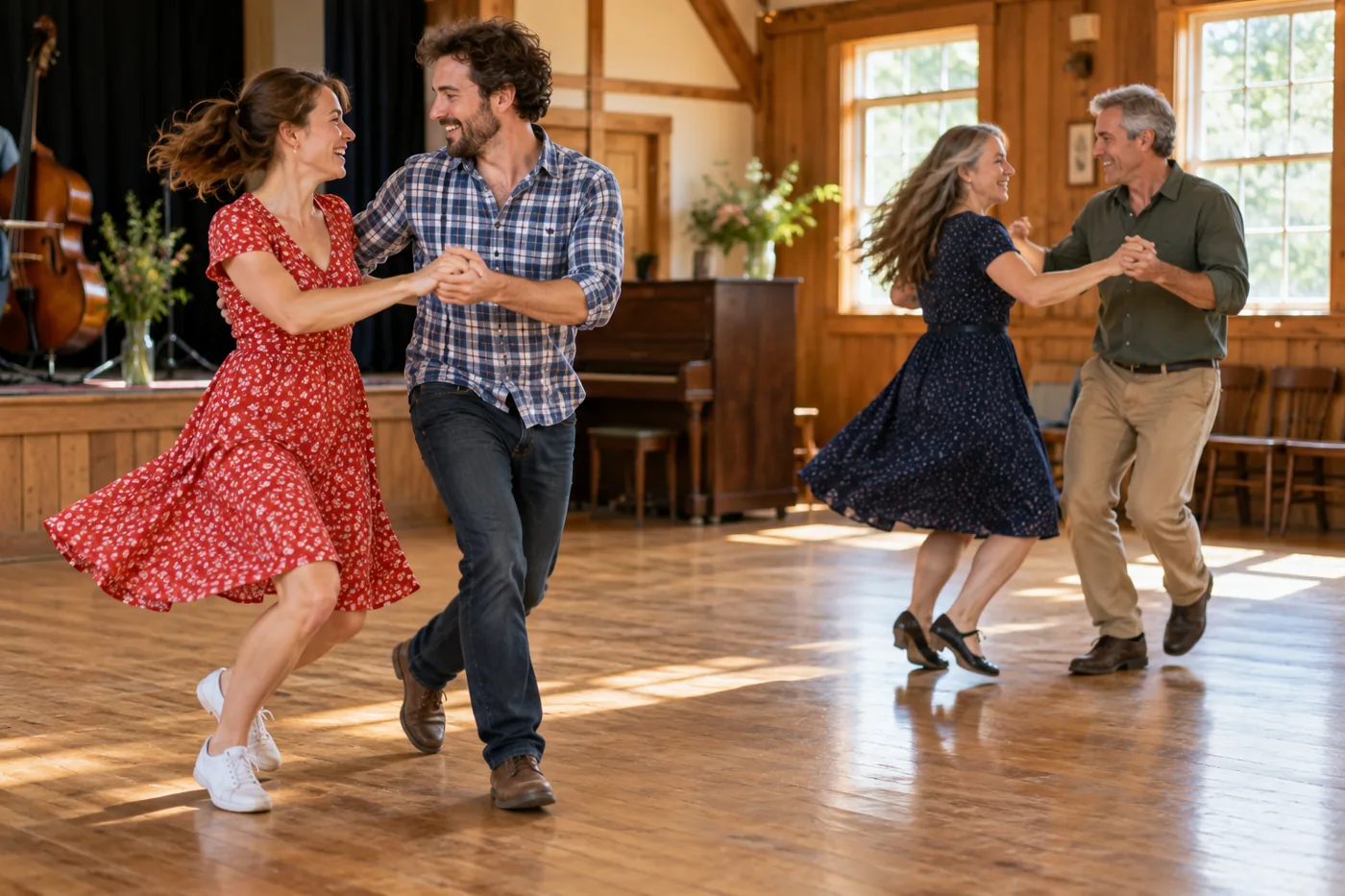
Generated interpretation, not documentary evidence. Two fictional contemporary couples dancing in a modest community hall; interpretive social-dance atmosphere, not a historical polka performance or step diagram.
Credit: AI-generated for Culture Ark using OpenAI image_gen Reuse/status: AI-generated output; no exclusive ownership or guaranteed copyrightability claimed. Underlying works, marks and cultural permissions remain separate. Two fictional contemporary couples dancing in a modest community hall; interpretive social-dance atmosphere, not a historical polka performance or step diagram. The Commission's short educational sheet reports competing origin stories; it does not settle a single inventor claim. The original 'Czech Republic' label is modern geographic shorthand for historical Bohemia. Texan examples are not the entire international history, and the invented contemporary dancers demonstrate atmosphere rather than authoritative steps or national costume.
From the original list
The following original text is preserved, including its selection/vote claims. Preservation is not independent verification of every assertion.
Why: A bouncy couples' dance that swept 19th-century Europe and immigrant America.
What to preserve: Dance steps, recordings
Year and origin: 1830s · Czech Republic (Bohemia)
Vote: 4/9 (historian 1 · future kid 1 · curator 2)
Learn more: Polka on Wikipedia
Supplemental context
Polka shows how a dance and its music can become locally meaningful after travelling. The Texas Historical Commission describes European migrants bringing different polka traditions to Texas in the mid-nineteenth century, contrasting accordion-led German and Czech examples with fiddle-led Polish ones. It also identifies voluntary associations as important preservers of the music. This invites future readers to look beyond a single national label: instruments, community organizations and places for social dancing all help carry a form forward. A dance archive should retain local names and versions rather than flattening them into one universal routine.
Creator/community: Polka musicians and social dancers across European and migrant communities; German, Czech and Polish Texan examples in the cited source Place/era: Nineteenth-century European circulation and mid-nineteenth-century migration to Texas; continuing dance-hall practice
Context and limits
The Commission's short educational sheet reports competing origin stories; it does not settle a single inventor claim. The original 'Czech Republic' label is modern geographic shorthand for historical Bohemia. Texan examples are not the entire international history, and the invented contemporary dancers demonstrate atmosphere rather than authoritative steps or national costume.
Where to learn more
- https://apiarybee.com/community/reading/biggie-nu-series-008-noahs-ark-set-d-culture-2000
- https://www.thc.texas.gov/public/upload/publications/Education/hah/pq_HatH_German_Heritage_polka_09_20.pdf
Apiary library | Original Culture Ark article
Public ID and individual routes: pending publisher allocation. Internal source ID: D-0164
Part of the Culture Ark: 2,000 things people should still be able to see in 2,000 years, picked by AI research teams. This page keeps the original list entry for D-0164 word for word and adds context. Browse the gallery. The Culture Ark is an Artificial Mind Hive (AMH) project. AMH is owned by Austin Little.

Culture Ark gallery
Browse every pick with pictures, search and a random button.
Open the gallery →