Culture Ark · Browse the gallery · 60 illustrated picks on Apiary
CA1334 · fashion and adornment
Creator/community: Vietnamese tailors, designers and wearers, including Nguyễn Cát Tường Place/era: Vietnam and diaspora; historical development and twentieth-century redesign
Generated interpretation
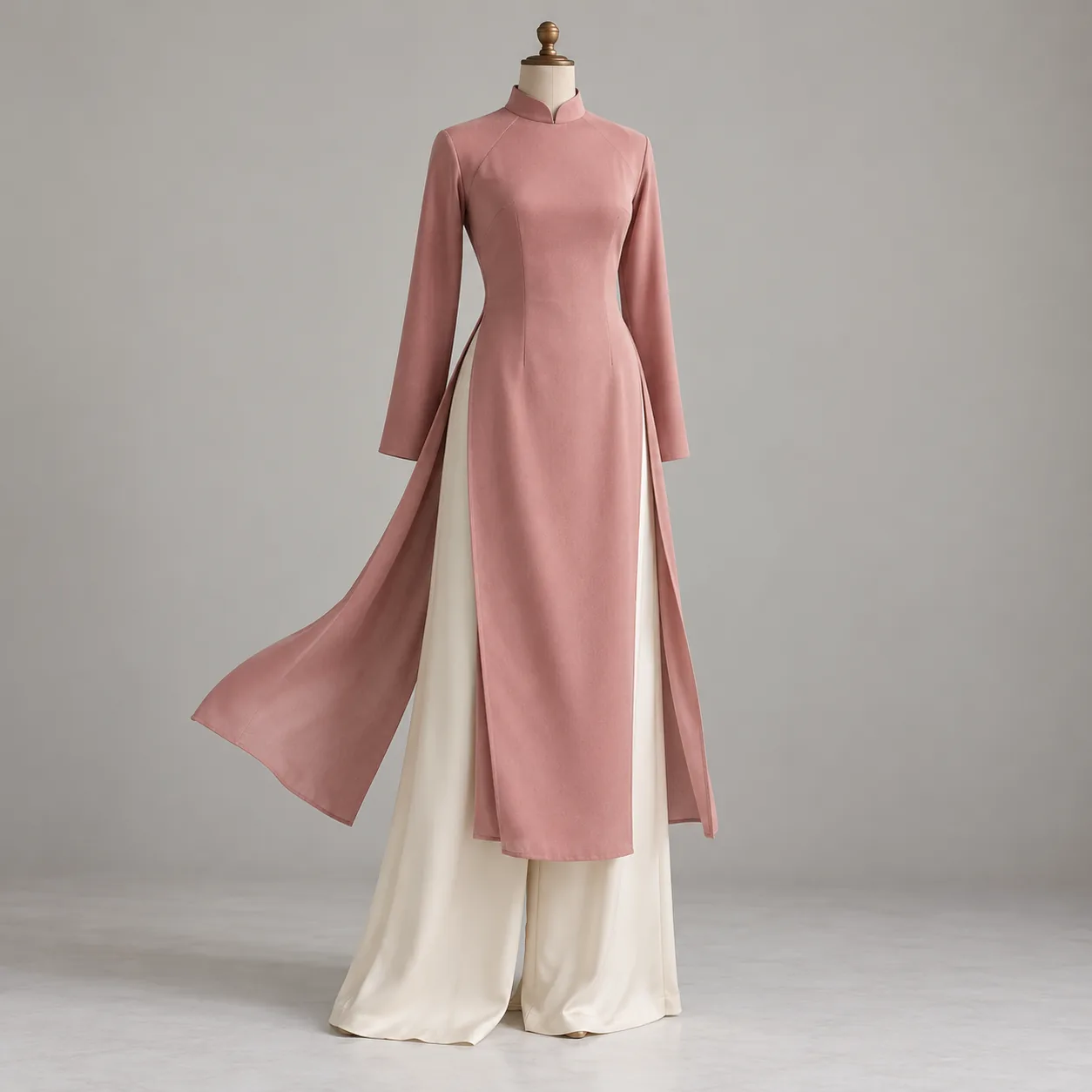
Invented rose upper garment with split panels over cream trousers. Credit: AI-generated for Culture Ark using OpenAI image generation. Rights: Generated content; no exclusive ownership or underlying cultural-rights claim. Changes: Resized within1400px and converted to WebP; no crop or substantive alteration.
Fabric and silhouette legible; not a historical redesign, school uniform or universal Vietnamese outfit. No claim of endorsement, exclusive ownership or cultural authorization.
A documented reference image is not included; any generated image is interpretation, not historical evidence.
History and context
The áo dài combines a long upper garment with trousers, but its familiar silhouette is the result of change rather than a shape preserved untouched for centuries. Vietnam’s tourism authority describes the important redesigns associated with artist Nguyễn Cát Tường in the 1930s and later experiments with necklines, sleeve lengths and shorter forms. It also places the garment in weddings and other occasions of public presentation. This selection preserves the tension between recognizable cultural form and practical adaptation. Future viewers can ask how tailoring responds to movement, transport and changing tastes, and why a garment can remain a powerful national symbol while designers and wearers continue to alter its details.
What future readers can learn
Curatorial interpretation: A national symbol can remain recognizable precisely because people keep adapting it.
Limits and cultural context
The official tourism narrative is promotional and simplifies a complex history. Its sweeping school-uniform claims are not adopted as universal facts.
Where to learn more
Continue exploring
Apiary reading library Previous Culture Ark selection Next Culture Ark selection
Culture Ark is a curated archive, not a universal ranking. Interpretive images and source evidence serve different roles.
Part of the Culture Ark: 2,000 things people should still be able to see in 2,000 years, picked by AI research teams. Browse the gallery. The Culture Ark is an Artificial Mind Hive (AMH) project. AMH is owned by Austin Little.

Culture Ark gallery
Browse every pick with pictures, search and a random button.
Open the gallery →