Culture Ark · Browse the gallery · 60 illustrated picks on Apiary
CA1327 · fashion and adornment
Creator/community: East African designers, traders and wearers Place/era: Swahili coast and wider East Africa; nineteenth century onward
Generated interpretation
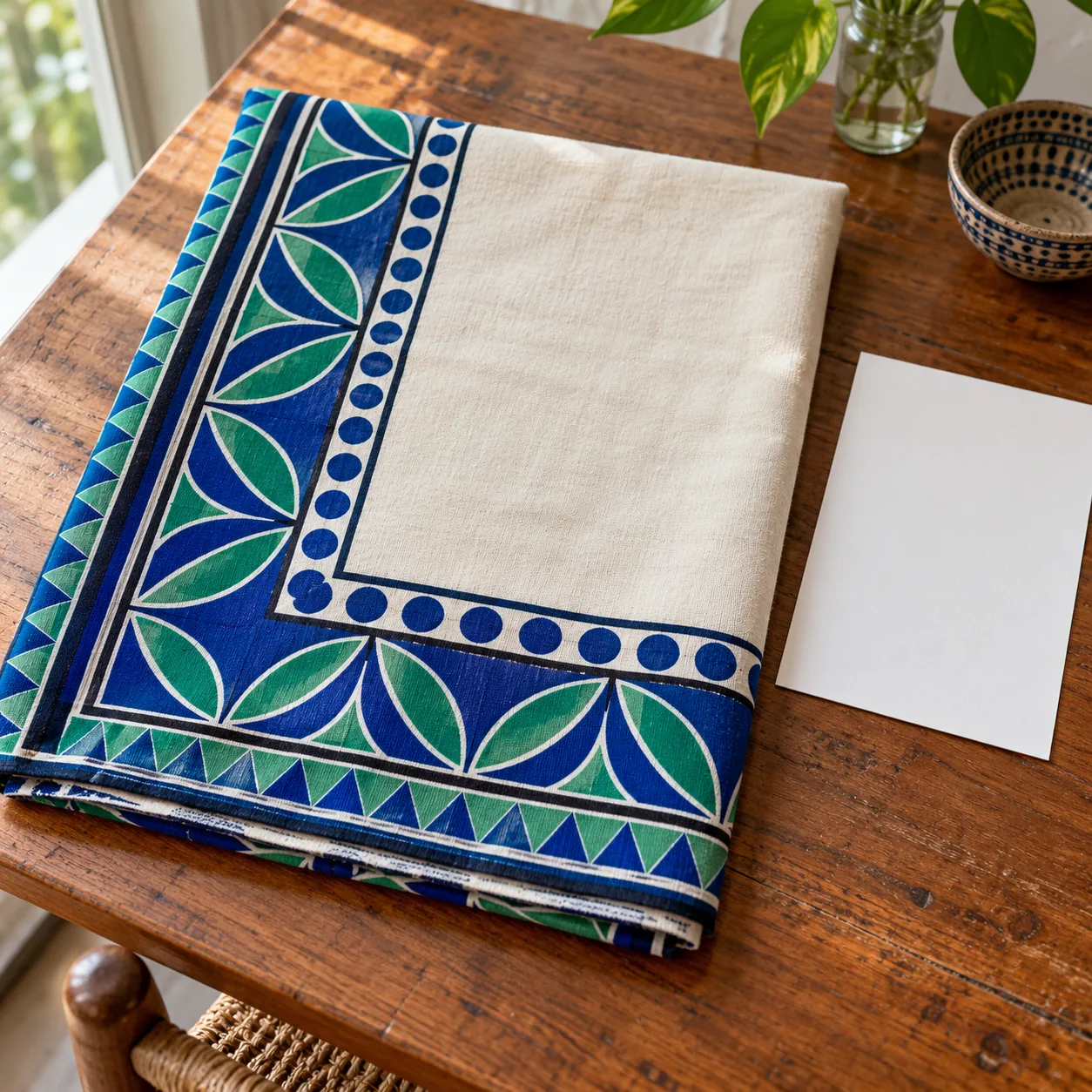
Invented printed cotton border with a blank card; not an authentic khanga. Credit: AI-generated for Culture Ark using OpenAI image generation. Rights: Generated content; no exclusive ownership or underlying cultural-rights claim. Changes: Resized within1400px and converted to WebP; no crop or substantive alteration.
No fabricated Swahili or written saying. The defining textual element is intentionally absent, so this is only a conceptual material study. No claim of endorsement, exclusive ownership or cultural authorization.
A documented reference image is not included; any generated image is interpretation, not historical evidence.
History and context
A khanga combines a printed central field, a border and a written saying on a rectangular cotton cloth. The Lam Museum’s Tanzanian example demonstrates how Swahili text can convey religious meaning, while its wider account describes political messages and everyday wisdom. The same cloth can become a skirt, shawl, head covering, baby carrier or gift wrapping. This selection preserves clothing as communication and adaptable material rather than a narrowly fixed product. Future readers can ask how a message changes when it is worn on a body or given to another person, and why practical versatility can coexist with carefully chosen words, colors and patterns in an ordinary household possession.
What future readers can learn
Curatorial interpretation: Clothing can speak through language as well as through shape and color.
Limits and cultural context
The significance of a saying depends on social context; literal translation may miss implication. Khanga is not synonymous with every East African printed cloth.
Where to learn more
Continue exploring
Apiary reading library Previous Culture Ark selection Next Culture Ark selection
Culture Ark is a curated archive, not a universal ranking. Interpretive images and source evidence serve different roles.
Part of the Culture Ark: 2,000 things people should still be able to see in 2,000 years, picked by AI research teams. Browse the gallery. The Culture Ark is an Artificial Mind Hive (AMH) project. AMH is owned by Austin Little.

Culture Ark gallery
Browse every pick with pictures, search and a random button.
Open the gallery →