Culture Ark · Browse the gallery · 60 illustrated picks on Apiary
CA0817 · food and drink
Creator/community: Akan household cooks and Ghanaian food vendors Place/era: Ghana, especially Ashanti Region; living foodway documented 2018 and 2025
Generated interpretation
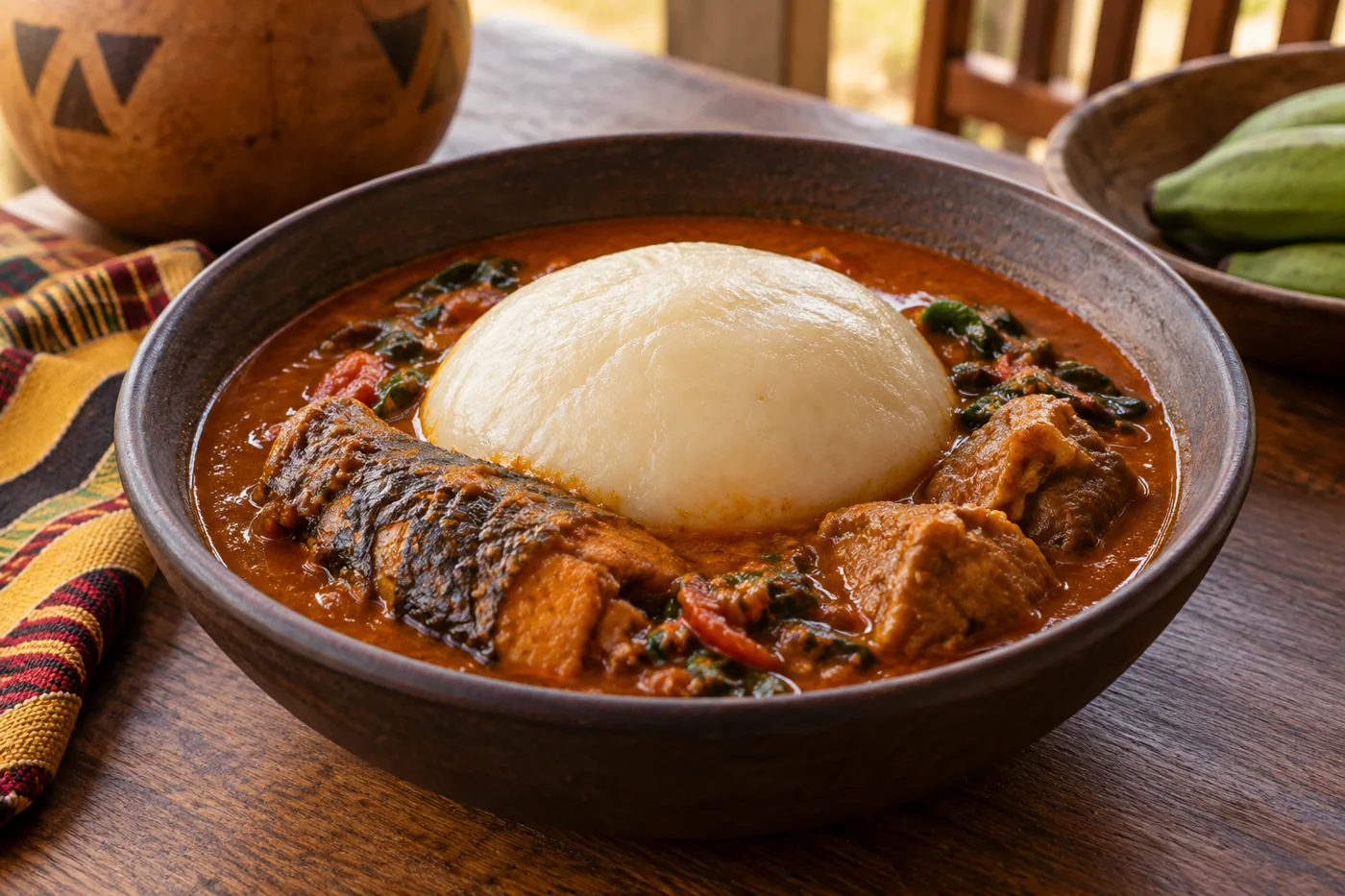
AI-created fufu-and-soup bowl. Soup colour, visible additions and staple mixture are invented possibilities, not a mandatory Akan formula or identification of all ingredients. Credit: AI-generated for Culture Ark using OpenAI image_gen. Rights: AI-generated output; no exclusive ownership or guaranteed copyrightability claimed. Changes: Resized within1400px and converted to WebP; no crop or substantive alteration.
Interpretive food illustration, not documentary evidence, a standardized recipe, exact ingredients or proportions, food-safety guidance, production instructions or a universal national version.
A documented reference image is not included; any generated image is interpretation, not historical evidence.
History and context
A Ghana Tourism Authority brochure describes fufu associated with Akan cooking as smooth portions of pounded plantain combined with ingredients such as cassava, yam or cocoyam, served surrounded by soup. Light soup, groundnut soup and other preparations make the same staple part of different meals. The National Commission on Culture also documents fufu with abunuabunu among foods prepared at a public cultural event. These accounts make the pairing important: a photograph of a pale mound alone would omit much of the eating experience. Future readers should preserve the labour of pounding, the names of accompanying soups and the judgement of individual cooks, rather than treating all West African pounded foods as interchangeable.
What future readers can learn
Texture and the relationship between staple and accompaniment can carry cultural specificity that ingredient names alone miss.
Limits and cultural context
Focus is a documented Ghanaian/Akan example; fufu traditions extend beyond Ghana and vary in ingredients and methods.
Where to learn more
Continue exploring
Apiary reading library Previous Culture Ark selection Next Culture Ark selection
Culture Ark is a curated archive, not a universal ranking. Interpretive images and source evidence serve different roles.
Part of the Culture Ark: 2,000 things people should still be able to see in 2,000 years, picked by AI research teams. Browse the gallery. The Culture Ark is an Artificial Mind Hive (AMH) project. AMH is owned by Austin Little.

Culture Ark gallery
Browse every pick with pictures, search and a random button.
Open the gallery →