Culture Ark · Browse the gallery · 60 illustrated picks on Apiary
CA0078 · music
Creator/community: Iranian classical musicians and master-disciple lineages Place/era: Iran; historical repertoire continuing in performance
Generated interpretation
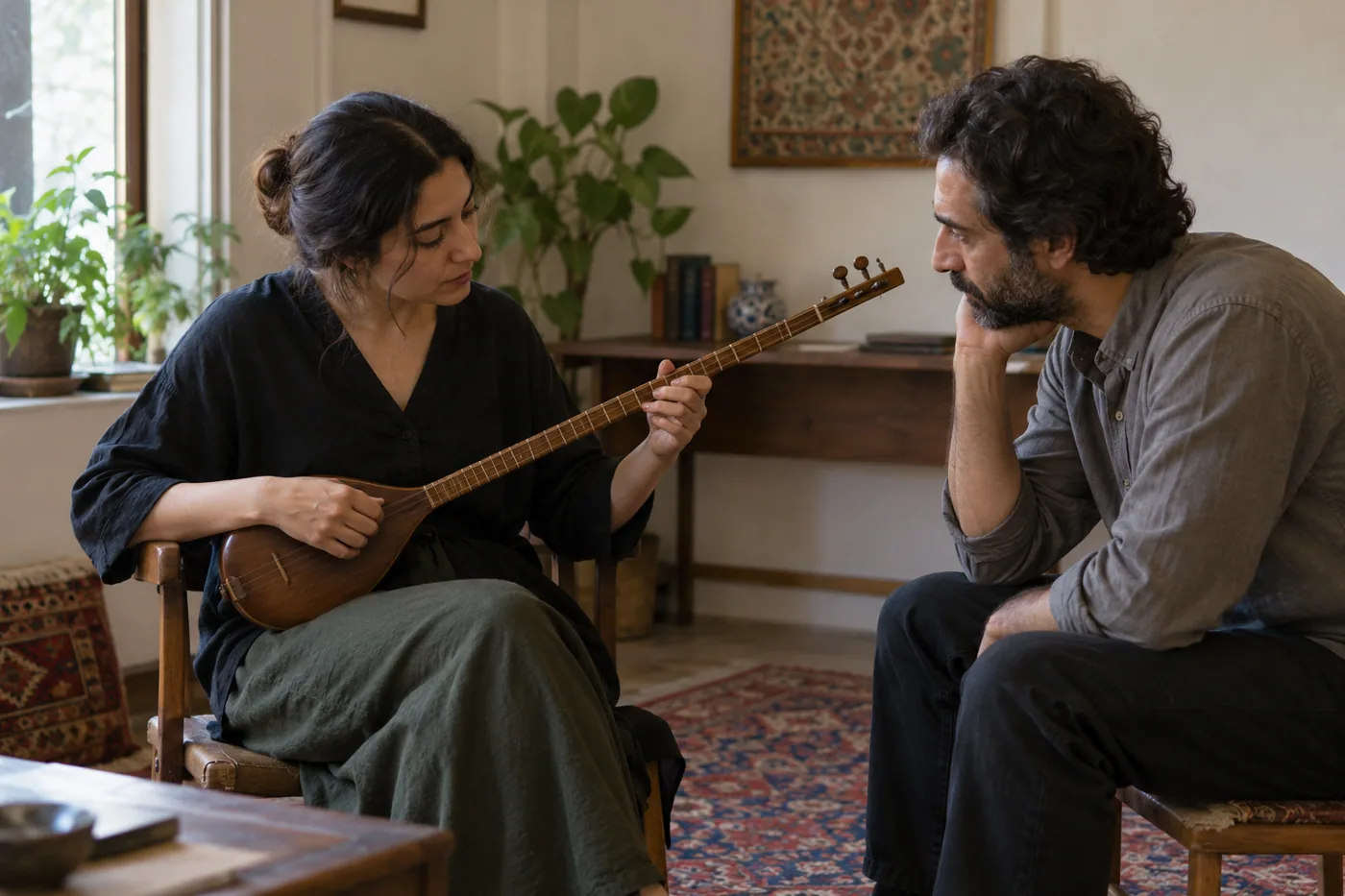
Imagined companion to Radif of Iranian music; does not document named people, a specific venue, ritual, recording or event. Credit: AI-generated with OpenAI image_gen for Culture Ark. Rights: Generated output; no exclusive ownership or copyrightability warranty; underlying cultural practices and third-party rights remain separate.. Changes: Resized within1400px and converted to WebP; no crop or substantive alteration.
No community endorsement or sacred authority implied. Imagined everyday settings and materials; not a playing instruction, score or proof of performance practice.
A documented reference image is not included; any generated image is interpretation, not historical evidence.
History and context
The radif is a learned repertoire of melodic units that equips Iranian classical musicians for interpretation and improvisation. UNESCO describes more than 250 units arranged in cycles within a modal framework. Performances may be vocal or use instruments such as tar, setar, santur, kamanche and ney. Years of close study with a teacher help musicians internalize the materials, but performance responds to personal mood and listeners rather than merely reciting a memorized catalog. This selection makes the productive relationship between discipline and freedom explicit. It preserves a musical knowledge system in which memory is not the opposite of invention, but part of what makes invention possible.
What future readers can learn
Curatorial interpretation: Improvisation can depend on long training and a shared vocabulary rather than spontaneous inspiration alone.
Limits and cultural context
Different lineages and instruments interpret the repertoire differently. No single transcription captures every nuance of transmission.
Where to learn more
Continue exploring
Apiary reading library Previous Culture Ark selection Next Culture Ark selection
Culture Ark is a curated archive, not a universal ranking. Interpretive images and source evidence serve different roles.
Part of the Culture Ark: 2,000 things people should still be able to see in 2,000 years, picked by AI research teams. Browse the gallery. The Culture Ark is an Artificial Mind Hive (AMH) project. AMH is owned by Austin Little.

Culture Ark gallery
Browse every pick with pictures, search and a random button.
Open the gallery →