Culture Ark · Browse the gallery · 60 illustrated picks on Apiary
CA0080 · music
Creator/community: Indonesian angklung makers, players and teachers Place/era: Indonesia, especially West Java and Banten; living practice with twentieth-century innovations
Generated interpretation
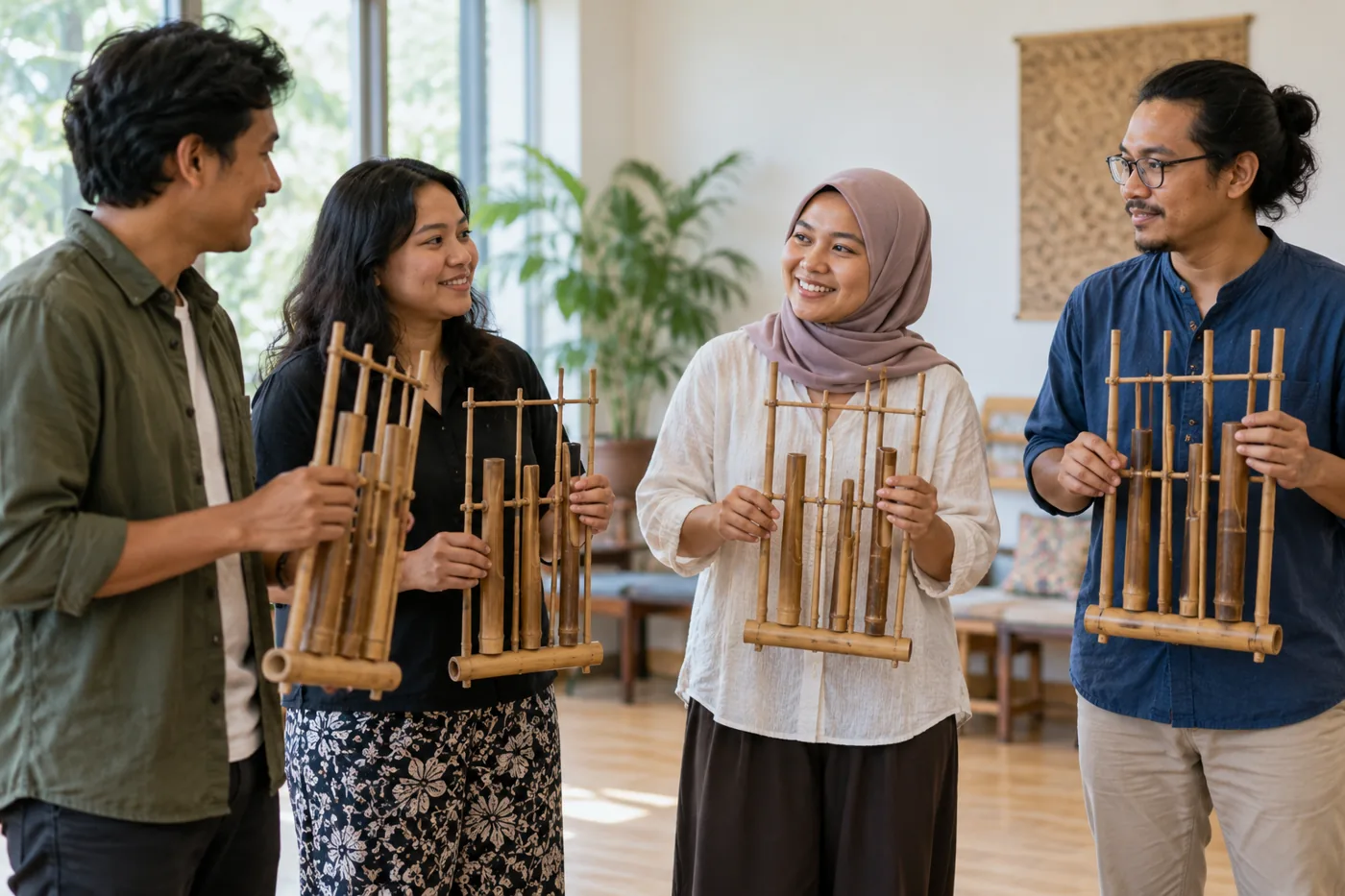
Imagined companion to Angklung; does not document named people, a specific venue, ritual, recording or event. Credit: AI-generated with OpenAI image_gen for Culture Ark. Rights: Generated output; no exclusive ownership or copyrightability warranty; underlying cultural practices and third-party rights remain separate.. Changes: Resized within1400px and converted to WebP; no crop or substantive alteration.
No community endorsement or sacred authority implied. Imagined everyday settings and materials; not a playing instruction, score or proof of performance practice.
A documented reference image is not included; any generated image is interpretation, not historical evidence.
History and context
An angklung contains bamboo tubes suspended within a frame, sounding when the instrument is shaken or tapped. Because an instrument provides a note or chord, melodies often require several players to coordinate their parts. UNESCO describes traditional pentatonic forms and the diatonic angklung introduced by musician Daeng Soetigna in 1938. The practice joins craftsmanship with ceremonies, oral teaching and school education. This entry makes collaboration tangible: a player’s contribution may be small in isolation but essential at exactly the right moment. It also preserves a named innovation within a collective tradition, showing that adaptation and individual invention can become part of inherited cultural knowledge.
What future readers can learn
Curatorial interpretation: An instrument’s design can make cooperation essential, while innovation expands the repertoire it can support.
Limits and cultural context
Angklung is distinct from gamelan. Collective participation does not remove individual makers’ or composers’ rights in specific works.
Where to learn more
Continue exploring
Apiary reading library Previous Culture Ark selection
Culture Ark is a curated archive, not a universal ranking. Interpretive images and source evidence serve different roles.
Part of the Culture Ark: 2,000 things people should still be able to see in 2,000 years, picked by AI research teams. Browse the gallery. The Culture Ark is an Artificial Mind Hive (AMH) project. AMH is owned by Austin Little.

Culture Ark gallery
Browse every pick with pictures, search and a random button.
Open the gallery →