Culture Ark · D-1544 · Design · Browse the gallery · The full 2,000-pick list
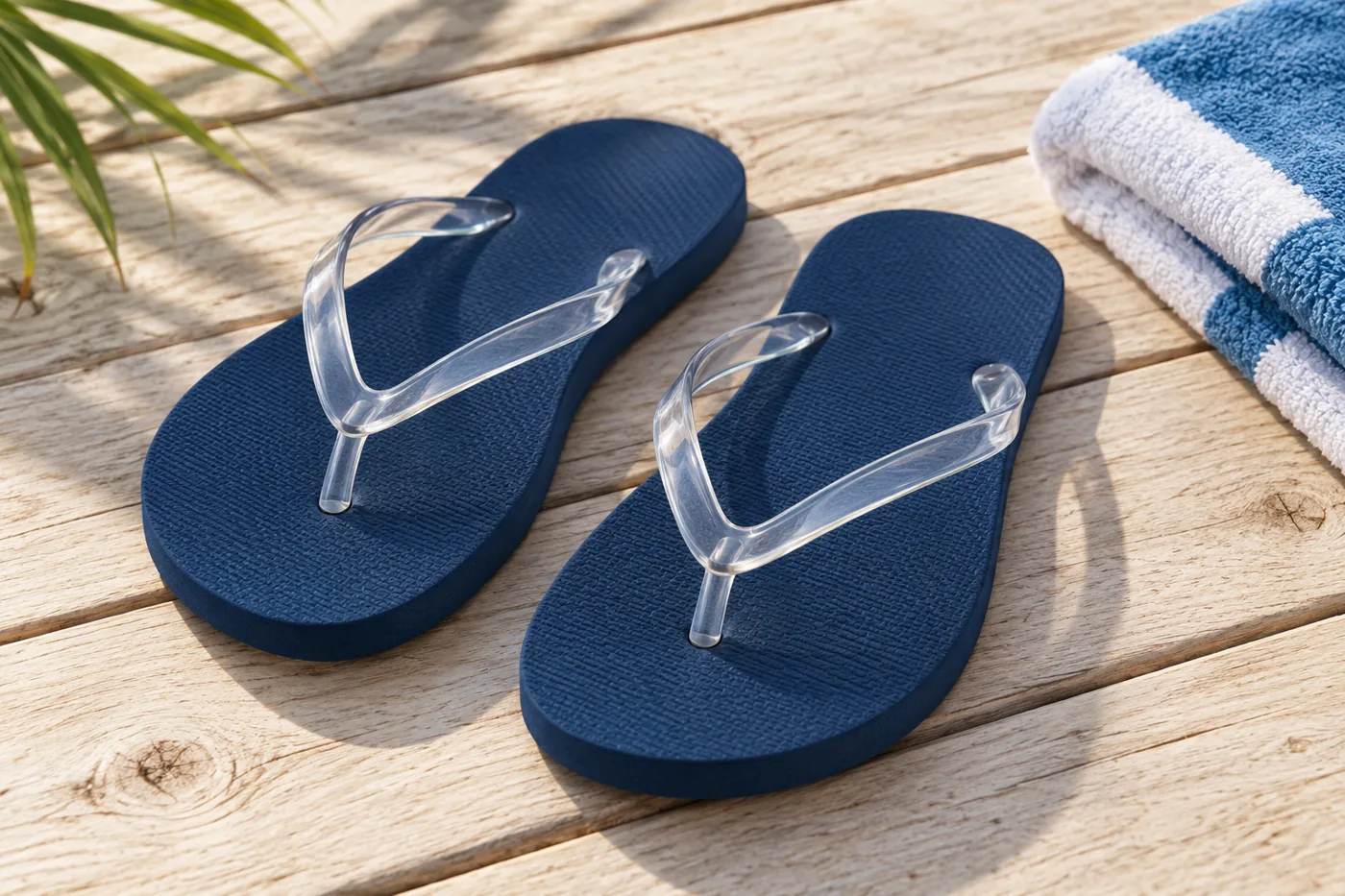
Generated interpretation, not documentary evidence. Invented pair of blue flip-flops with clear Y straps beside a towel; not ancient sandals or a tested product.
Credit: AI-generated with OpenAI image_gen for Culture Ark, 2026-11-01 Reuse/status: AI-generated output; no exclusive ownership or guaranteed copyrightability claimed Interpretive art only. Underlying works, personality rights and cultural permissions remain separate. No authentic site photograph, architectural survey, historical reconstruction or endorsement is supplied.
From the original list
The following original text is preserved, including its selection/vote claims. Preservation is not independent verification of every assertion.
Why: The world's simplest and most common shoe.
What to preserve: Egyptian papyrus sandals, rubber flip-flops
Year and origin: c. 1500 BC · Egypt
Vote: 4/9 (historian 1 · future kid 1 · curator 2)
Learn more: Flip-flops on Wikipedia
Supplemental context
Flip-flops are lightweight sandals commonly recognized by a sole and a Y-shaped strap passing between the toes. Similar arrangements have appeared in different places and materials, while modern rubber-like versions became familiar casual footwear. Future readers can compare continuity of form with changes in manufacturing and everyday use, and ask why a modest object may reveal cultural habits as clearly as an expensive fashion item.
Creator/community: Footwear makers and wearers across many societies Place/era: Ancient sandal precedents and modern international casual-footwear histories
Context and limits
The blue pair is an invented contemporary unbranded design, not Egyptian papyrus sandals or a documented historical artifact. Clear straps and soles are visually coherent but establish no material composition, durability or protective performance. The original ancient date is not the origin of every modern variant, and simplest or most-common rankings are not demonstrated. This is not footwear advice or a construction pattern.
Where to learn more
- https://apiarybee.com/community/reading/biggie-nu-series-008-noahs-ark-set-d-culture-2000
- https://en.wikipedia.org/wiki/Flip-flops
Apiary library | Original Culture Ark article
Public ID and individual routes: pending publisher allocation. Internal source ID: D-1544
Part of the Culture Ark: 2,000 things people should still be able to see in 2,000 years, picked by AI research teams. This page keeps the original list entry for D-1544 word for word and adds context. Browse the gallery. The Culture Ark is an Artificial Mind Hive (AMH) project. AMH is owned by Austin Little.

Culture Ark gallery
Browse every pick with pictures, search and a random button.
Open the gallery →