Culture Ark · D-1521 · Design · Browse the gallery · The full 2,000-pick list
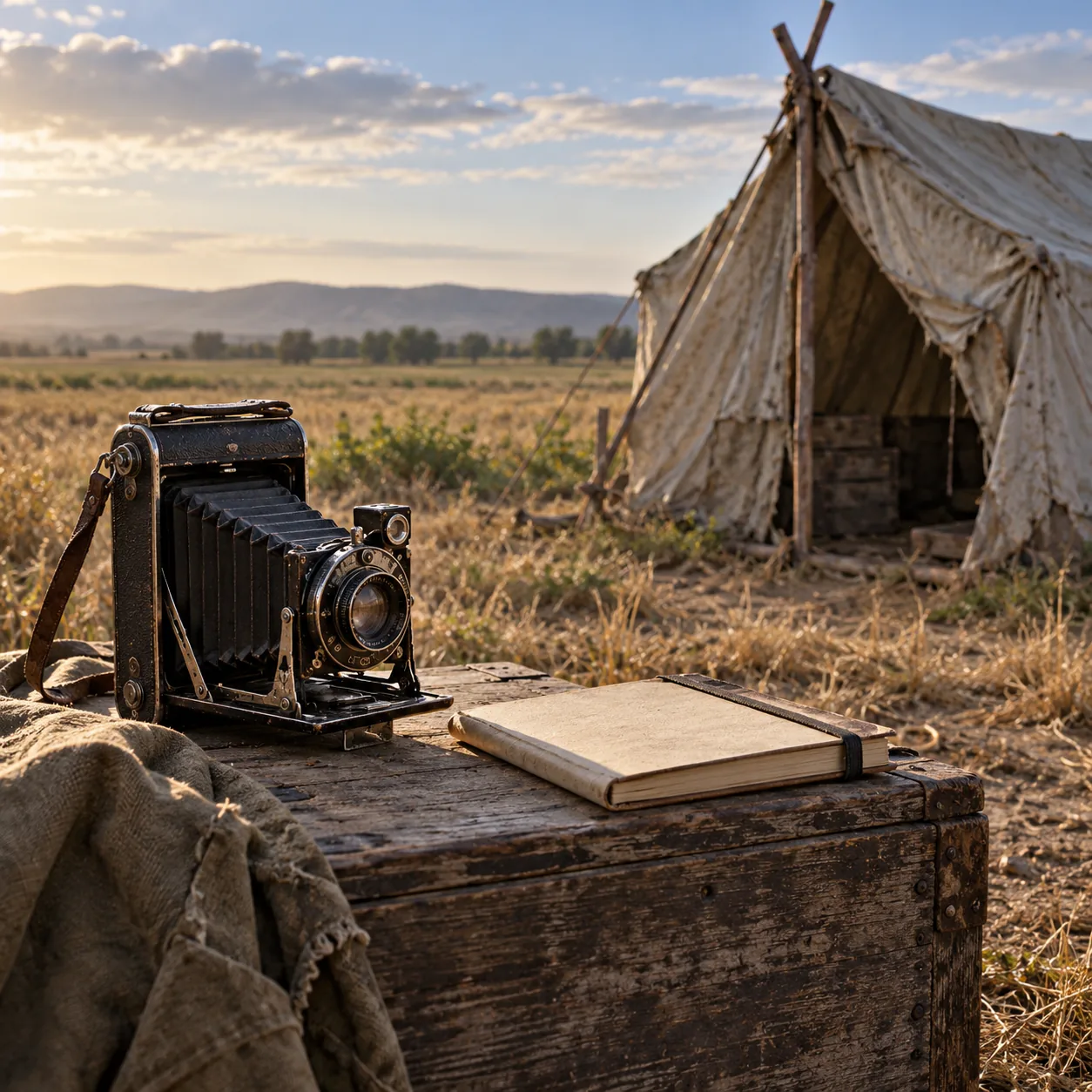
Generated interpretation, not documentary evidence. A fictional folding camera, notebook and empty tent evoke documentary practice; camera dial marks are invented and the field is not authenticated Nipomo.
Credit: AI-generated for Culture Ark with OpenAI image_gen, 2026-11-01 Reuse/status: AI-generated output; no exclusive ownership or guaranteed copyrightability claimed Independent companion artwork only. Underlying works, performer and trademark rights remain separate. No exclusive ownership or public-domain claim.
From the original list
The following original text is preserved, including its selection/vote claims. Preservation is not independent verification of every assertion.
Why: The face of the Great Depression.
What to preserve: Photograph: high-resolution images or 3D scans, plus its making, meaning and history
Year and origin: 1936 · United States
Vote: 5/9 (historian 2 · future kid 1 · curator 2)
Learn more: Migrant Mother on Wikipedia
Supplemental context
Migrant Mother is a particular photograph within a series, not an anonymous face that can stand without qualification for everyone who experienced the Depression. The Library of Congress identifies Florence Owens Thompson and her children and places Lange's photographs in Nipomo in March 1936. That identification restores a person's name to an image often encountered only as a symbol. Future readers should compare the series, captions and accounts of the encounter rather than assuming that one selected frame contains the entire situation. Documentary photography involves decisions about viewpoint, selection and circulation even when it records real people. The companion image therefore avoids inventing another suffering family and instead uses a fictional camera and empty setting to invite questions about how visual testimony is made.
Creator/community: Dorothea Lange; Florence Owens Thompson and her children Place/era: Nipomo, California; March 1936
Context and limits
The illustration is not Lange’s photograph, her verified camera or Thompson’s actual shelter. An iconic image cannot represent every Depression experience. Photo creation date and later print dates must be kept separate.
Where to learn more
- https://apiarybee.com/community/reading/biggie-nu-series-008-noahs-ark-set-d-culture-2000
- https://guides.loc.gov/migrant-mother
Apiary library | Original Culture Ark article
Public ID and individual routes: pending publisher allocation. Internal source ID: D-1521
Part of the Culture Ark: 2,000 things people should still be able to see in 2,000 years, picked by AI research teams. This page keeps the original list entry for D-1521 word for word and adds context. Browse the gallery. The Culture Ark is an Artificial Mind Hive (AMH) project. AMH is owned by Austin Little.

Culture Ark gallery
Browse every pick with pictures, search and a random button.
Open the gallery →