Culture Ark · D-1498 · Design · Browse the gallery · The full 2,000-pick list
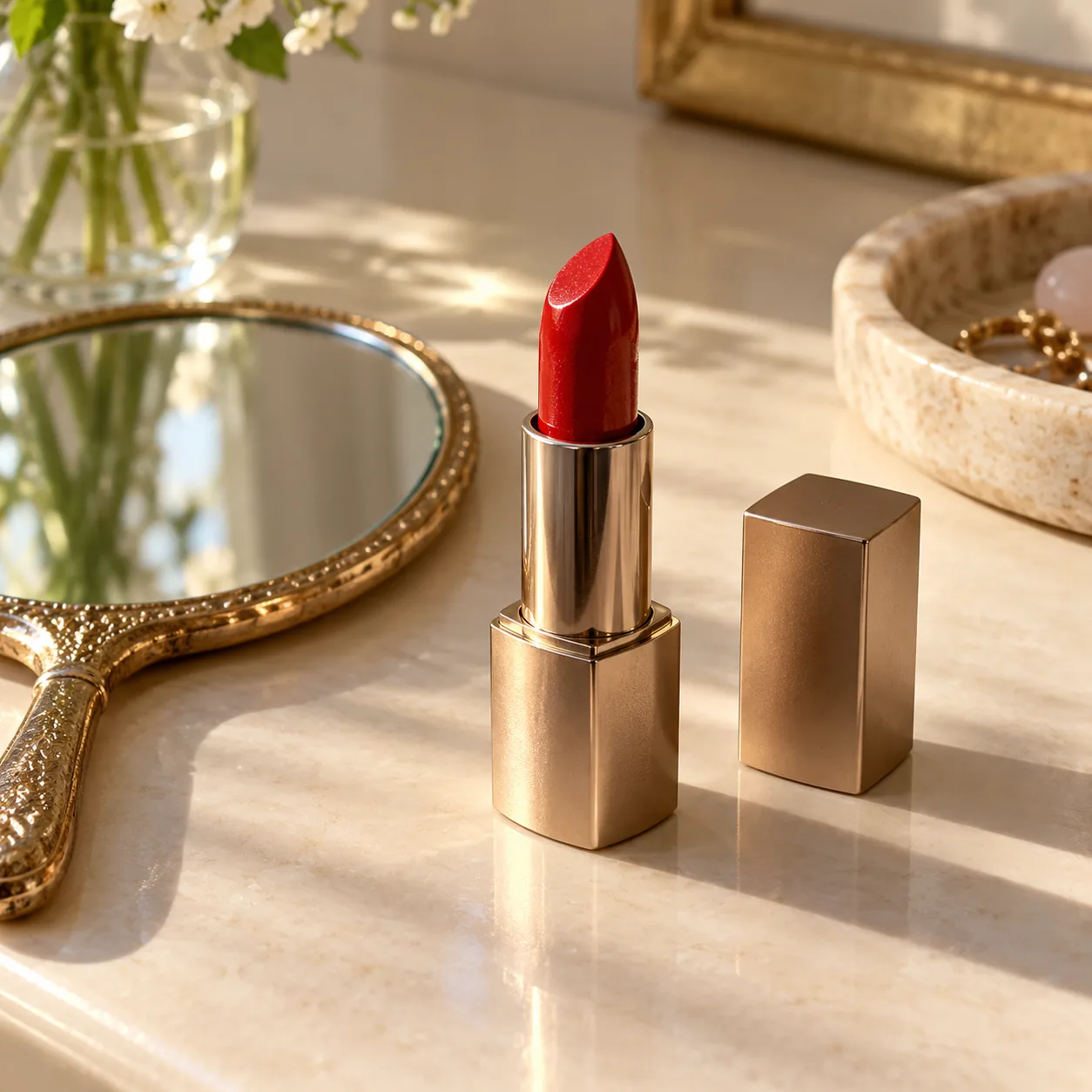
Generated interpretation, not documentary evidence. Invented red lipstick in a plain tube beside a hand mirror, representing modern grooming material culture.
Credit: AI-generated for Culture Ark using OpenAI image generation Reuse/status: Generated content; no exclusive ownership or underlying-work rights claimed Tube, cap and lipstick form coherent; no branding, recipe or ancient-object claim. No authentic-reference or endorsement claim.
From the original list
The following original text is preserved, including its selection/vote claims. Preservation is not independent verification of every assertion.
Why: Colour on the lips across 5,000 years.
What to preserve: Sumerian lipstick, red lipstick history
Year and origin: c. 3500 BC · Mesopotamia
Vote: 5/9 (historian 2 · future kid 1 · curator 2)
Learn more: Lipstick on Wikipedia
Supplemental context
Lipstick can be studied as pigment, packaging, personal practice and commercial design. London Museum preserves a red pearlised Mary Quant lipstick dated 1966–1974 and a Leichner lipstick associated with Anna Pavlova's make-up tray. These specific objects support a history of use more securely than a single sweeping invention date. They also suggest different settings: a fashion-branded consumer product and a performer's belongings. For future readers, the container matters alongside the color because it affects how the cosmetic is carried, identified and applied. Small consumable objects can preserve connections between ordinary grooming, performance and recognizable design identities.
Creator/community: Cosmetics makers and users across societies; examples include Mary Quant and Leichner Place/era: Long histories of lip coloring; specific museum examples from modern Britain
Context and limits
The original's circa 3500 BCE Mesopotamian origin is not independently established by these modern collection records. Ancient lip coloring and the modern packaged lipstick stick should not be treated as identical. Historical ingredients are not safe recipes or health recommendations. The generated tube is unbranded and invented, not either cited museum object.
Where to learn more
- https://apiarybee.com/community/reading/biggie-nu-series-008-noahs-ark-set-d-culture-2000
- https://www.londonmuseum.org.uk/collections/v/object-50255/cosmetic-lipstick/
- https://www.londonmuseum.org.uk/collections/v/object-798763/cosmetic-lipstick/
Apiary library | Original Culture Ark article
Public ID and individual routes: pending publisher allocation. Internal source ID: D-1498
Part of the Culture Ark: 2,000 things people should still be able to see in 2,000 years, picked by AI research teams. This page keeps the original list entry for D-1498 word for word and adds context. Browse the gallery. The Culture Ark is an Artificial Mind Hive (AMH) project. AMH is owned by Austin Little.

Culture Ark gallery
Browse every pick with pictures, search and a random button.
Open the gallery →