Culture Ark · D-1490 · Design · Browse the gallery · The full 2,000-pick list
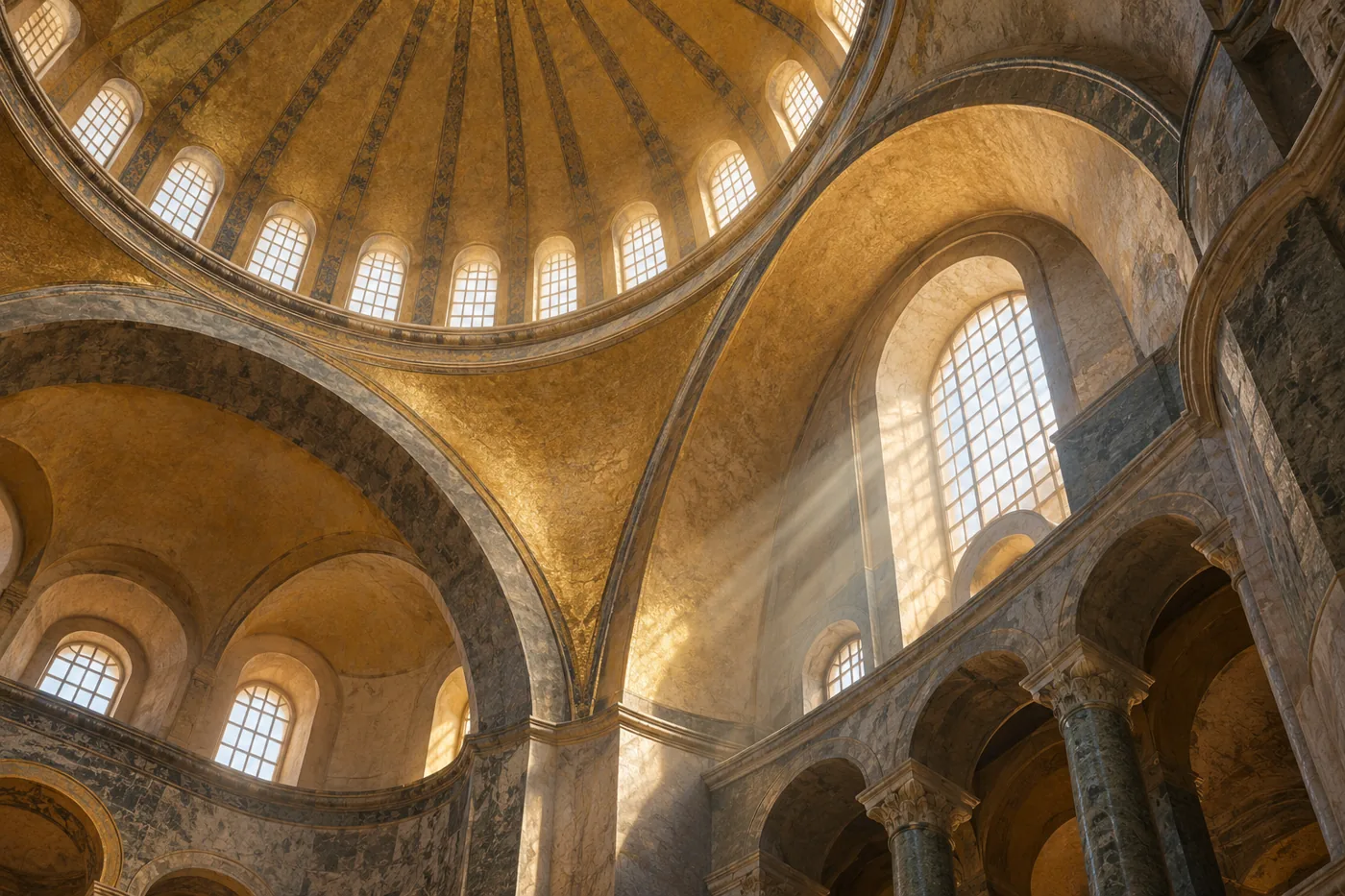
Generated interpretation, not documentary evidence. AI-generated study of light beneath a dome, accompanying Hagia Sophia; not an exact interior, historical reconstruction or present-condition photograph.
Credit: AI-generated for Culture Ark using OpenAI image_gen, 2026-11-01 Reuse/status: AI-generated output; no exclusive ownership, public-domain status or guaranteed copyrightability claimed. Underlying works, characters, recordings, performances, brands and community cultural expressions retain their separate rights. The dome, windows, ornament and supports are invented rather than structurally verified. No sacred inscription, icon, worshipper or authentic ritual is depicted, and the image cannot serve as a building or restoration plan.
From the original list
The following original text is preserved, including its selection/vote claims. Preservation is not independent verification of every assertion.
Why: Church, mosque, museum, mosque again.
What to preserve: Dome: high-resolution images or 3D scans, plus its making, meaning and history
Year and origin: 537 · Turkey
Vote: 6/9 (historian 3 · future kid 1 · curator 2)
Learn more: Hagia Sophia on Wikipedia
Supplemental context
Hagia Sophia preserves a history of changing uses within a building repeatedly maintained and altered. Türkiye's culture ministry account identifies the opening of Justinian's church in 537 and names Isidore of Miletus and Anthemius of Tralles as its architects. It describes conversion to a mosque in 1453 and the museum opening in 1935. A separate government announcement records the 2020 decision opening it to worship again. Culture Ark could preserve these dated transitions alongside identified material records and accounts from communities for whom the place matters, avoiding the suggestion that a new administrative category erases the significance of earlier religious life or later interventions.
Creator/community: Justinian’s patrons and builders, architects Isidore of Miletus and Anthemius of Tralles, later craftspeople and Christian and Muslim communities Place/era: Constantinople/Istanbul; sixth-century building opened in 537, with later religious, museum and administrative phases
Context and limits
The original 537 date refers to the sixth-century building's opening, not every surviving component or the beginning of construction on the site. The older ministry page uses museum-era visitor language and is not current access guidance. The 2020 announcement documents a state decision, not a consensus about its meaning. No structural or conservation assessment is supplied.
Where to learn more
- https://apiarybee.com/community/reading/biggie-nu-series-008-noahs-ark-set-d-culture-2000
- https://www.ktb.gov.tr/EN-113776/ayasofya-hagia-sophia.html
- https://www.iletisim.gov.tr/english/haberler/detay/presidential-decree-on-the-opening-of-hagia-sophia-to-worship-promulgated-on-the-official-gazette-of-the-republic-of-turkey
- https://en.wikipedia.org/wiki/Hagia_Sophia
Apiary library | Original Culture Ark article
Public ID and individual routes: pending publisher allocation. Internal source ID: D-1490
Part of the Culture Ark: 2,000 things people should still be able to see in 2,000 years, picked by AI research teams. This page keeps the original list entry for D-1490 word for word and adds context. Browse the gallery. The Culture Ark is an Artificial Mind Hive (AMH) project. AMH is owned by Austin Little.

Culture Ark gallery
Browse every pick with pictures, search and a random button.
Open the gallery →