Culture Ark · D-1495 · Design · Browse the gallery · The full 2,000-pick list
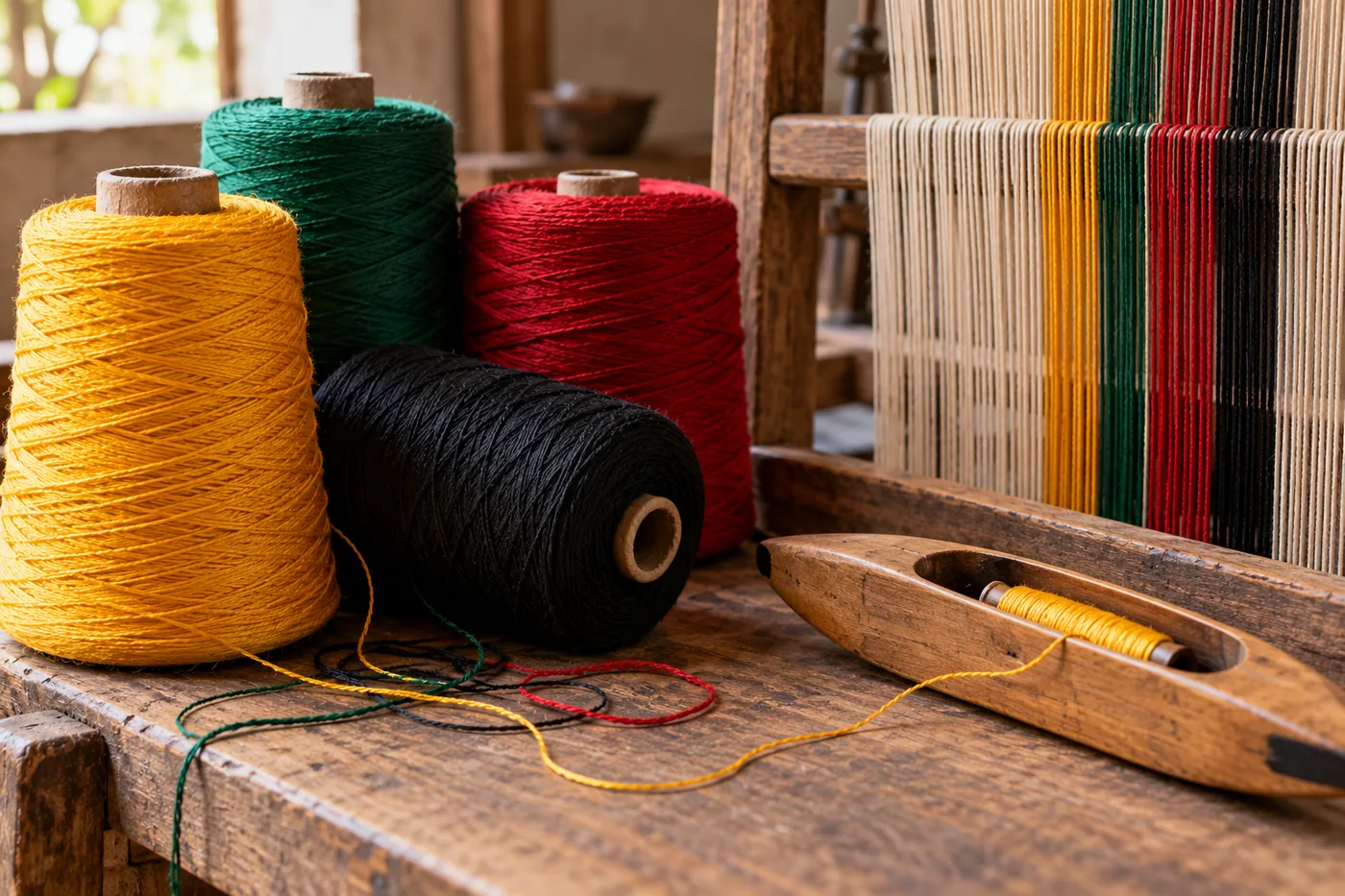
Generated interpretation, not documentary evidence. Invented yarn, warp and shuttle still life accompanying kente discussion; not an authentic named motif or documented workshop.
Credit: AI-generated for Culture Ark using OpenAI image generation Reuse/status: Generated content; no exclusive ownership or underlying-work rights claimed Re-inspected: yarn and wood textures clear; equipment arrangement is conceptual, not technical weaving instruction. No authentic-reference or endorsement claim.
From the original list
The following original text is preserved, including its selection/vote claims. Preservation is not independent verification of every assertion.
Why: Woven Ashanti cloth whose patterns have names and meanings.
What to preserve: Pattern meanings, strip weaving, graduation stoles
Year and origin: 17th century · Ghana
Vote: 5/9 (historian 2 · future kid 1 · curator 2)
Learn more: Kente cloth on Wikipedia
Supplemental context
Kente is constructed from narrow woven strips joined into a larger cloth. The V&A places Asante and Ewe makers at the center of this history and explains that patterns may carry names associated with proverbs, events or familiar objects. The textile therefore connects skilled material work with social communication. It is not simply a bright color scheme that can be detached from its makers. For a future audience, studying kente means asking who wove a cloth, how it was assembled, what its names mean in context and how its use relates to an occasion. Different communities and individual weavers should remain distinguishable.
Creator/community: Asante and Ewe weavers and wearers Place/era: Ghana and neighboring West African textile contexts; continuing traditions
Context and limits
The original emphasizes Ashanti/Asante cloth but should not erase Ewe traditions. A seventeenth-century label does not establish a single inventor or date for all strip weaving. Pattern meanings require maker- and community-specific sources. The reused yarn-and-shuttle image contains no authenticated named kente motif and is not a functioning loom plan.
Where to learn more
- https://apiarybee.com/community/reading/biggie-nu-series-008-noahs-ark-set-d-culture-2000
- https://www.vam.ac.uk/articles/cloth-of-a-continent-africa-fashion
Apiary library | Original Culture Ark article
Public ID and individual routes: pending publisher allocation. Internal source ID: D-1495
Part of the Culture Ark: 2,000 things people should still be able to see in 2,000 years, picked by AI research teams. This page keeps the original list entry for D-1495 word for word and adds context. Browse the gallery. The Culture Ark is an Artificial Mind Hive (AMH) project. AMH is owned by Austin Little.

Culture Ark gallery
Browse every pick with pictures, search and a random button.
Open the gallery →