Culture Ark · D-1420 · Design · Browse the gallery · The full 2,000-pick list
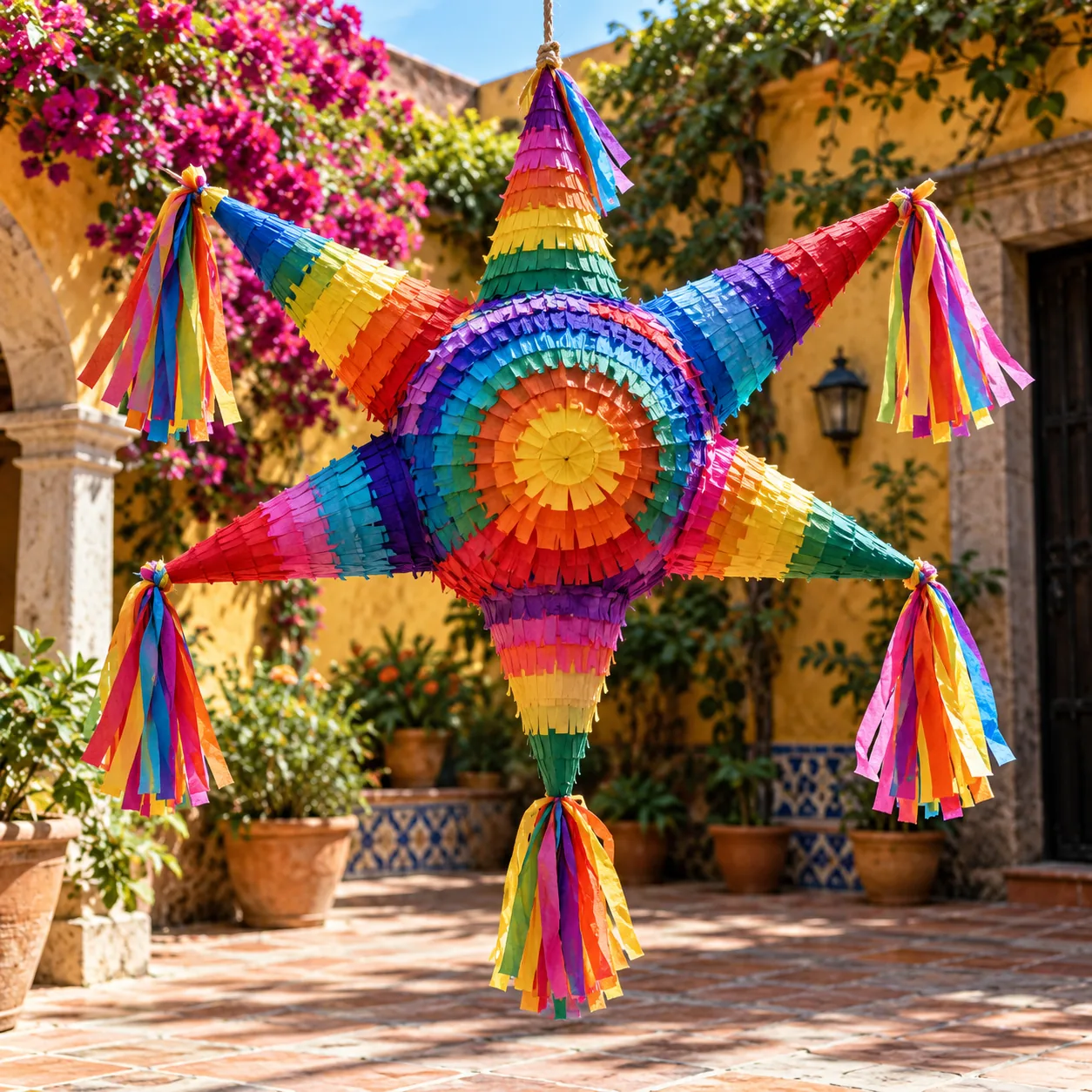
Generated interpretation, not documentary evidence. Generated six-point decorative paper star piñata in a fictional courtyard; not a traditional seven-point religious star or a documented maker’s work.
Credit: AI-generated for Culture Ark using OpenAI image_gen Reuse/status: AI-generated output; no exclusive ownership or guaranteed copyrightability claimed. Underlying works, marks and cultural permissions remain separate. Generated six-point decorative paper star piñata in a fictional courtyard; not a traditional seven-point religious star or a documented maker’s work. The original sixteenth-centuryMexicoorigin is not established as a universal starting point by this fieldwork. Seven-point religious stars have specific meanings; the generated decorative star visibly has six points and is explicitly NOT that symbolic form. No claim of an authenticated ceremony, filling, suspension or play-safety guidance.
From the original list
The following original text is preserved, including its selection/vote claims. Preservation is not independent verification of every assertion.
Why: A candy-filled figure smashed at parties.
What to preserve: Star piñata: high-resolution images or 3D scans, plus its making, meaning and history
Year and origin: 16th century · Mexico
Vote: 8/9 (historian 2 · future kid 3 · curator 3)
Learn more: Piñata on Wikipedia
Supplemental context
A piñata is an object made for a social occasion, often with the knowledge that its careful decoration will be destroyed. Louisiana Folklife Program fieldwork with Maria Lopez and Teresa Turrubiartes shows how making piñatas can sustain relationships, transmit skills and adapt family practices after migration. Their work includes stars for religious celebrations and other shapes for birthdays, with materials changing according to availability. The researchers also warn that popular origin stories have limited supporting evidence. For future readers, this local account is valuable precisely because it names makers and circumstances rather than treating every celebration as identical. Preserving memories of preparation, shared labor and aesthetic judgment would explain more than a photograph of the finished container alone.
Creator/community: Mexican and diasporic piñata makers; documented example Maria Lopez and Teresa Turrubiartes Place/era: Mexico and diaspora; specific fieldwork in Bernice, Louisiana,2007–2008
Context and limits
The original sixteenth-centuryMexicoorigin is not established as a universal starting point by this fieldwork. Seven-point religious stars have specific meanings; the generated decorative star visibly has six points and is explicitly NOT that symbolic form. No claim of an authenticated ceremony, filling, suspension or play-safety guidance.
Where to learn more
- https://apiarybee.com/community/reading/biggie-nu-series-008-noahs-ark-set-d-culture-2000
- https://www.louisianafolklife.org/LT/Articles_Essays/makingpinatas.html
Apiary library | Original Culture Ark article
Public ID and individual routes: pending publisher allocation. Internal source ID: D-1420
Part of the Culture Ark: 2,000 things people should still be able to see in 2,000 years, picked by AI research teams. This page keeps the original list entry for D-1420 word for word and adds context. Browse the gallery. The Culture Ark is an Artificial Mind Hive (AMH) project. AMH is owned by Austin Little.

Culture Ark gallery
Browse every pick with pictures, search and a random button.
Open the gallery →