Culture Ark · D-1350 · Inventions · Browse the gallery · The full 2,000-pick list
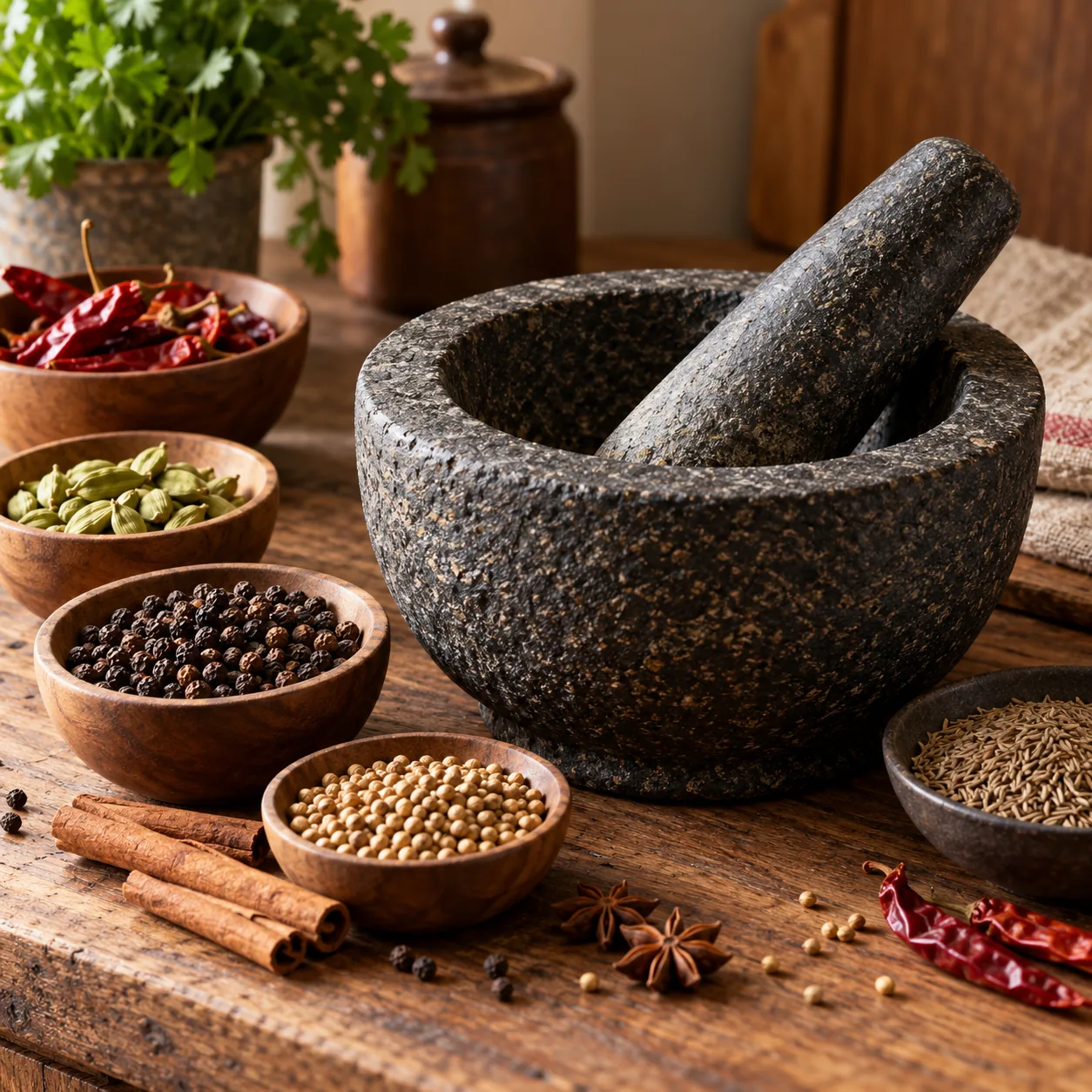
Generated interpretation, not documentary evidence. An undecorated fictional stone mortar and pestle with whole spices evokes kitchen work, not the linked Deccani object or a named community’s exact tool.
Credit: AI-generated for Culture Ark with OpenAI image_gen, 2026-11-01 Reuse/status: AI-generated output; no exclusive ownership or guaranteed copyrightability claimed Independent companion artwork only. Underlying works, performer and trademark rights remain separate. No exclusive ownership or public-domain claim.
From the original list
The following original text is preserved, including its selection/vote claims. Preservation is not independent verification of every assertion.
Why: Grinding spices and medicines since the Stone Age.
What to preserve: Molcajete, Thai krok, apothecary versions
Year and origin: ancient · worldwide
Vote: 4/9 (historian 2 · future kid 1 · curator 1)
Learn more: Mortar and pestle on Wikipedia
Supplemental context
A mortar and pestle can appear so straightforward that its cultural specificity disappears. The Metropolitan Museum's seventeenth-century Indian double-sided example demonstrates why that would be a mistake: its curatorial account connects a practical grinding object with carefully considered symbolic form. That particular interpretation should not be generalized to every kitchen mortar, apothecary vessel or regional tradition named in the original selection. Future readers should preserve the maker, place, material and documented use of individual objects whenever possible. The broader cultural lesson concerns the learned work of transforming ingredients and the different meanings attached to that work. The present illustration deliberately uses an undecorated fictional kitchen object rather than reproducing the museum's ritual associations or claiming to represent an authenticated molcajete or Thai krok.
Creator/community: Diverse makers and users of grinding vessels across many communities Place/era: Long histories and continuing use; linked example is seventeenth-century India
Context and limits
The linked Indian object is one example, not proof of all worldwide or Stone Age origins. Regional forms are not interchangeable. No medicinal preparation, food-safety assurance or culturally specific ritual reconstruction is supplied.
Where to learn more
- https://apiarybee.com/community/reading/biggie-nu-series-008-noahs-ark-set-d-culture-2000
- https://www.metmuseum.org/art/collection/search/817378
Apiary library | Original Culture Ark article
Public ID and individual routes: pending publisher allocation. Internal source ID: D-1350
Part of the Culture Ark: 2,000 things people should still be able to see in 2,000 years, picked by AI research teams. This page keeps the original list entry for D-1350 word for word and adds context. Browse the gallery. The Culture Ark is an Artificial Mind Hive (AMH) project. AMH is owned by Austin Little.

Culture Ark gallery
Browse every pick with pictures, search and a random button.
Open the gallery →