Culture Ark · D-1349 · Inventions · Browse the gallery · The full 2,000-pick list
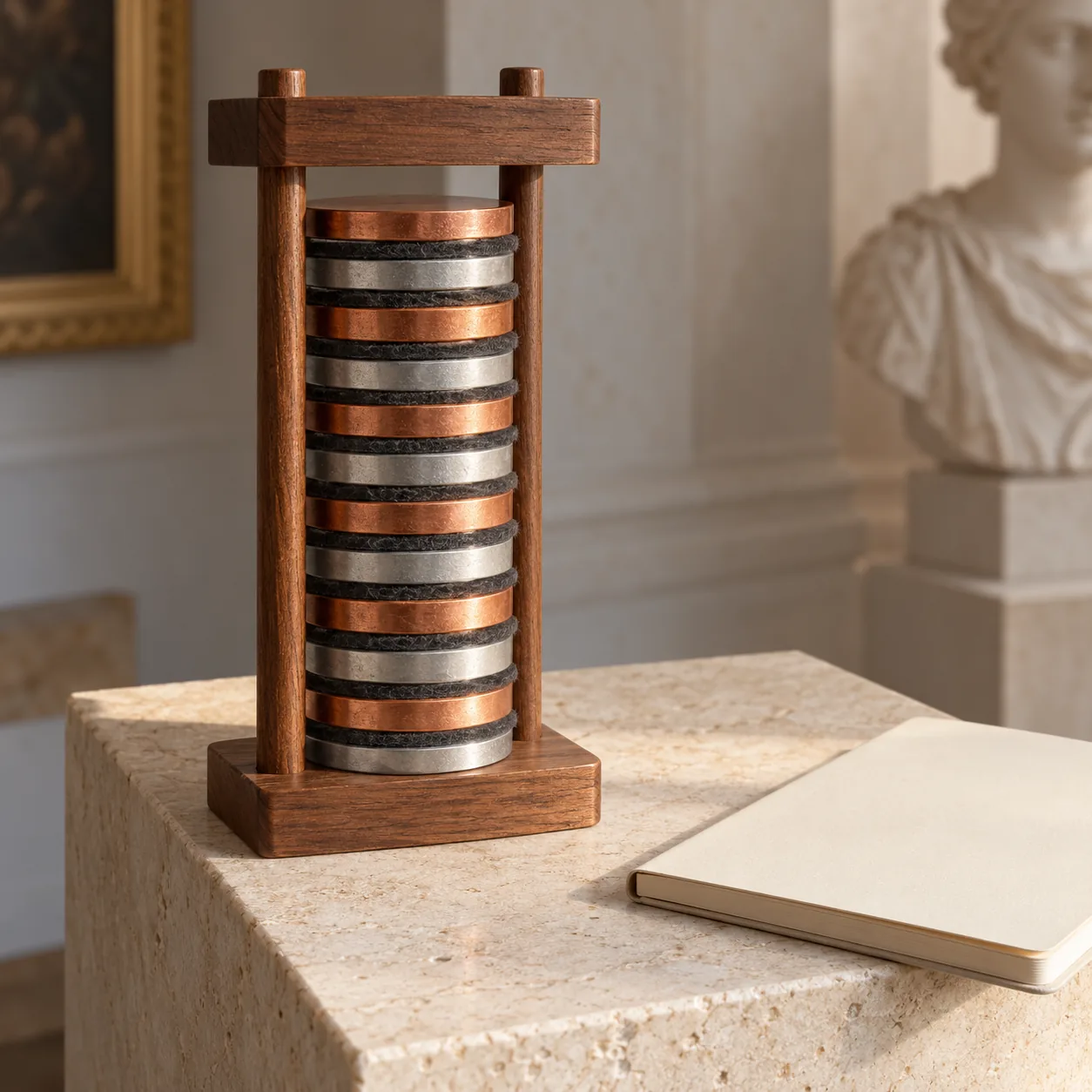
Generated interpretation, not documentary evidence. A fictional stack of metallic discs and dark separators evokes early electrochemistry; its layer pattern is not a functional pile and background bust is not identified as Volta.
Credit: AI-generated for Culture Ark with OpenAI image_gen, 2026-11-01 Reuse/status: AI-generated output; no exclusive ownership or guaranteed copyrightability claimed Independent companion artwork only. Underlying works, performer and trademark rights remain separate. No exclusive ownership or public-domain claim.
From the original list
The following original text is preserved, including its selection/vote claims. Preservation is not independent verification of every assertion.
Why: The first battery: stored electricity for the first time.
What to preserve: Volta's stack, battery evolution to lithium-ion
Year and origin: 1800 · Italy
Vote: 4/9 (historian 2 · future kid 1 · curator 1)
Learn more: Voltaic pile on Wikipedia
Supplemental context
The voltaic pile belongs to a history of experimental objects that changed what investigators could do with electricity. The Royal Institution preserves an early battery given by Volta to Faraday in 1814, while the American Physical Society describes Volta's report to Joseph Banks in March 1800. These sources distinguish a particular surviving object from the earlier announcement. The important change was a source of continuing electric current from chemical processes, not the first occasion on which any electrical charge had been stored. Future readers can also study how instruments traveled between researchers and institutions, carrying both practical possibilities and prestige. The generated stack is only an interpretive visual cue: its layer order, supports and materials should not be treated as an authenticated reconstruction or a working experiment.
Creator/community: Alessandro Volta and later experimental communities including Davy and Faraday Place/era: Italian scientific work around 1800; surviving Royal Institution example predates 1814
Context and limits
The archived stored-electricity-for-the-first-time phrase is misleading; earlier charge-storage devices existed. The pile is not a lithium-ion battery. No electrolyte recipe, operating procedure or validated layer sequence is provided.
Where to learn more
- https://apiarybee.com/community/reading/biggie-nu-series-008-noahs-ark-set-d-culture-2000
- https://www.rigb.org/explore-science/explore/collection/alessandro-voltas-voltaic-pile
- https://www.aps.org/apsnews/2006/03/this-month-in-physics-history
Apiary library | Original Culture Ark article
Public ID and individual routes: pending publisher allocation. Internal source ID: D-1349
Part of the Culture Ark: 2,000 things people should still be able to see in 2,000 years, picked by AI research teams. This page keeps the original list entry for D-1349 word for word and adds context. Browse the gallery. The Culture Ark is an Artificial Mind Hive (AMH) project. AMH is owned by Austin Little.

Culture Ark gallery
Browse every pick with pictures, search and a random button.
Open the gallery →