Culture Ark · D-1233 · Inventions · Browse the gallery · The full 2,000-pick list
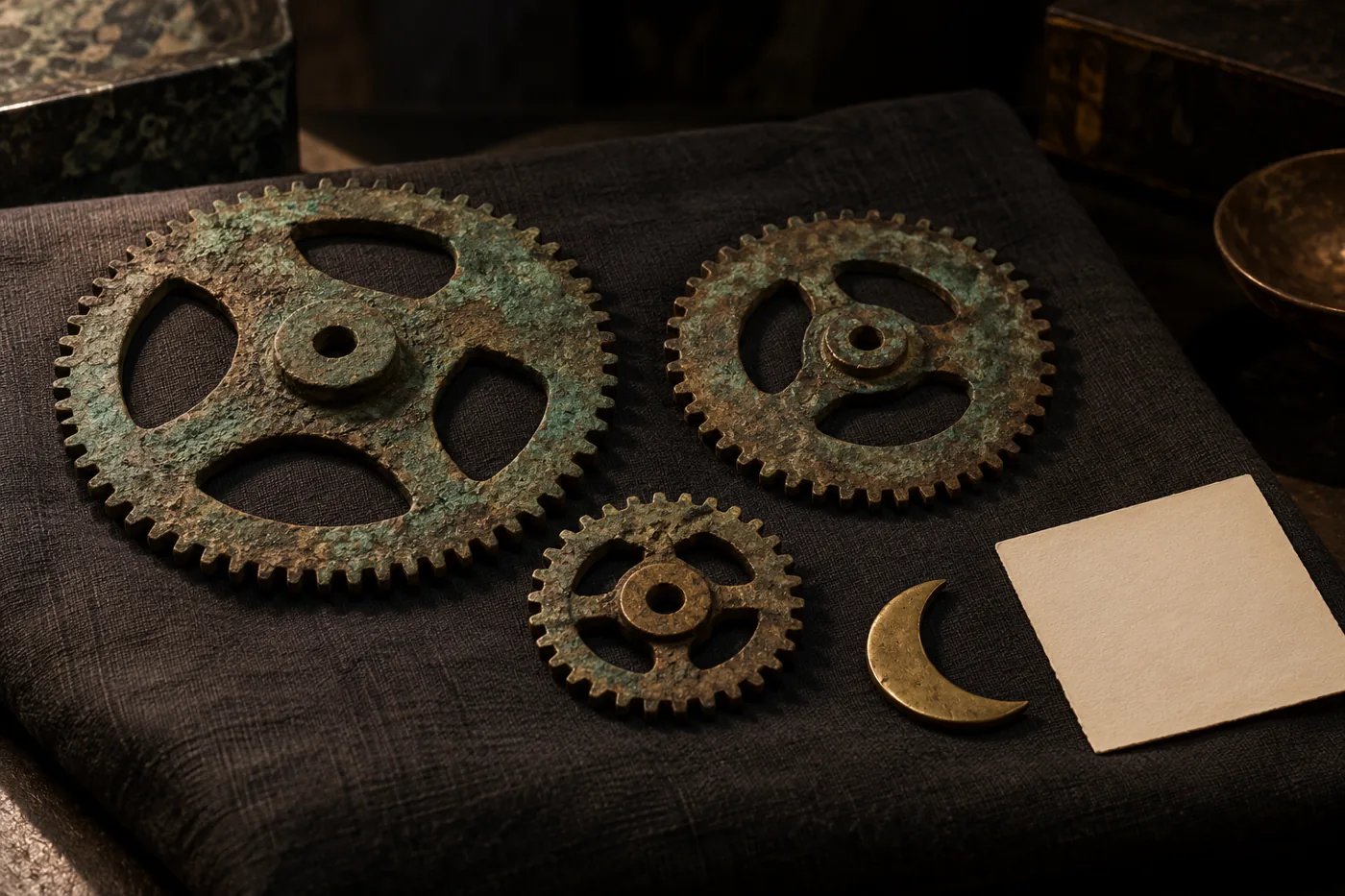
Generated interpretation, not documentary evidence. AI-generated metaphor for mechanism and celestial cycles; not Antikythera fragments, a reconstruction or a functional gearing arrangement.
Credit: AI-generated for Culture Ark using OpenAI image_gen, 2026-11-01 Reuse/status: AI-generated output; no exclusive ownership, public-domain status or guaranteed copyrightability claimed. Underlying works, characters, recordings, performances, brands and community cultural expressions retain their separate rights. All discs, tooth shapes, patina and the crescent are invented. The gears do not mesh and provide no verified ratios, ancient inscriptions, object measurements or archaeological evidence.
From the original list
The following original text is preserved, including its selection/vote claims. Preservation is not independent verification of every assertion.
Why: An ancient Greek analog computer that tracked the heavens.
What to preserve: Fragments, reconstructions, CT scans
Year and origin: c. 100 BC · Greece
Vote: 8/9 (historian 3 · future kid 3 · curator 2)
Learn more: Antikythera mechanism on Wikipedia
Supplemental context
The Antikythera mechanism is valuable both for what survives and for what researchers must infer. The Greek cultural-heritage record describes bronze fragments, gears and astronomical inscriptions, dating the object probably to 150–100 BC. UCL's account of a 2021 research model explains how imaging and inscriptions help investigate missing parts, while explicitly describing further work needed to test the proposed construction. Culture Ark should preserve those layers separately: original fragments, measured observations and dated reconstructions. A polished complete model is easier to understand than corroded remains, but it must not silently replace them as evidence. The uncertainty itself shows how knowledge about an ancient object is assembled.
Creator/community: Unidentified ancient Greek makers; museum custodians and multiple modern research teams Place/era: Ancient Mediterranean; Greek cultural-heritage account dates the object probably 150–100 BC, recovered near Antikythera
Context and limits
The original circa 100 BC is an approximate label, not a securely identified manufacturing year or workshop. 'Analog computer' is a modern description, not evidence of electronics or general-purpose computing. The 2021 model is attributed, not presented as settled in every detail. No CT data, original fragment image or working reconstruction was inspected here.
Where to learn more
- https://apiarybee.com/community/reading/biggie-nu-series-008-noahs-ark-set-d-culture-2000
- https://olympicgames.culture.gov.gr/en/texnologia/1_Mixanismos-Antikithirwn.html
- https://www.ucl.ac.uk/news/2021/mar/experts-recreate-mechanical-cosmos-worlds-first-computer
- https://en.wikipedia.org/wiki/Antikythera_mechanism
Apiary library | Original Culture Ark article
Public ID and individual routes: pending publisher allocation. Internal source ID: D-1233
Part of the Culture Ark: 2,000 things people should still be able to see in 2,000 years, picked by AI research teams. This page keeps the original list entry for D-1233 word for word and adds context. Browse the gallery. The Culture Ark is an Artificial Mind Hive (AMH) project. AMH is owned by Austin Little.

Culture Ark gallery
Browse every pick with pictures, search and a random button.
Open the gallery →