Culture Ark · D-1238 · Inventions · Browse the gallery · The full 2,000-pick list
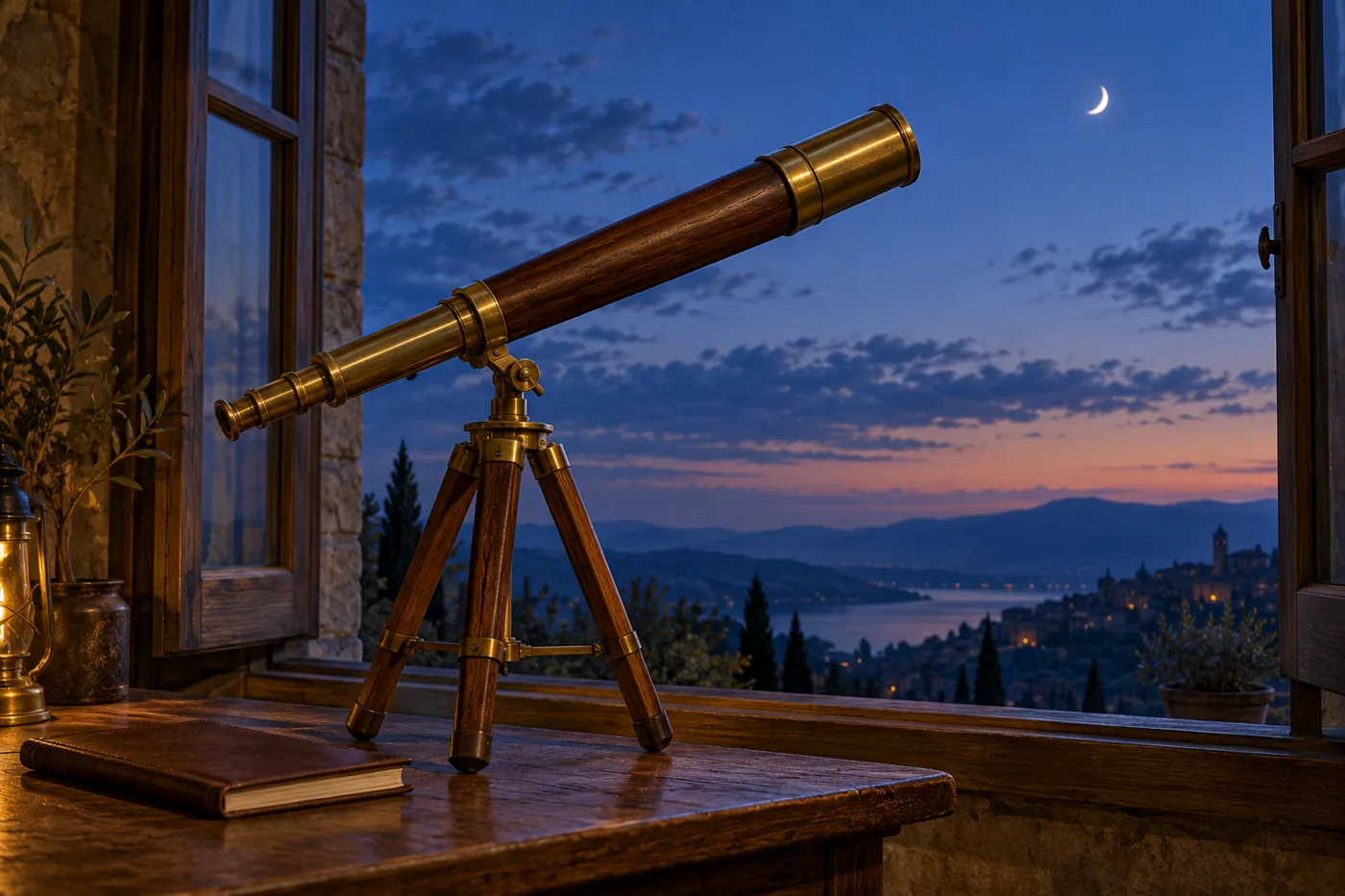
Generated interpretation, not documentary evidence. AI-generated interpretation of observing at dusk; not Galileo’s or Lipperhey’s instrument, a historic observatory or a view through a telescope.
Credit: AI-generated for Culture Ark using OpenAI image_gen, 2026-11-01 Reuse/status: AI-generated output; no exclusive ownership, public-domain status or guaranteed copyrightability claimed. Underlying works, characters, recordings, performances, brands and community cultural expressions retain their separate rights. The telescope, mount, town and sky are imagined. Their dimensions and optical arrangement are not verified; the crescent is a scene element, not recorded astronomical data or an image made by the instrument.
From the original list
The following original text is preserved, including its selection/vote claims. Preservation is not independent verification of every assertion.
Why: Revealed moons, galaxies and our place in space.
What to preserve: Lippershey patent, Galileo's views
Year and origin: 1608 · Netherlands
Vote: 8/9 (historian 3 · future kid 2 · curator 3)
Learn more: Telescope on Wikipedia
Supplemental context
The telescope's cultural importance includes a change in what could count as evidence. Rice University's Galileo Project traces the instrument through craft knowledge and the Dutch patent applications discussed in 1608, then distinguishes those events from Galileo's later construction and astronomical observations. It also includes other observers, rather than presenting Galileo as the only person to look through a new device. Culture Ark could preserve a specific instrument with an observing record and an explanation of its limits. Seeing, drawing and persuading others are different activities: a new view does not automatically produce a shared interpretation, and later telescopes should not be collapsed into the earliest examples.
Creator/community: Instrument makers and observers, including Hans Lipperhey, Jacob Metius, Thomas Harriot and Galileo Galilei Place/era: Netherlands, patent applications discussed in 1608; astronomical use and publication developed subsequently
Context and limits
The original 'Lippershey patent' should be understood as a patent application, not proof that a patent was granted. The 1608 date is not the date of every later astronomical discovery. This is historical context, not optical design or observing guidance; no authentic observation, lens specification or complete invention-priority judgment is supplied.
Where to learn more
- https://apiarybee.com/community/reading/biggie-nu-series-008-noahs-ark-set-d-culture-2000
- https://galileo.library.rice.edu/sci/instruments/telescope.html
- https://en.wikipedia.org/wiki/Telescope
Apiary library | Original Culture Ark article
Public ID and individual routes: pending publisher allocation. Internal source ID: D-1238
Part of the Culture Ark: 2,000 things people should still be able to see in 2,000 years, picked by AI research teams. This page keeps the original list entry for D-1238 word for word and adds context. Browse the gallery. The Culture Ark is an Artificial Mind Hive (AMH) project. AMH is owned by Austin Little.

Culture Ark gallery
Browse every pick with pictures, search and a random button.
Open the gallery →