Culture Ark · D-1211 · Language and humor · Browse the gallery · The full 2,000-pick list
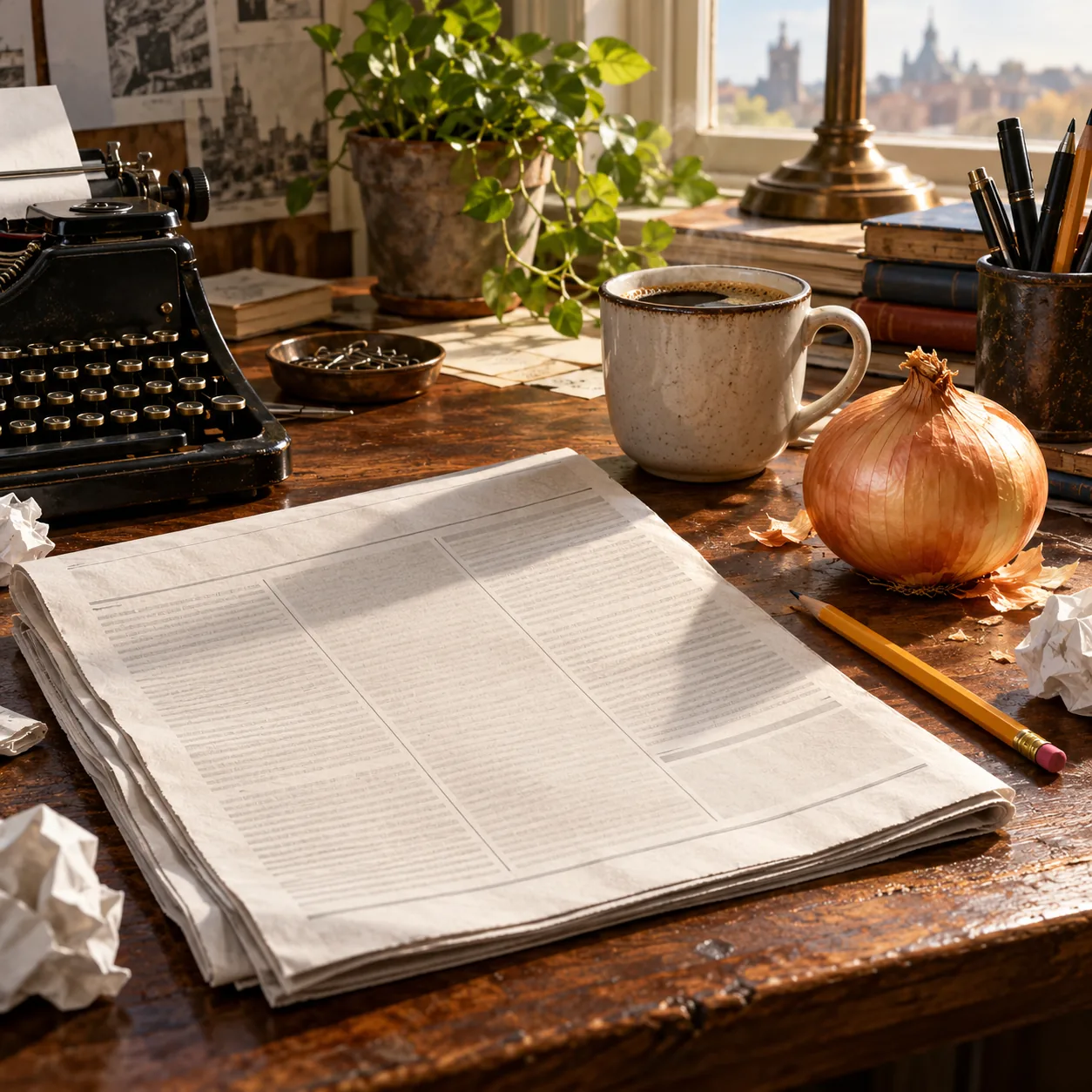
Generated interpretation, not documentary evidence. Invented writer’s desk with simulated newsprint and an onion as a visual pun; not an actual Onion issue, headline, office or logo.
Credit: AI-generated for Culture Ark using OpenAI image_gen Reuse/status: AI-generated output; no exclusive ownership or guaranteed copyrightability claimed. Underlying works, marks and cultural permissions remain separate. Invented writer’s desk with simulated newsprint and an onion as a visual pun; not an actual Onion issue, headline, office or logo. The original claim that headlines often felt real is an interpretation, not a measured frequency. Satirical corporate self-descriptions are not reliable founding histories. The interview is dated evidence, not a guarantee of present staffing, ownership or business arrangements. No original headlines or articles reproduced.
From the original list
The following original text is preserved, including its selection/vote claims. Preservation is not independent verification of every assertion.
Why: A satirical newspaper whose fake headlines often felt real.
What to preserve: famous headlines
Year and origin: 1988 · United States
Vote: 3/9 (historian 1 · future kid 1 · curator 1)
Learn more: The Onion on Wikipedia
Supplemental context
The Onion borrows the voice and formats of news to make deliberately invented stories communicate a comic perspective. A Reuters Institute interview with head writer Mike Gillis discusses the publication’s movement between college newspaper, tabloid parody, website and other media forms. The same interview anchors its founding in Madison in 1988. For future readers, a headline alone is an incomplete artifact: its date, surrounding news and recognizable journalistic conventions help explain the joke. Preserving the label of satire is equally important, especially when a screenshot travels without its original page. This selection documents an editorial practice that depends on audiences recognizing a gap between sober presentation and an absurd or uncomfortable premise.
Creator/community: The Onion writers and editors; founded by University of Wisconsin–Madison students Place/era: United States; print publication founded 1988, later digital forms
Context and limits
The original claim that headlines often felt real is an interpretation, not a measured frequency. Satirical corporate self-descriptions are not reliable founding histories. The interview is dated evidence, not a guarantee of present staffing, ownership or business arrangements. No original headlines or articles reproduced.
Where to learn more
- https://apiarybee.com/community/reading/biggie-nu-series-008-noahs-ark-set-d-culture-2000
- https://reutersinstitute.politics.ox.ac.uk/news/onions-head-writer-takes-satire-very-seriously-our-mandate-just-be-funny
Apiary library | Original Culture Ark article
Public ID and individual routes: pending publisher allocation. Internal source ID: D-1211
Part of the Culture Ark: 2,000 things people should still be able to see in 2,000 years, picked by AI research teams. This page keeps the original list entry for D-1211 word for word and adds context. Browse the gallery. The Culture Ark is an Artificial Mind Hive (AMH) project. AMH is owned by Austin Little.

Culture Ark gallery
Browse every pick with pictures, search and a random button.
Open the gallery →