Culture Ark · D-1217 · Language and humor · Browse the gallery · The full 2,000-pick list
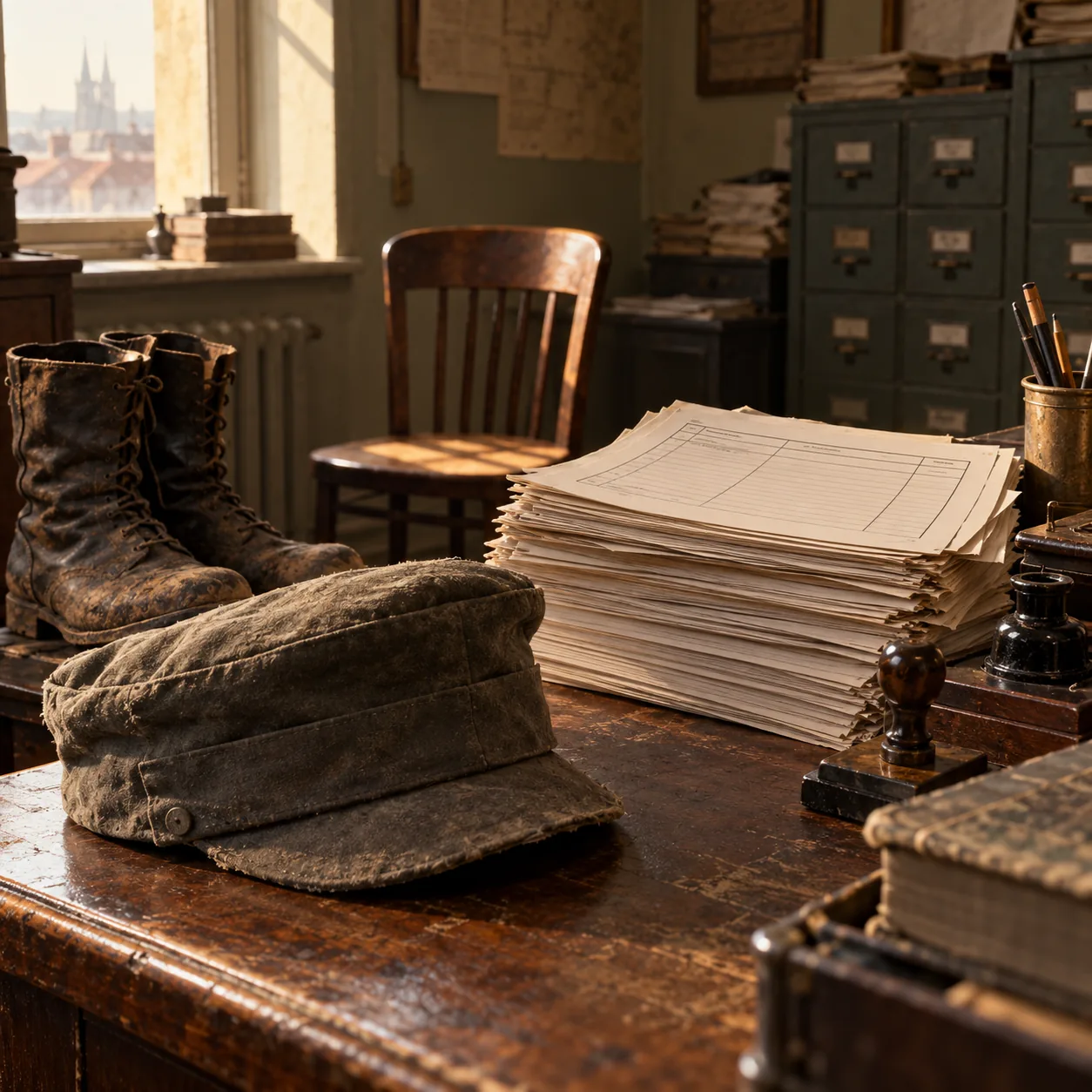
Generated interpretation, not documentary evidence. Invented cap, boots and bureaucratic forms in a dim office; not Švejk’s established likeness, an exact Austro-Hungarian uniform, Josef Lada drawing or historical document.
Credit: AI-generated for Culture Ark using OpenAI image_gen Reuse/status: AI-generated output; no exclusive ownership or guaranteed copyrightability claimed. Underlying works, marks and cultural permissions remain separate. Invented cap, boots and bureaucratic forms in a dim office; not Švejk’s established likeness, an exact Austro-Hungarian uniform, Josef Lada drawing or historical document. The original statement that he survives war should not be treated as a verified completed ending. The source promotes one edition and favors a strategic-fool interpretation. Its 1993 publication date refers to this English edition, not the original novel. Translation and illustration rights are separate; no pages copied.
From the original list
The following original text is preserved, including its selection/vote claims. Preservation is not independent verification of every assertion.
Why: A Czech soldier who survives war by seeming foolish.
What to preserve: the novel
Year and origin: 1921 · Czechoslovakia
Vote: 3/9 (historian 1 · future kid 1 · curator 1)
Learn more: The Good Soldier Švejk on Wikipedia
Supplemental context
The Good Soldier Švejk makes military authority encounter a character whose apparent compliance produces confusion rather than efficient obedience. The publisher’s description presents Hašek’s antiwar satire through a small individual confronting the bureaucratic machinery of the Austro-Hungarian army. That framing helps future readers distinguish the novel’s wartime setting from the later country and publication era named in the original selection. The cited Everyman’s Library edition also identifies Cecil Parrott’s translation and introduction and Josef Lada’s drawings. Those contributors matter: a translated joke and a familiar illustrated face influence how audiences imagine the protagonist. Preserving more than the title allows readers to compare versions and question whether they interpret Švejk’s behavior as innocence, strategy or resistance.
Creator/community: Jaroslav Hašek; cited English translation and introduction by Cecil Parrott, illustrations by Josef Lada Place/era: Czech literary culture after World War I; narrative set in Austro-Hungarian wartime service
Context and limits
The original statement that he survives war should not be treated as a verified completed ending. The source promotes one edition and favors a strategic-fool interpretation. Its 1993 publication date refers to this English edition, not the original novel. Translation and illustration rights are separate; no pages copied.
Where to learn more
- https://apiarybee.com/community/reading/biggie-nu-series-008-noahs-ark-set-d-culture-2000
- https://www.penguinrandomhouse.com/books/76666/the-good-soldier-svejk-by-jaroslav-hasek-translated-and-introduced-by-cecil-parrott/9780679420361/
Apiary library | Original Culture Ark article
Public ID and individual routes: pending publisher allocation. Internal source ID: D-1217
Part of the Culture Ark: 2,000 things people should still be able to see in 2,000 years, picked by AI research teams. This page keeps the original list entry for D-1217 word for word and adds context. Browse the gallery. The Culture Ark is an Artificial Mind Hive (AMH) project. AMH is owned by Austin Little.

Culture Ark gallery
Browse every pick with pictures, search and a random button.
Open the gallery →