Culture Ark · D-1106 · Language and humor · Browse the gallery · The full 2,000-pick list
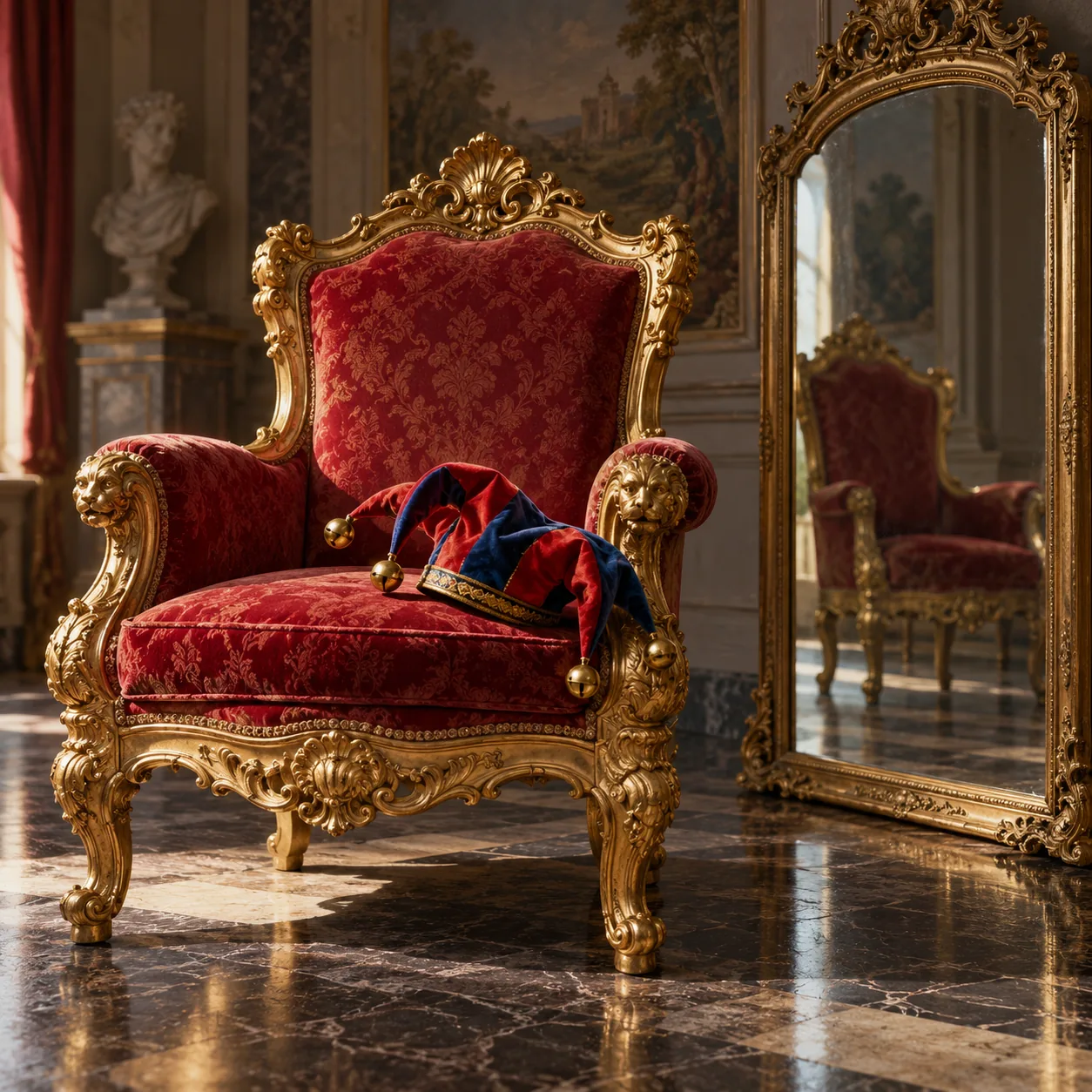
Generated interpretation, not documentary evidence. Imagined jester cap on an ornate empty chair; a new metaphor for pretension, not an existing satire or royal artifact.
Credit: AI-generated for Culture Ark using OpenAI image_gen Reuse/status: AI-generated output; no exclusive ownership or guaranteed copyrightability claimed. Underlying works, marks and cultural permissions remain separate. Imagined jester cap on an ornate empty chair; a new metaphor for pretension, not an existing satire or royal artifact. The original 400 BC Greece date cannot serve as the birth of all satire. Satire may challenge power, support it or reinforce prejudice; a label of humor does not make its claims true. The museum example is one British print, not a global survey. The generated chair, mirror and cap are fictional props rather than artifacts or a portrait of a ruler.
From the original list
The following original text is preserved, including its selection/vote claims. Preservation is not independent verification of every assertion.
Why: Humor that attacks folly and power.
What to preserve: famous works, examples
Year and origin: 400 BC · Ancient Greece
Vote: 5/9 (historian 2 · future kid 1 · curator 2)
Learn more: Satire on Wikipedia
Supplemental context
Satire asks an audience to recognize a gap between what people claim to be and what their behavior reveals. The British Museum's record for The Rapacious Quack offers one concrete example: a print turns a doctor's demand for payment into a criticism of greed. That is a particular social argument, not a definition of every satirical work. Future readers should identify the target, the exaggeration and the assumptions that make the joke legible, then ask whose interests the mockery serves. The invented jester's cap on an ornate chair visualizes pretension without accusing a real person or pretending to reproduce a work from the ancient world.
Creator/community: Writers, performers, image makers and their audiences in many cultures Place/era: A broad mode of criticism across periods and media; no single origin established here
Context and limits
The original 400 BC Greece date cannot serve as the birth of all satire. Satire may challenge power, support it or reinforce prejudice; a label of humor does not make its claims true. The museum example is one British print, not a global survey. The generated chair, mirror and cap are fictional props rather than artifacts or a portrait of a ruler.
Where to learn more
- https://apiarybee.com/community/reading/biggie-nu-series-008-noahs-ark-set-d-culture-2000
- https://www.britishmuseum.org/collection/object/P_2010-7081-3161
Apiary library | Original Culture Ark article
Public ID and individual routes: pending publisher allocation. Internal source ID: D-1106
Part of the Culture Ark: 2,000 things people should still be able to see in 2,000 years, picked by AI research teams. This page keeps the original list entry for D-1106 word for word and adds context. Browse the gallery. The Culture Ark is an Artificial Mind Hive (AMH) project. AMH is owned by Austin Little.

Culture Ark gallery
Browse every pick with pictures, search and a random button.
Open the gallery →