Culture Ark · D-1051 · Language and humor · Browse the gallery · The full 2,000-pick list
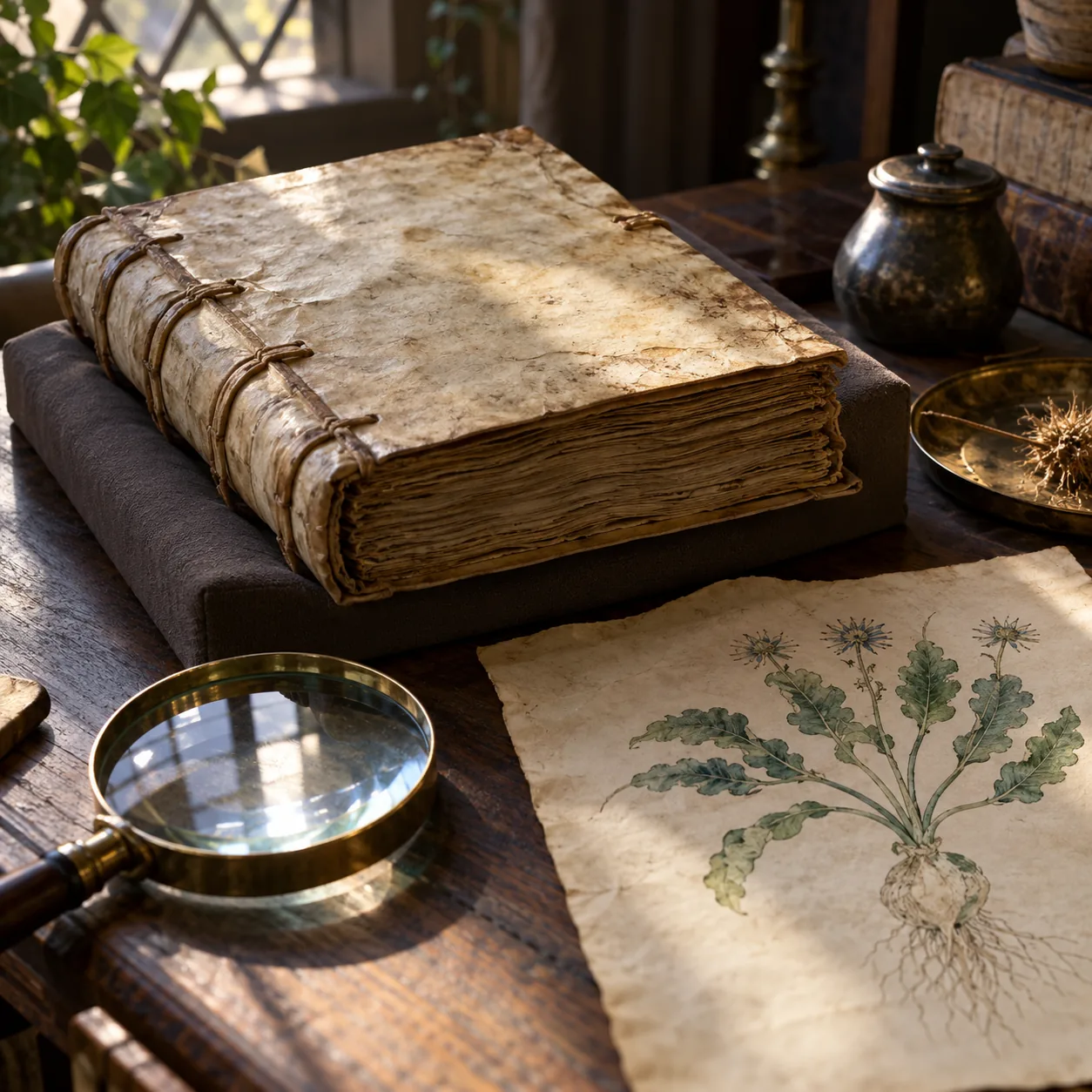
Generated interpretation, not documentary evidence. An invented closed vellum-looking codex, magnifying glass and separate botanical sketch evoke manuscript study; not MS 408, a copied page or conservation instructions.
Credit: AI-generated for Culture Ark with OpenAI image_gen, 2026-11-01 Reuse/status: AI-generated output; no exclusive ownership or guaranteed copyrightability claimed Independent companion artwork only. Underlying works, performer and trademark rights remain separate. No exclusive ownership or public-domain claim.
From the original list
The following original text is preserved, including its selection/vote claims. Preservation is not independent verification of every assertion.
Why: A book in an unknown script no one has read.
What to preserve: the pages
Year and origin: 1404 · Europe
Vote: 7/9 (historian 2 · future kid 3 · curator 2)
Learn more: Voynich manuscript on Wikipedia
Supplemental context
The Voynich manuscript is an unusually useful reminder that preserving an object does not guarantee understanding it. Yale’s Beinecke Library identifies the volume as MS 408 and describes an unidentified script, unknown authorship and illustrations grouped around plants, celestial forms, baths and other subjects. Those images suggest possible organizing themes without providing a secure translation of the writing. Its modern name comes from bookseller Wilfrid Voynich, who acquired it in 1912; it later entered Yale’s collection. Future readers should encounter both the surviving material and the limits of present interpretation. A closed imaginary codex in this illustration intentionally avoids presenting invented characters as genuine evidence or pretending that an attractive botanical drawing solves the manuscript.
Creator/community: Unknown manuscript makers; Beinecke Library custodian Place/era: European manuscript, generally associated with fifteenth-century materials
Context and limits
The original 1404 marker is preserved, not endorsed as an exact writing date. Yale’s page itself juxtaposes a later dating statement with fifteenth-century material evidence. Material dating, composition date and authorship are distinct; no decipherment or medicinal use is claimed.
Where to learn more
- https://apiarybee.com/community/reading/biggie-nu-series-008-noahs-ark-set-d-culture-2000
- https://beinecke.library.yale.edu/beinecke/collections/beinecke-cipher-voynich-manuscript
Apiary library | Original Culture Ark article
Public ID and individual routes: pending publisher allocation. Internal source ID: D-1051
Part of the Culture Ark: 2,000 things people should still be able to see in 2,000 years, picked by AI research teams. This page keeps the original list entry for D-1051 word for word and adds context. Browse the gallery. The Culture Ark is an Artificial Mind Hive (AMH) project. AMH is owned by Austin Little.

Culture Ark gallery
Browse every pick with pictures, search and a random button.
Open the gallery →