Culture Ark · D-1049 · Language and humor · Browse the gallery · The full 2,000-pick list
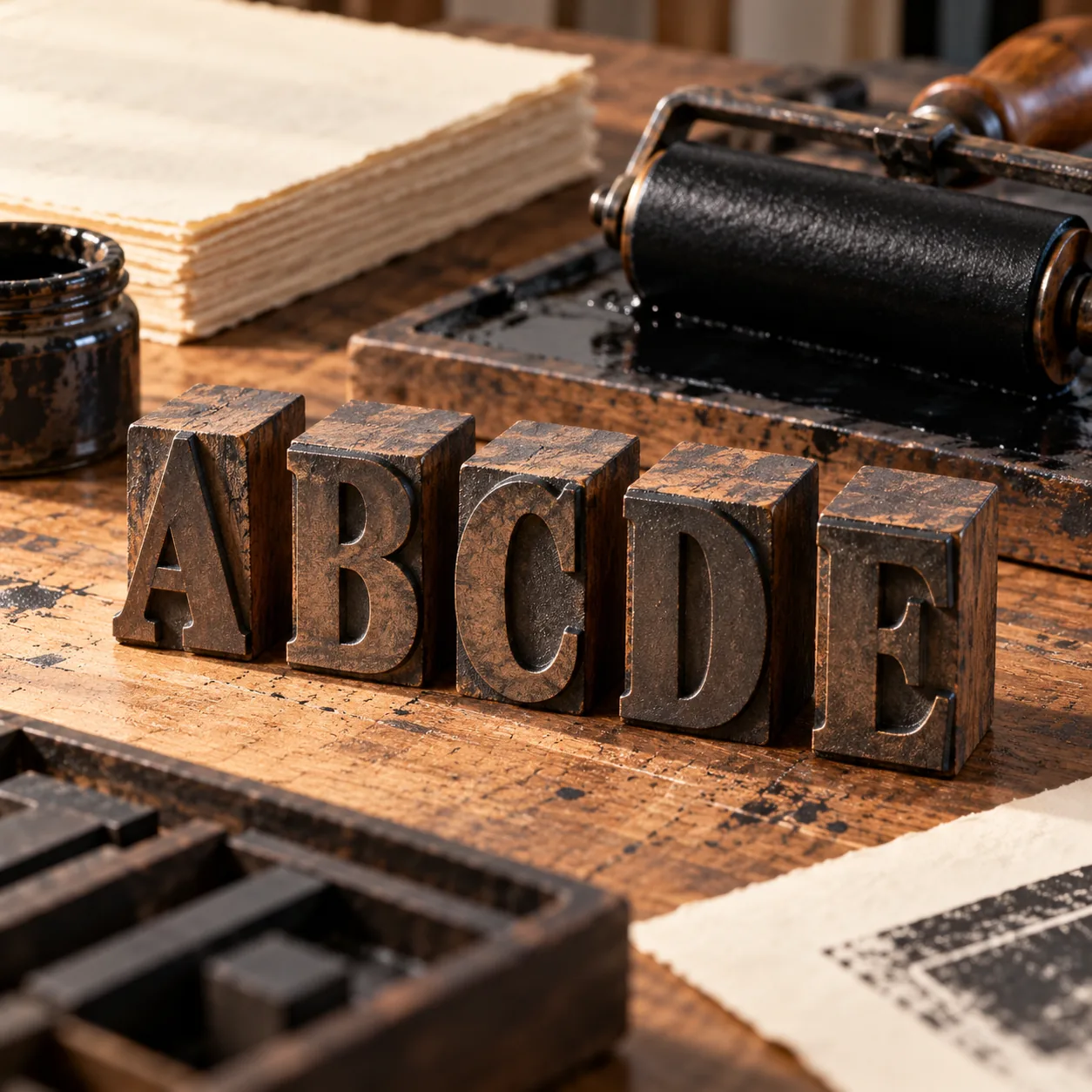
Generated interpretation, not documentary evidence. Imagined forward-facing A–E display blocks with printing props; not ancient inscriptions or correctly reversed working type.
Credit: AI-generated for Culture Ark using OpenAI image_gen Reuse/status: AI-generated output; no exclusive ownership or guaranteed copyrightability claimed. Underlying works, marks and cultural permissions remain separate. Imagined forward-facing A–E display blocks with printing props; not ancient inscriptions or correctly reversed working type. The original 700 BC marker is approximate, and the most-used claim requires a defined measure and period. The modern English alphabet is not identical to classical Latin. The illustrated blocks show forward-facing display letters; actual printing type normally reverses the image. They are interpretive props, not ancient artifacts, a full alphabet or practical printing evidence.
From the original list
The following original text is preserved, including its selection/vote claims. Preservation is not independent verification of every assertion.
Why: The world's most used alphabet.
What to preserve: letters
Year and origin: 700 BC · Italy
Vote: 7/9 (historian 3 · future kid 2 · curator 2)
Learn more: Latin alphabet on Wikipedia
Supplemental context
The Latin alphabet is not a single unchanged row of letters carried intact from antiquity. The Scuola Normale Superiore's Mnamon guide describes its Greek and Etruscan connections, early variation and the twenty-three-letter classical alphabet. Its discussion of uncertain inscription dates cautions against turning a complicated development into one birthday. Future readers can compare letter shapes, writing directions and language-specific additions, asking how a script changes when adopted for new speech communities and media. Preserving actual examples with dates and contexts is more informative than saving a modern alphabet alone. The generated wooden letters evoke later material writing culture, not the form of the earliest inscriptions or a functioning historical printing setup.
Creator/community: Successive writing communities, scribes, printers and users of Latin-derived alphabets Place/era: Early Latin inscriptions in central Italy from the seventh–sixth centuries BCE; later widespread adaptations
Context and limits
The original 700 BC marker is approximate, and the most-used claim requires a defined measure and period. The modern English alphabet is not identical to classical Latin. The illustrated blocks show forward-facing display letters; actual printing type normally reverses the image. They are interpretive props, not ancient artifacts, a full alphabet or practical printing evidence.
Where to learn more
- https://apiarybee.com/community/reading/biggie-nu-series-008-noahs-ark-set-d-culture-2000
- https://mnamon.sns.it/index.php?id=17&lang=en&page=Scrittura
Apiary library | Original Culture Ark article
Public ID and individual routes: pending publisher allocation. Internal source ID: D-1049
Part of the Culture Ark: 2,000 things people should still be able to see in 2,000 years, picked by AI research teams. This page keeps the original list entry for D-1049 word for word and adds context. Browse the gallery. The Culture Ark is an Artificial Mind Hive (AMH) project. AMH is owned by Austin Little.

Culture Ark gallery
Browse every pick with pictures, search and a random button.
Open the gallery →