Culture Ark · D-1028 · Language and humor · Browse the gallery · The full 2,000-pick list
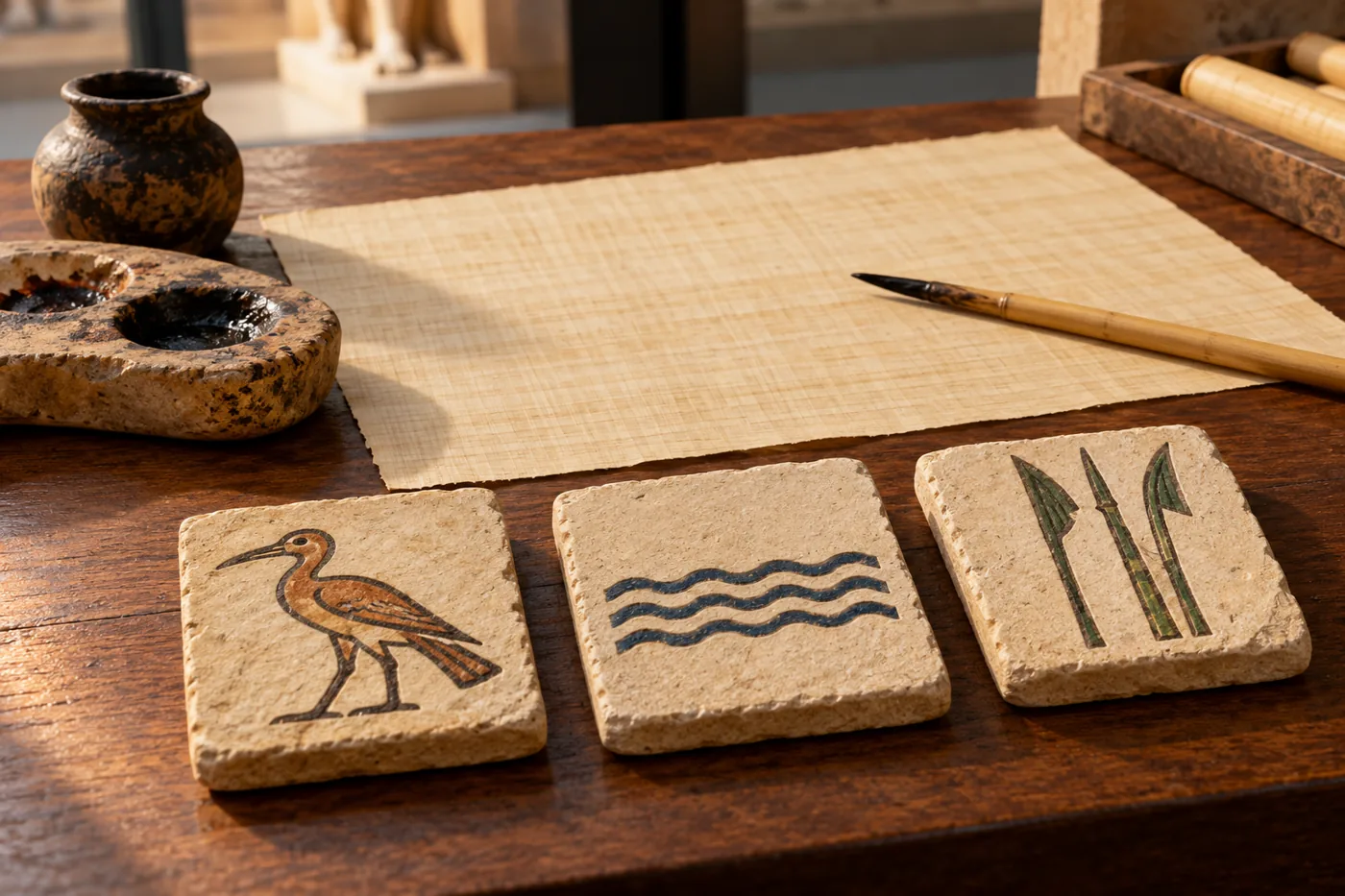
Generated interpretation, not documentary evidence. AI-generated study materials with isolated pictorial tiles, a contextual illustration rather than readable hieroglyphic evidence.
Credit: AI-generated for Culture Ark using OpenAI image generation Reuse/status: Generated content; no exclusive ownership or underlying-work rights claimed Three separate pictorial tiles, blank papyrus-like sheet and writing props coherent. Bird, waves and plant-like motifs are interpretive, not validated hieroglyphs or a translatable sequence. No authentic-reference or endorsement claim.
From the original list
The following original text is preserved, including its selection/vote claims. Preservation is not independent verification of every assertion.
Why: Picture writing of ancient Egypt.
What to preserve: signs, the Rosetta Stone
Year and origin: 3200 BC · Ancient Egypt
Vote: 9/9 (historian 3 · future kid 3 · curator 3)
Learn more: Egyptian hieroglyphs on Wikipedia
Supplemental context
Egyptian hieroglyphs are not simply pictures standing for pictured objects. University College London's teaching resource distinguishes signs for one or more consonants, determinatives that help establish meaning and signs with pictorial or combined functions. This is a crucial correction to the shorthand description picture writing. For future readers, the selection shows how recognizable images can belong to a structured linguistic system rather than a visual guessing game. Learning to identify an attractive bird shape is not the same as being able to read an inscription. Language, context and combinations of signs all matter.
Creator/community: Ancient Egyptian scribes and communities; later readers and Egyptologists Place/era: Ancient Egypt; a long-lived writing system with varied sign functions
Context and limits
This source explains the writing system, not a complete chronology beginning precisely in 3200 BC. The generated tiles are isolated pictorial study motifs, not a validated sign chart, readable sentence or translation. No claim is made that the illustrated tools or arrangement reconstruct a particular ancient workshop.
Where to learn more
- https://apiarybee.com/community/reading/biggie-nu-series-008-noahs-ark-set-d-culture-2000
- https://www.ucl.ac.uk/museums-static/digitalegypt/writing/system.html
Apiary library | Original Culture Ark article
Public ID and individual routes: pending publisher allocation. Internal source ID: D-1028
Part of the Culture Ark: 2,000 things people should still be able to see in 2,000 years, picked by AI research teams. This page keeps the original list entry for D-1028 word for word and adds context. Browse the gallery. The Culture Ark is an Artificial Mind Hive (AMH) project. AMH is owned by Austin Little.

Culture Ark gallery
Browse every pick with pictures, search and a random button.
Open the gallery →