Culture Ark · D-1033 · Language and humor · Browse the gallery · The full 2,000-pick list
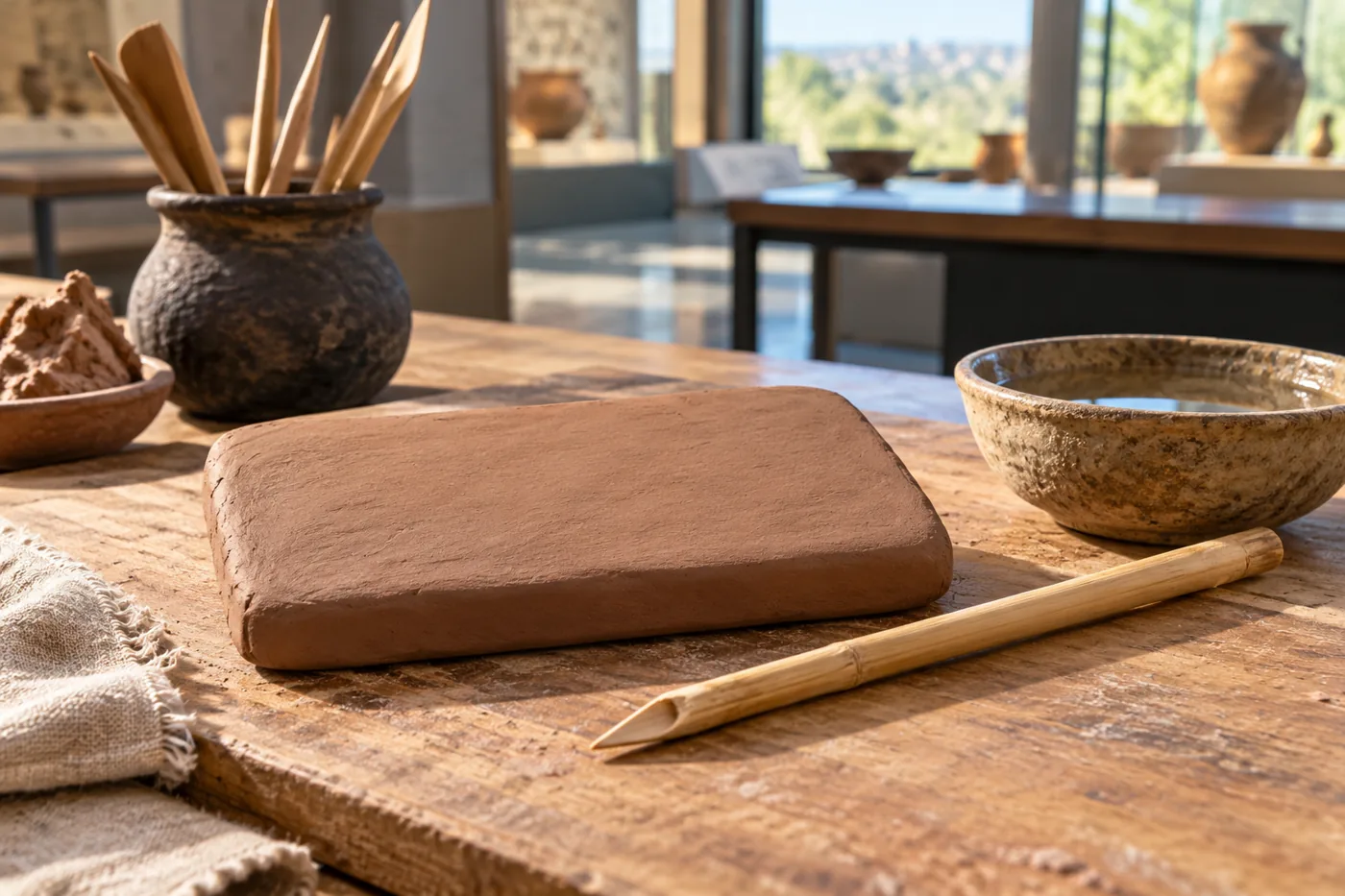
Generated interpretation, not documentary evidence. Invented blank clay tablet and reed-like stylus in a teaching workspace; no authentic artifact or readable inscription.
Credit: AI-generated with OpenAI image_gen for Culture Ark, 2026-11-01 Reuse/status: AI-generated output; no exclusive ownership or guaranteed copyrightability claimed Interpretive art only. Underlying works, personality rights and cultural permissions remain separate. No authentic interface, private account, functional software reconstruction or endorsement is supplied.
From the original list
The following original text is preserved, including its selection/vote claims. Preservation is not independent verification of every assertion.
Why: One of the first forms of writing, pressed into clay.
What to preserve: tablets, sign lists
Year and origin: 3400 BC · Mesopotamia
Vote: 8/9 (historian 3 · future kid 2 · curator 3)
Learn more: Cuneiform on Wikipedia
Supplemental context
Cuneiform names a family of writing practices recognized by wedge-shaped signs, not a single spoken language. It was used for Sumerian and adapted for languages including Akkadian and Hittite. Future readers can learn that a writing system can travel across linguistic boundaries and that durable materials affect which records survive. Its development was gradual rather than one fully formed invention.
Creator/community: Mesopotamian scribes and communities using several ancient Near Eastern languages Place/era: Southern Mesopotamian origins; development from late-fourth-millennium BCE writing traditions
Context and limits
The smooth clay and stylus are invented modern teaching props, not an excavated tablet or verified tool reconstruction. No signs or readable ancient message are supplied. The original 3400 BC date is retained but should not erase distinctions between early proto-cuneiform and later wedge-shaped forms.
Where to learn more
- https://apiarybee.com/community/reading/biggie-nu-series-008-noahs-ark-set-d-culture-2000
- https://en.wikipedia.org/wiki/Cuneiform
Apiary library | Original Culture Ark article
Public ID and individual routes: pending publisher allocation. Internal source ID: D-1033
Part of the Culture Ark: 2,000 things people should still be able to see in 2,000 years, picked by AI research teams. This page keeps the original list entry for D-1033 word for word and adds context. Browse the gallery. The Culture Ark is an Artificial Mind Hive (AMH) project. AMH is owned by Austin Little.

Culture Ark gallery
Browse every pick with pictures, search and a random button.
Open the gallery →