Culture Ark · D-0693 · Food · Browse the gallery · The full 2,000-pick list
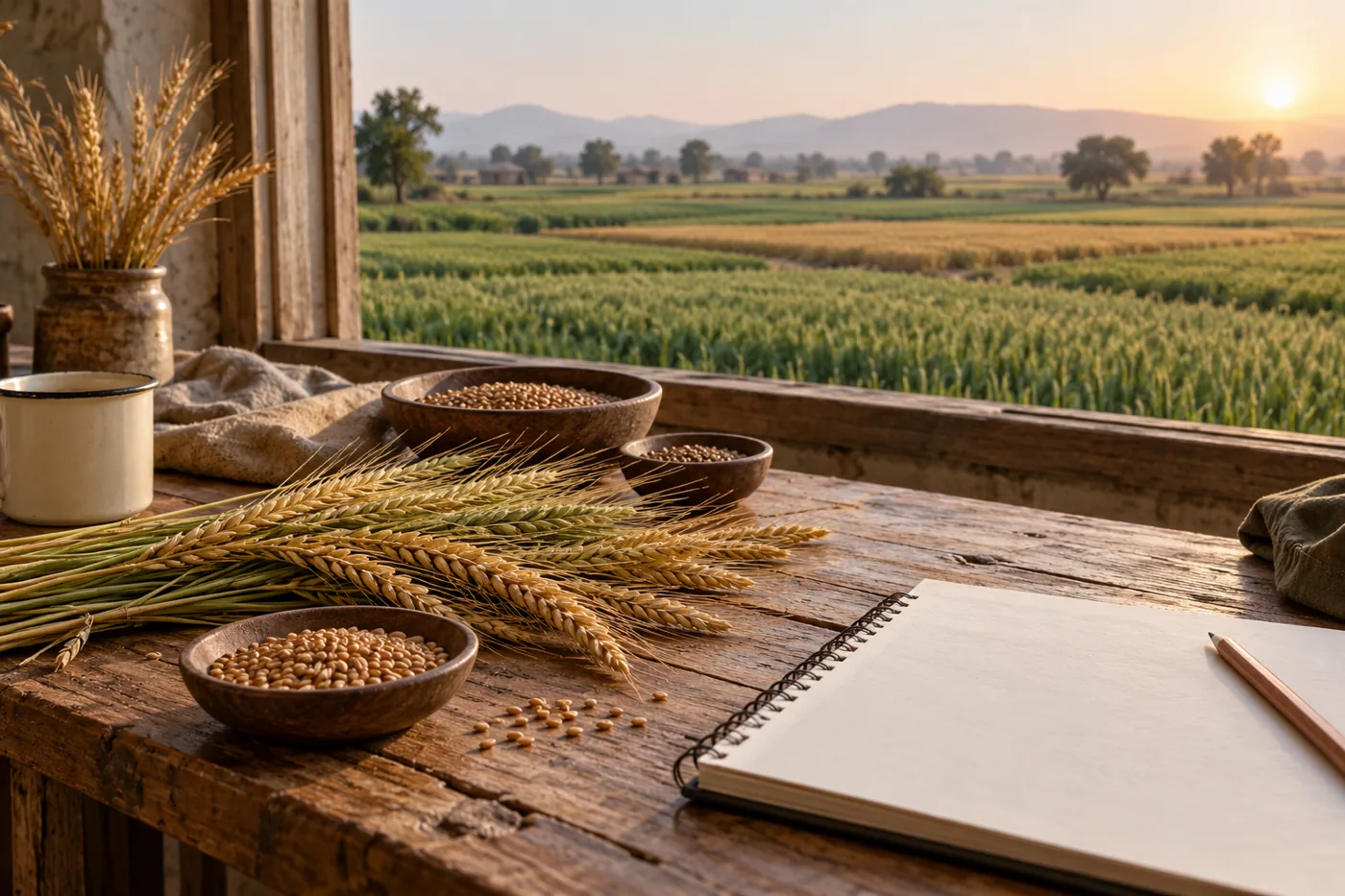
Generated interpretation, not documentary evidence. Generic wheat, grain and blank notebook evoke agricultural research and farmer knowledge; not a named Green Revolution variety.
Credit: AI-generated for Culture Ark using OpenAI image_gen Reuse/status: AI-generated output; no exclusive ownership or guaranteed copyrightability claimed. Underlying works, marks and cultural permissions remain separate. Generic wheat, grain and blank notebook evoke agricultural research and farmer knowledge; not a named Green Revolution variety. The original 'fed billions' is broad evaluative shorthand, not a verified count of individual lives saved. Outcomes differed by region and cannot be credited to one scientist or variety alone. The image does not identify an actual cultivar, demonstrate yield, or provide agricultural or survival instructions.
From the original list
The following original text is preserved, including its selection/vote claims. Preservation is not independent verification of every assertion.
Why: New crops that fed billions.
What to preserve: Wheat varieties
Year and origin: 1960s · Mexico / India
Vote: 6/9 (historian 3 · future kid 1 · curator 2)
Learn more: Green Revolution on Wikipedia
Supplemental context
The Green Revolution changed not only harvests but ideas about science, development and national self-sufficiency. CIMMYT traces its roots to Mexican government and Rockefeller Foundation work in the 1940 s and 1950 s, followed by wheat varieties adopted in India and Pakistan. Its institutional history emphasizes production gains. Prabhu Pingali's retrospective, summarized by Cornell, also asks about social, environmental and economic limits. Future readers could compare those perspectives rather than treat a seed as an isolated miracle. The cultural object is a network of fields, farmers, laboratories and policies, together with the powerful promise that organized research could transform everyday access to food.
Creator/community: Farmers, agricultural researchers and public institutions; Mexican research program, CIMMYT and international partners Place/era: Mexico and multiple Asian regions; mid-twentieth-century crop research and adoption, especially 1960 s–1970 s
Context and limits
The original 'fed billions' is broad evaluative shorthand, not a verified count of individual lives saved. Outcomes differed by region and cannot be credited to one scientist or variety alone. The image does not identify an actual cultivar, demonstrate yield, or provide agricultural or survival instructions.
Where to learn more
- https://apiarybee.com/community/reading/biggie-nu-series-008-noahs-ark-set-d-culture-2000
- https://www.cimmyt.org/about/our-history/
- https://tci.cornell.edu/?publications=green-revolution-impacts-limits-and-the-path-ahead
Apiary library | Original Culture Ark article
Public ID and individual routes: pending publisher allocation. Internal source ID: D-0693
Part of the Culture Ark: 2,000 things people should still be able to see in 2,000 years, picked by AI research teams. This page keeps the original list entry for D-0693 word for word and adds context. Browse the gallery. The Culture Ark is an Artificial Mind Hive (AMH) project. AMH is owned by Austin Little.

Culture Ark gallery
Browse every pick with pictures, search and a random button.
Open the gallery →