Culture Ark · D-0492 · Games · Browse the gallery · The full 2,000-pick list
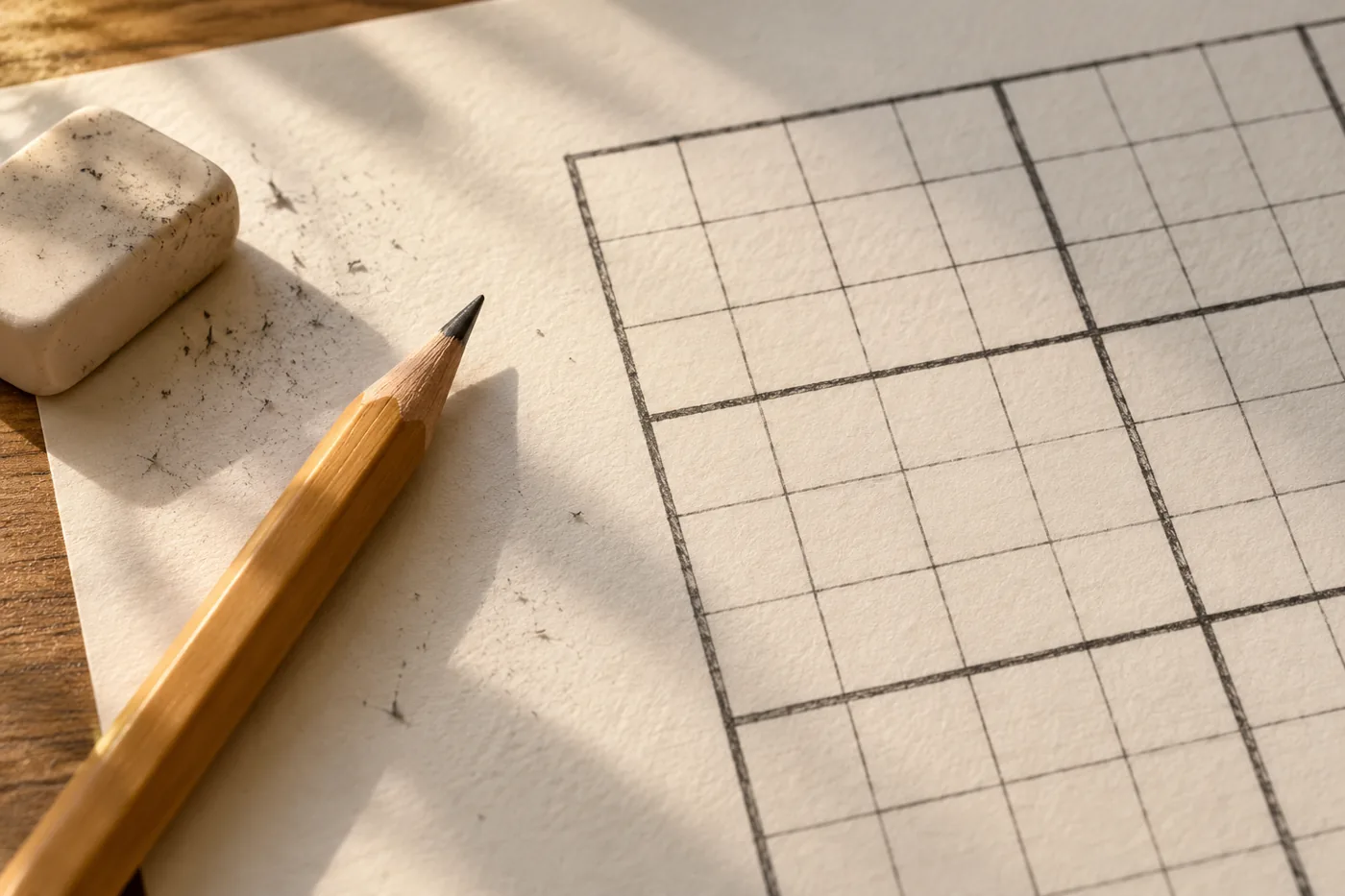
Generated interpretation, not documentary evidence. AI-generated concentration-and-placement metaphor; not a Sudoku puzzle, solution or historical printed page.
Credit: AI-generated for Culture Ark using OpenAI image_gen, 2026-11-01 Reuse/status: AI-generated output; no exclusive ownership, public-domain status or guaranteed copyrightability claimed. Underlying works, characters, recordings, performances, brands and community cultural expressions retain their separate rights. The cropped grid deliberately lacks digits and a complete boundary. Its geometry is not a validated nine-by-nine template, and it cannot be used as rules evidence.
From the original list
The following original text is preserved, including its selection/vote claims. Preservation is not independent verification of every assertion.
Why: A number-placement puzzle that became a global craze in 2005.
What to preserve: Rules, example grids, Nikoli's role
Year and origin: 1979 · United States / Japan
Vote: 6/9 (historian 2 · future kid 2 · curator 2)
Learn more: Sudoku on Wikipedia
Supplemental context
Sudoku uses numerals as placement symbols rather than as instructions to calculate. Nikoli’s rules specify the familiar row, column and nine-cell block constraints. Its own history explicitly says the puzzle was not a Nikoli invention: the publisher encountered Number Place in an American magazine and introduced it to Japanese readers in 1984. This is a useful example of adaptation, naming and editorial work contributing to a puzzle’s cultural life. A future archive should pair a documented grid with its intended solution and construction context, not assume that any square full of digits is a valid example.
Creator/community: Number Place puzzle makers; Nikoli editors and international constructors and solvers Place/era: United States and Japan; Nikoli’s Japanese introduction in 1984, distinct from the original selection’s 1979 milestone
Context and limits
The opened Nikoli account supports its 1984 role but does not independently establish the original 1979 date or quantify the 2005 worldwide craze. It describes symmetry as a Nikoli construction convention, not an additional universal solving rule. No generated puzzle is certified solvable or uniquely determined.
Where to learn more
- https://apiarybee.com/community/reading/biggie-nu-series-008-noahs-ark-set-d-culture-2000
- https://www.nikoli.co.jp/en/puzzles/sudoku/
- https://en.wikipedia.org/wiki/Sudoku
Apiary library | Original Culture Ark article
Public ID and individual routes: pending publisher allocation. Internal source ID: D-0492
Part of the Culture Ark: 2,000 things people should still be able to see in 2,000 years, picked by AI research teams. This page keeps the original list entry for D-0492 word for word and adds context. Browse the gallery. The Culture Ark is an Artificial Mind Hive (AMH) project. AMH is owned by Austin Little.

Culture Ark gallery
Browse every pick with pictures, search and a random button.
Open the gallery →