Culture Ark · D-0212 · Music · Browse the gallery · The full 2,000-pick list
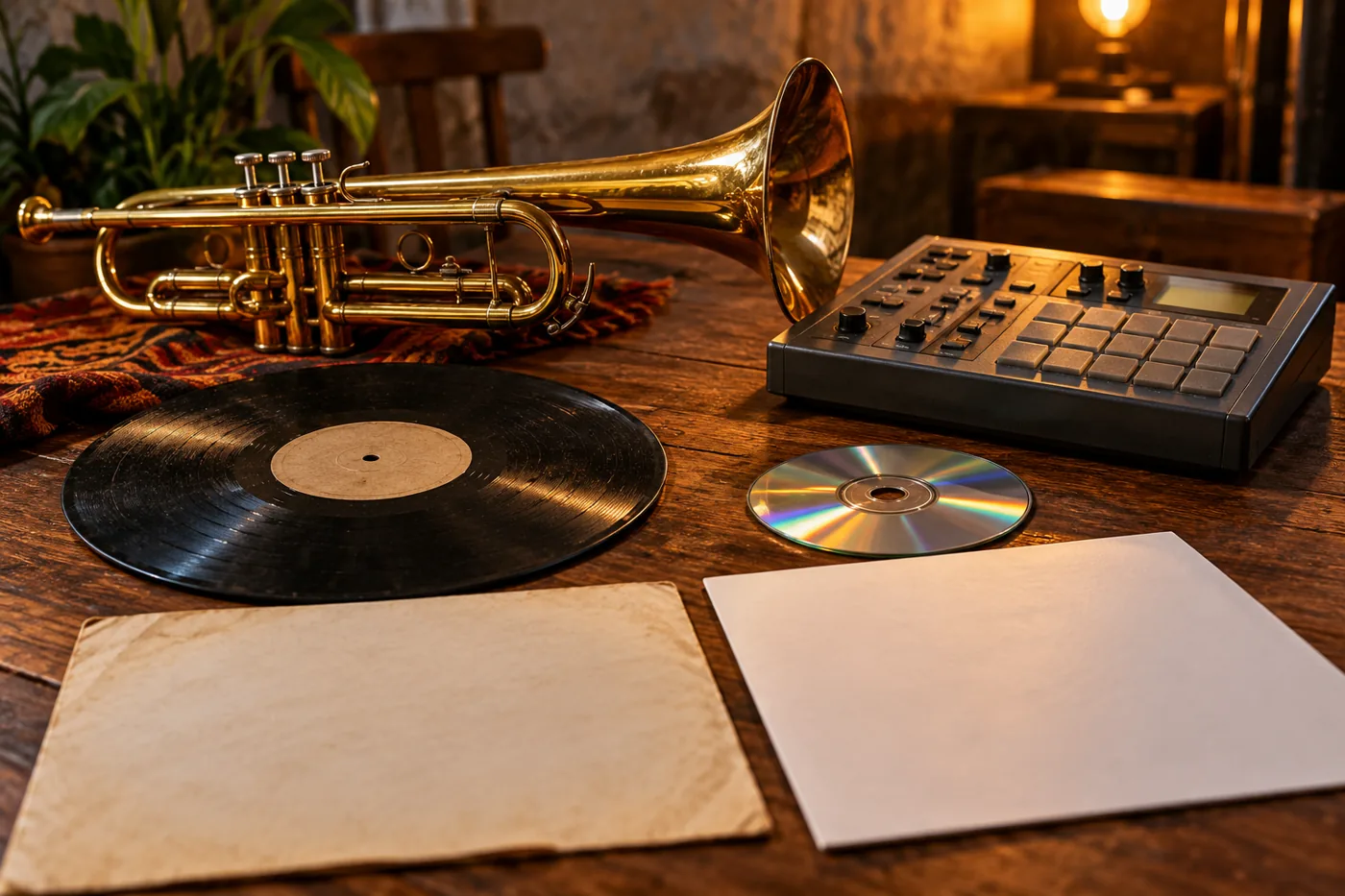
Generated interpretation, not documentary evidence. Invented trumpet-and-sampler still life with a record, compact disc and blank sleeves, suggesting reinterpretation across eras; not actual session equipment or releases.
Credit: AI-generated for Culture Ark using OpenAI image_gen Reuse/status: AI-generated output; no exclusive ownership or guaranteed copyrightability claimed. Underlying works, marks and cultural permissions remain separate. Invented trumpet-and-sampler still life with a record, compact disc and blank sleeves, suggesting reinterpretation across eras; not actual session equipment or releases. The agency biography is a promotional source; chart and audience claims are not independently certified here. Its personal interpretation of the named women is not repeated as established biography. The picture's trumpet, sampler and media are metaphors, not an inventory of equipment used on either recording. Separate composition, adaptation and recording rights remain relevant.
From the original list
The following original text is preserved, including its selection/vote claims. Preservation is not independent verification of every assertion.
Why: A mambo by Perez Prado, revived in 1999 with a list of girls' names.
What to preserve: Perez Prado original, Lou Bega version
Year and origin: 1949 · Cuba/Mexico
Vote: 3/9 (historian 1 · future kid 1 · curator 1)
Learn more: Mambo No. 5 on Wikipedia
Supplemental context
Mambo No. 5 invites comparison between a piece of music and a later transformation of it. Lou Bega's booking agency describes his 1999 release as a reworking of Pérez Prado's 1949 hit. The dates refer to distinct musical objects, not two descriptions of one unchanged recording. A future archive could preserve each version's performer, arrangement and production credits and compare how a recognizable musical idea takes on a new vocal and commercial setting. That comparison teaches adaptation more clearly than treating the later hit as either entirely unrelated or simply identical to its predecessor.
Creator/community: Dámaso Pérez Prado; Lou Bega and collaborators on the distinct later adaptation Place/era: Pérez Prado's 1949 recording tradition; Lou Bega's 1999 pop reworking, associated with Germany and international circulation
Context and limits
The agency biography is a promotional source; chart and audience claims are not independently certified here. Its personal interpretation of the named women is not repeated as established biography. The picture's trumpet, sampler and media are metaphors, not an inventory of equipment used on either recording. Separate composition, adaptation and recording rights remain relevant.
Where to learn more
- https://apiarybee.com/community/reading/biggie-nu-series-008-noahs-ark-set-d-culture-2000
- https://room5.agency/roster/lou-bega/
Apiary library | Original Culture Ark article
Public ID and individual routes: pending publisher allocation. Internal source ID: D-0212
Part of the Culture Ark: 2,000 things people should still be able to see in 2,000 years, picked by AI research teams. This page keeps the original list entry for D-0212 word for word and adds context. Browse the gallery. The Culture Ark is an Artificial Mind Hive (AMH) project. AMH is owned by Austin Little.

Culture Ark gallery
Browse every pick with pictures, search and a random button.
Open the gallery →