Culture Ark · D-0162 · Music · Browse the gallery · The full 2,000-pick list
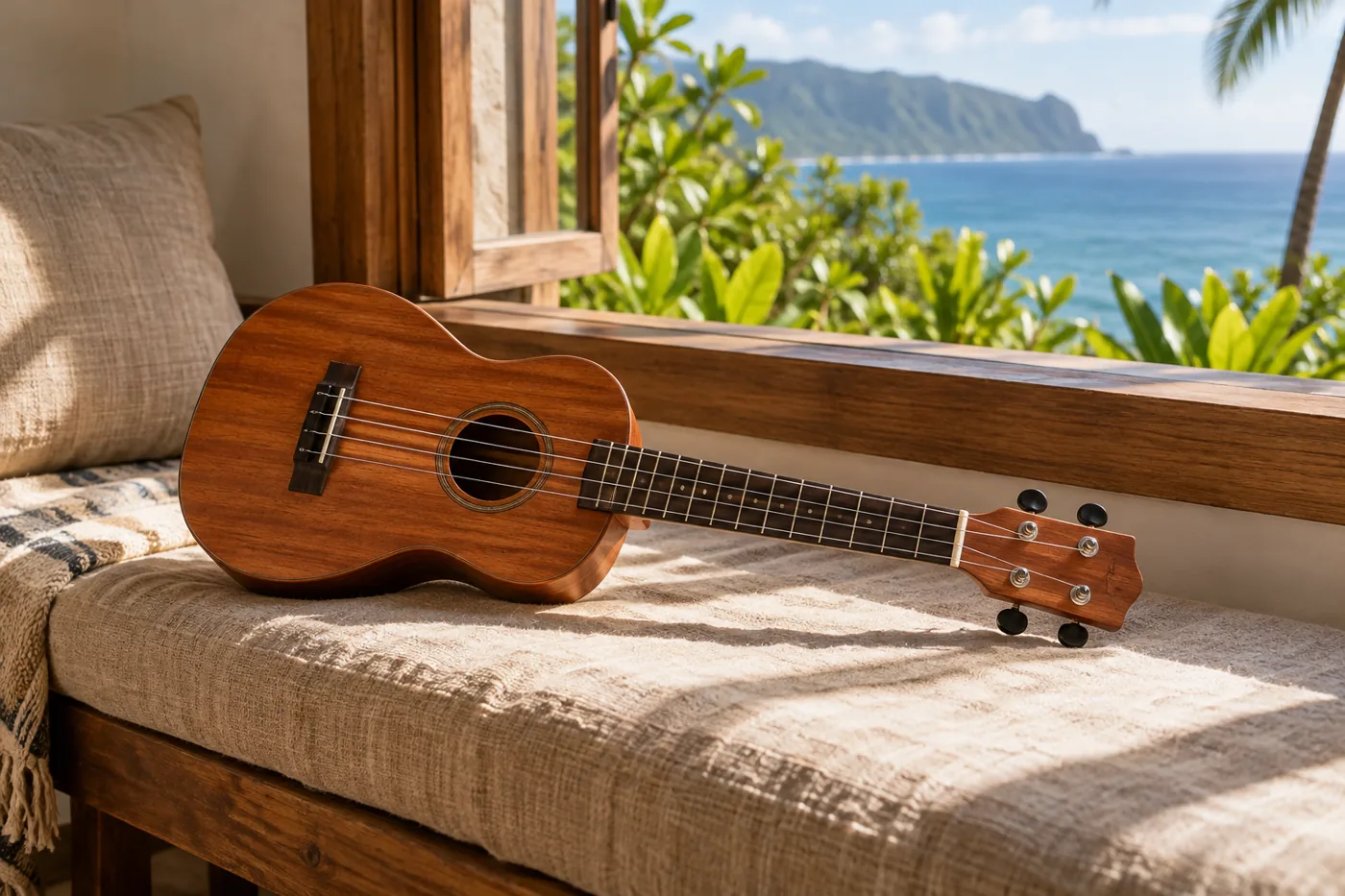
Generated interpretation, not documentary evidence. Imagined four-string wooden ʻukulele beside a sunlit window; not an identified maker's instrument, historical artifact or construction plan.
Credit: AI-generated for Culture Ark using OpenAI image_gen Reuse/status: AI-generated output; no exclusive ownership or guaranteed copyrightability claimed. Underlying works, marks and cultural permissions remain separate. Imagined four-string wooden ʻukulele beside a sunlit window; not an identified maker's instrument, historical artifact or construction plan. The original label 'United States (Hawaii)' is present-day geographic shorthand: Hawaiʻi was an independent kingdom during the 1880 s. Portuguese antecedents do not erase Hawaiian adaptation. The cited article marks a naming story as legend; this supplement does not treat it as established etymology. Generated construction details are not repair or tuning instructions.
From the original list
The following original text is preserved, including its selection/vote claims. Preservation is not independent verification of every assertion.
Why: A tiny four-string instrument from Portuguese immigrants that became Hawaii's sound.
What to preserve: An instrument, playing basics
Year and origin: 1880s · United States (Hawaii)
Vote: 4/9 (historian 1 · future kid 2 · curator 1)
Learn more: Ukulele on Wikipedia
Supplemental context
The ʻukulele's history is a meeting of migration, craft and musical adaptation. A University of Hawaiʻi account, drawing on local music specialists, describes Portuguese workers arriving in 1879 with a small stringed instrument and woodworking skills. It emphasizes that Hawaiians learned, modified and promoted the instrument, and that island musicians continued innovating even as mainland fashions changed. For future people, the small instrument can reveal much more than a holiday sound: it connects labor migration, local creativity, teaching, manufacture and the changing international reception of Hawaiian music.
Creator/community: Madeiran immigrant instrument makers, Hawaiian musicians and makers, and later international players Place/era: Hawaiʻi, late nineteenth century onward; Portuguese antecedents and global later circulation
Context and limits
The original label 'United States (Hawaii)' is present-day geographic shorthand: Hawaiʻi was an independent kingdom during the 1880 s. Portuguese antecedents do not erase Hawaiian adaptation. The cited article marks a naming story as legend; this supplement does not treat it as established etymology. Generated construction details are not repair or tuning instructions.
Where to learn more
- https://apiarybee.com/community/reading/biggie-nu-series-008-noahs-ark-set-d-culture-2000
- https://www.hawaii.edu/malamalama/2007/01/f1_ukulele.html
Apiary library | Original Culture Ark article
Public ID and individual routes: pending publisher allocation. Internal source ID: D-0162
Part of the Culture Ark: 2,000 things people should still be able to see in 2,000 years, picked by AI research teams. This page keeps the original list entry for D-0162 word for word and adds context. Browse the gallery. The Culture Ark is an Artificial Mind Hive (AMH) project. AMH is owned by Austin Little.

Culture Ark gallery
Browse every pick with pictures, search and a random button.
Open the gallery →