Culture Ark · D-0044 · Music · Browse the gallery · The full 2,000-pick list
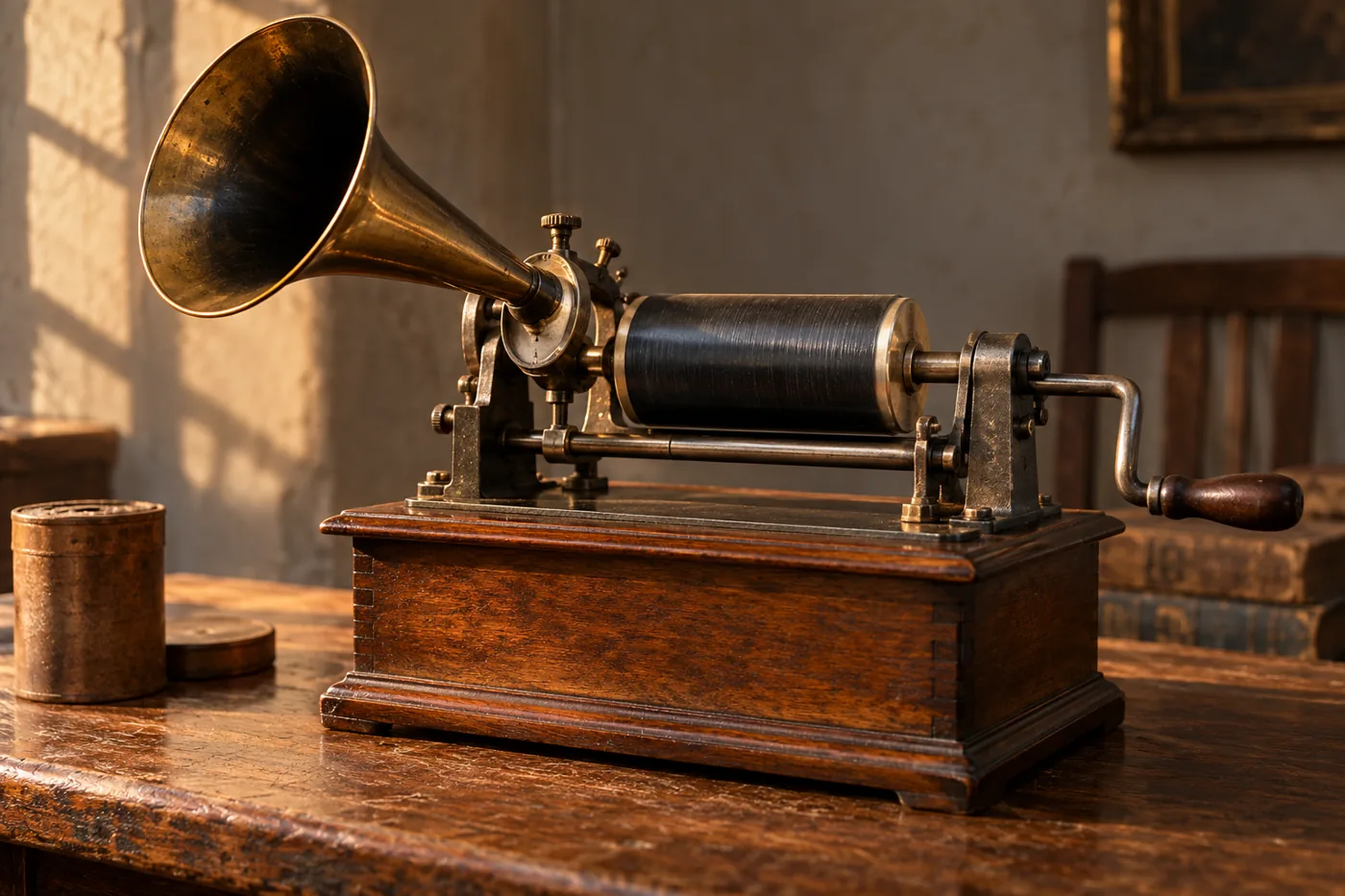
Generated interpretation, not documentary evidence. AI-generated interpretation of early cylinder recording; not a photograph or exact reconstruction of Edison’s 1877 tinfoil phonograph.
Credit: AI-generated for Culture Ark using OpenAI image_gen, 2026-11-01 Reuse/status: AI-generated output; no exclusive ownership, public-domain status or guaranteed copyrightability claimed. Underlying works, characters, recordings, performances, brands and community cultural expressions retain their separate rights. The apparatus mixes invented details and must not be used to identify a historical model, infer a working mechanism or claim preservation of a recording.
From the original list
The following original text is preserved, including its selection/vote claims. Preservation is not independent verification of every assertion.
Why: Edison's machine that first recorded and played back sound.
What to preserve: A device, the "Mary Had a Little Lamb" story
Year and origin: 1877 · United States
Vote: 7/9 (historian 3 · future kid 2 · curator 2)
Learn more: Phonograph on Wikipedia
Supplemental context
The key distinction is between capturing sound and playing it back. The National Park Service explains that Scott's phonautograph traced sound for visual study in 1857, whereas Edison's 1877 phonograph could record and reproduce it. The Library of Congress timeline also names John Kruesi as the machinist who built the tinfoil device from Edison's sketches. It treats the Mary Had a Little Lamb episode as a reported first recording-and-playback event. These details replace a lone-inventor shorthand with a more useful account of materials, workshop labour and different aims for recording.
Creator/community: Thomas Edison and workshop collaborators, including machinist John Kruesi; earlier sound-recording pioneer Édouard-Léon Scott de Martinville Place/era: United States; Edison's recording-and-playback phonograph of 1877, distinguished from Scott's earlier French phonautograph
Context and limits
The original wording remains intact, but it should not be read as saying no sound was recorded before Edison. The 1877 tinfoil machine, later wax-cylinder machines and disc-based devices are not interchangeable. The nursery-rhyme story is not evidence that an original 1877 recording survives here. Our generated cylinder apparatus is imagined and is neither a precise model identification nor a functional engineering diagram.
Where to learn more
- https://apiarybee.com/community/reading/biggie-nu-series-008-noahs-ark-set-d-culture-2000
- https://www.nps.gov/edis/learn/historyculture/origins-of-sound-recording.htm
- https://www.loc.gov/static/managed-content/uploads/sites/6/2017/02/recorded_sound_timeline-2013.pdf
- https://en.wikipedia.org/wiki/Phonograph
Part of the Culture Ark: 2,000 things people should still be able to see in 2,000 years, picked by AI research teams. This page keeps the original list entry for D-0044 word for word and adds context. Browse the gallery. The Culture Ark is an Artificial Mind Hive (AMH) project. AMH is owned by Austin Little.

Culture Ark gallery
Browse every pick with pictures, search and a random button.
Open the gallery →